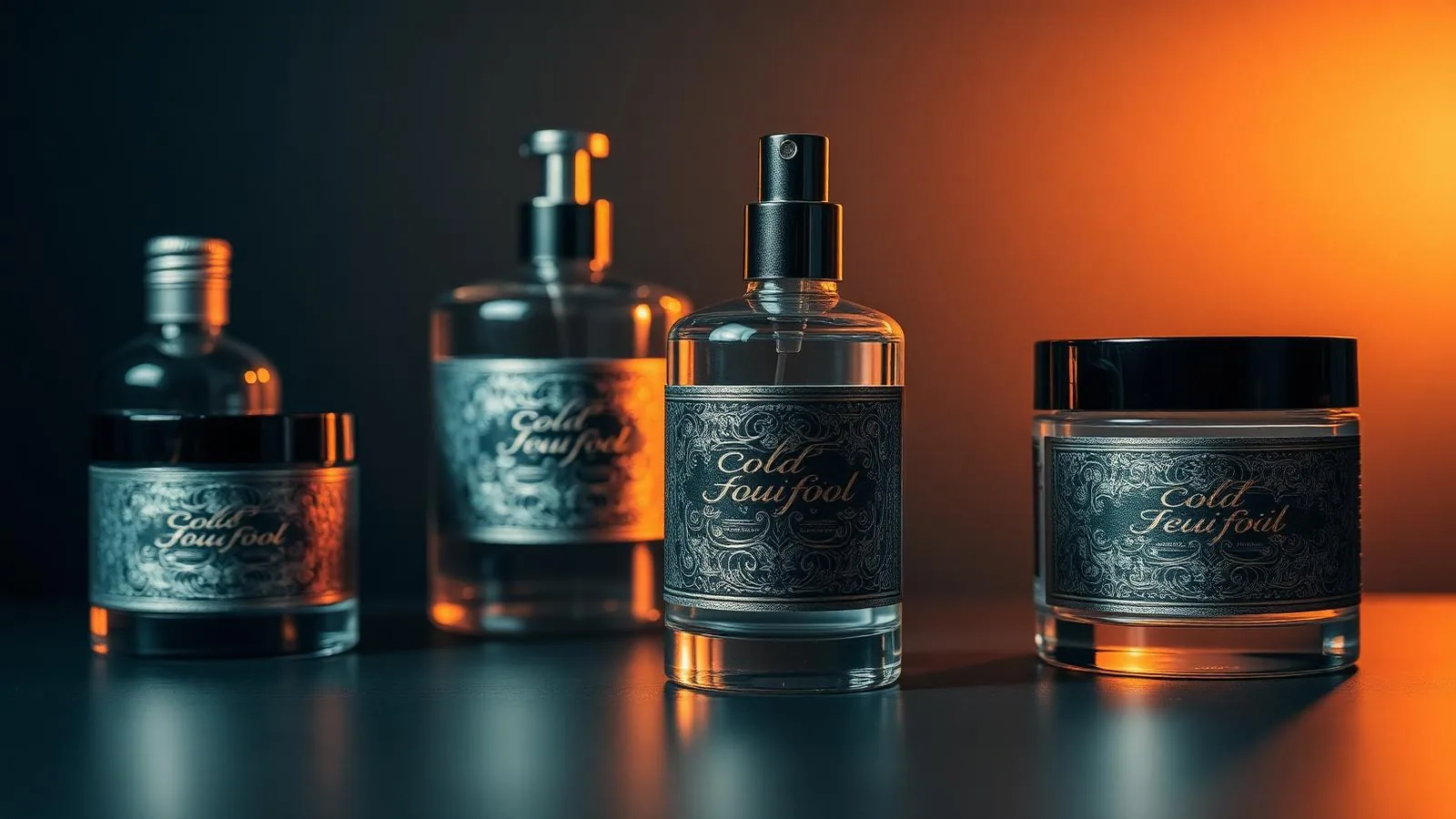
If you are a brand or packaging buyer, this guide helps you describe a cold-foil label job to your label printer. Cold foil is a decoration method in which a metallic or holographic layer is transferred onto a printed adhesive image on the label. The quality of the result depends on choices you and your printer make together, so a clear brief matters more than any single specification.
CFS supplies cold transfer foil rolls to label converters and printers. We do not print or sell finished labels, and we do not quote finished-label prices or lead times. Work with your own label printer for the labels; CFS can discuss foil supply for the project.
What does a cold-foil label job involve?
In a common UV flexo process, an adhesive is printed in the shape of the foil design, the foil is brought into contact with it, the adhesive is cured as the suppliers specify and the carrier film is peeled away. The metallic layer stays where the adhesive was printed. Process-color printing and finishing can then follow. This is an outline: equipment layouts differ between printers, and the printer is responsible for choosing a workable process for your label.
For the material-system questions that converters ask suppliers, see the converter's materials guide.
What should a buyer tell the label printer?
You do not need to know anilox volumes or UV doses to start. You do need to describe the label's purpose and how it will be judged. Use this table as a briefing checklist.
| What the buyer should state | Why the printer needs it | Appearance check or production check | When it can be added later |
|---|---|---|---|
| Container and use conditions | Handling, moisture and filling conditions decide which checks matter | Production check | Before material selection is final |
| The metallic effect you want | Silver, gold, colored metal or holographic effects use different foil | Appearance check | Can start from a reference and be refined |
| Dirección de visualización | Foil on the printed face and foil seen through clear film are built differently | Production check | Early; it changes the construction |
| Where the foil sits in the artwork | Placement and fine detail affect plate and artwork decisions | Appearance check, then production check | Before artwork is finalized |
| Overprint or protective layers | Process color, varnish or lamination can change appearance and adhesion | Production check | Before the trial |
| Who chooses the label material | Face material and adhesive systems must be matched by the printer | Production check | Early, to avoid late changes |
| Who approves samples | Avoids repeated trials with no decision-maker | Both | Before the trial |
| Estimated project demand | Helps plan material supply | Neither | Rough figures are enough at first |
Can I approve the effect from a screen?
No. A screen or printed proof can show where foil goes, but not how a metallic or holographic layer looks in the light. Approve the effect on a physical sample made with the intended materials. A color or swatch sample shows appearance only; it does not show that your actual label construction has been tested. The kit de muestra de cold foil is for judging foil appearance, and a trial on your printer's press is what shows how the combination performs.
How should artwork be prepared?
Foil is normally treated as its own layer in the artwork, but the naming and file requirements differ by printer. Ask your printer for its artwork specification instead of working from a generic rule, and ask about minimum line weight and text size for foil on the actual construction. The prepress guide for designers explains what to discuss. If you want colored metallic effects from process color over silver, read the CMYK sobre guía de foil en frío.
What affects cost?
Cost depends on the label construction, the foil effect and coverage, the printer's process and the quantity. This guide does not give finished-label prices, ranges or return on investment, because those depend on your printer's quotation and the volumes and materials involved. Ask your printer to explain which choices add cost, such as the number of foil areas, overprint and finishing.
What should be agreed about durability?
Define how the finished label will be handled and what it must withstand, then agree appearance and adhesion checks with your printer before the trial. Different containers and conditions need different checks, and no general statement here can substitute for testing the real construction. Do not assume food-contact, recyclability or chemical-resistance suitability from the foil alone; these depend on the complete label and must be confirmed with the relevant suppliers.
Which label material should be used?
Film and paper labels both use cold foil, and the right choice depends on the container, appearance and handling. The printer normally selects and sources the face material and adhesive system. If you want to understand the options, see cold foil en etiquetas de BOPP y cold foil para etiquetas transparentes, and the flexo cold foil materials page.
How do we help?
CFS handles the foil roll requirement. Send the details your printer has given you, or your project brief, through the request form or contact page, and we will reply about foil supply. For printers preparing a quotation, the lista de verificación de cotización de lámina de estampado en frío lists what to include.
Preguntas frecuentes preguntas
Does CFS print cold foil labels? +
No. CFS supplies cold transfer foil rolls. For finished labels, work with your own label printer.
Can I approve foil from a screen proof? +
No. Approve the metallic effect on a physical sample made with the intended materials.
Does a swatch show my label has passed testing? +
No. A swatch shows appearance only. Testing your construction requires a trial with your materials and your printer's press.
Does the label need to be a particular material? +
Both film and paper are used. Your printer normally selects and sources the face material and adhesive system for your container and conditions.
Is cold foil recyclable or suitable for food contact? +
That depends on the complete label construction and your local requirements. Confirm it with the relevant suppliers rather than assuming it from the foil alone.