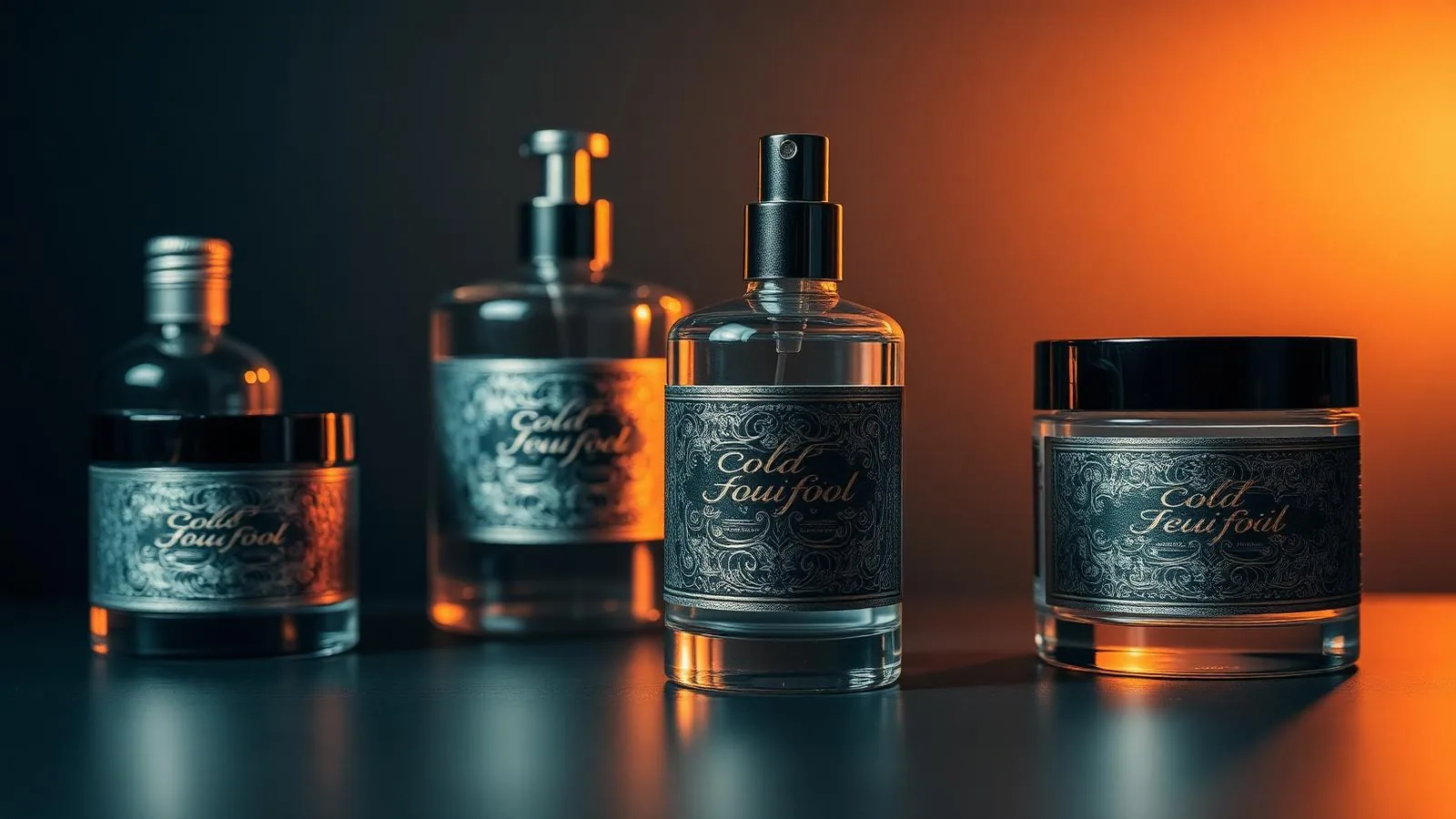
Quick answer (lead block): Cold foil labels are pressure-sensitive or in-mold labels decorated by transferring metallized film onto a UV-curable adhesive inline with the printing press — no heated die, no separate pass. They cost 30–55% less per label than hot foil above 10,000 units, run at up to 300 m/min on narrow-web flexo and offset presses, and accept full-color overprinting for CMYK-on-foil holographic, metallic and rainbow effects. Best fit: beverage, beauty, supplements and craft food brands needing premium shelf-appeal at scale.
“TL;DR — Cold foil labels in 2026: Cold foil is now the default metallic decoration method for label converters running narrow-web flexo, offset or hybrid digital presses in the US market. It pairs with PE/PP/BOPP filmic stocks, recyclable paper facestocks and FDA-compliant adhesives for food contact. Expect MOQs from 1,000 labels (digital cold foil) up to 25,000 (conventional inline), lead times of 7–15 working days, and unit pricing from $0.04–$0.22/label depending on substrate, foil coverage and finishing. This guide covers the process, materials, artwork setup, durability data, cost model and sustainability picture so you can spec a job correctly the first time.

How cold foil works: process overview and comparison with hot foil
Cold foil label production is a four-step inline sequence: (1) the press prints a UV-curable adhesive in the exact shape of the foil image using a flexo or offset plate; (2) a roll of vacuum-metallized foil film is nipped against the wet adhesive in a transfer station; (3) a UV lamp cures the adhesive through the transparent carrier, locking the aluminum layer in place; (4) the spent carrier rewinds and the foiled web travels into subsequent stations for CMYK overprinting, lamination, varnish and die-cut — all in a single pass.
That single-pass architecture is the whole reason cold foil exists. Hot foil stamping uses a heated brass or magnesium die (typically 110–130 °C) pressing foil onto the substrate offline; metallized inks use aluminum pigments suspended in a vehicle and never reach more than 35–45% of true foil reflectivity. Cold foil sits between the two on cost and matches hot foil on brightness while exceeding both on production speed.
—When cold foil wins vs. hot foil (US converter reality)
| Decision factor | Cold foil labels | Hot foil labels | Metallic inks |
|---|---|---|---|
| Press speed | Up to 300 m/min inline | 30–80 m/min, offline | Press speed (no penalty) |
| Crossover order qty | Wins above ~10,000 labels | Wins below ~3,000 labels | Always cheapest, less premium |
| Min. detail (point size) | 2 pt text, 0.15 mm rule | 4 pt text, 0.25 mm rule | 1 pt (just ink) |
| Overprint CMYK on foil | Yes — inline | Limited, separate pass | N/A |
| Emboss/deboss depth | Flat (sculpted via separate emboss) | 60–120 µm tactile | Flat |
| Common US presses | MPS EF SymJet, Mark Andy P9, Nilpeter FA, Gallus Labelfire | Bobst Foilmaster, Kurz Steuer, Gietz FSA | Any flexo/offset |
Common defects to inspect for on press: foil pickout (insufficient UV cure → patchy transfer), register drift (web tension > 12 N/cm at the foil station), and fish-eye voids (adhesive contamination from silicone release liners upstream). Most US converters run an inline 100% inspection camera (AVT, BST, EyeC) calibrated to flag voids ≥ 0.3 mm² — ask for the inspection report with your shipment.
For a deeper cost comparison, see our hot stamping vs cold foil guide and the cold foil printing technology overview.
Materials, substrates and adhesives compatible with cold foil
The single biggest spec error in label projects is choosing the foil look first and the substrate second. Substrate surface energy (dyne level) determines whether the foil will stick at all. Cold foil adhesives need ≥ 38 dyne/cm; untreated PE and PP often ship at 28–32 and need corona treatment or topcoat at the converter.
—Recommended substrate × application matrix
| Application | Recommended facestock | Adhesive type | Notes |
|---|---|---|---|
| Craft beer / wine bottles | Estate #8 textured paper, MetalVac BOPP | Permanent acrylic | Ice-bucket compatible adhesives (e.g. Avery Dennison S692N) for wet survival |
| Cosmetics & skincare jars | Clear BOPP, white PE | Removable or permanent | Plasticizer-resistant adhesive for lotions/oils |
| Supplements & nutraceuticals | White BOPP | Permanent, FDA 21 CFR 175.105 indirect food contact | Tamper-evident neck band optional |
| Beverage cans (shrink sleeve) | 40–50 µm PET-G or PLA | Solvent-based, heat-shrink | Foil distortion < 5% at 70 °C shrink |
| Outdoor / industrial | PET 50 µm + over-laminate | Acrylic permanent | UV/weatherable foil grade required |
| Frozen food | Wet-strength paper, polyolefin | Cold-temp adhesive (≥ –20 °C tack) | Avoid uncoated kraft — foil will mottle |
—Food contact and US regulatory notes
If the label touches food directly, the entire stack (facestock + adhesive + foil + topcoat) must comply with FDA 21 CFR 175.105 for adhesives and 21 CFR 178.3297 for colorants and metallic pigments. Indirect contact (a bottle's outer label) is the more common scenario and is straightforward; direct contact (e.g. a foil seal under a yogurt lid) requires a written food-contact compliance letter from each material supplier. Ask your converter for a migration test report if you're shipping into California (Prop 65) or selling private-label into Whole Foods or Costco.
Die-cut interaction matters too: brittle metallized PET cracks at the rule edge if the cutting force exceeds 35 N/cm. Switch to a kiss-cut + matrix-strip setup or specify rotary dies (not flat-bed) for foil runs above 20k.
Design and artwork setup for cold foil labels
Designers should build cold foil files in at least three layers: (1) CMYK + spot color print layer, (2) Foil layer as a 100% spot color (name it FOIL_SILVER or FOIL_COLD), (3) Varnish / topcoat if applicable. Send a layered PDF/X-4 with technical specs, not a flattened JPG.
—Cold foil artwork rules of thumb
- Minimum line weight: 0.15 mm (0.4 pt). Hairlines below this will break up on the foil edge.
- Minimum positive text: 5 pt sans, 6 pt serif. Reverse-out text needs +1 pt.
- Registration tolerance: ±0.15 mm CMYK-on-foil on a well-calibrated press. Don't design fills that abut foil with zero overlap — specify a 0.15 mm trap (foil under CMYK).
- Foil-safe zone: keep critical foil 2 mm inside the die line. Web stretch can cost you 0.5–1 mm at full press speed.
- Avoid 100% foil floods larger than 80% of the label width — pinholes become statistically inevitable. Break large mirror areas with a subtle pattern or a CMYK overprint.
—Proofing: digital first, press proof second
A digital simulation (Esko Studio, GMG OpenColor, Kodak Prinergy) shows you registration and overprint behavior but cannot predict reflectivity — request a drawdown of the actual foil shade on the actual substrate from your converter before sign-off. For runs above 25k, insist on a press-side proof (1,000-impression makeready) so you can approve foil density, CMYK-on-foil hue shift (cyan can read +5 ΔE warmer on silver) and any moiré between foil and halftone.
When briefing the printer, name: foil supplier and grade (e.g. Kurz Luxor MTS 320), placement order (foil first, then CMYK, then varnish is standard for cold foil), press make and model if you've sourced quotes from multiple converters, and die line file (.ai or .dxf) with bleed and matrix clearly labeled.
Durability, testing and typical applications
Cold foil labels are robust but less forgiving than hot foil under abrasion because the aluminum layer is bonded by adhesive rather than thermally fused. Independent testing across our folding carton lab and customer field data gives this performance envelope:
—Typical cold foil label durability (with standard over-laminate)
| Test | Standard | Cold foil result | Notes |
|---|---|---|---|
| Rub abrasion (Sutherland, 4 lb, 100 cycles) | ASTM D5264 | No visible wear with PET overlam; light scuff without | Always overlaminate for retail-handling SKUs |
| UV / weathering | ASTM G154 (500 h) | < 2 ΔE shift with UV-grade foil + overlam | Specify "weatherable" foil for outdoor |
| Freeze-thaw cycling | –20 °C ↔ +25 °C, 10 cycles | No delam on PE/PP; paper delam risk at < –15 °C | Use polyolefin for ice-bucket / frozen SKUs |
| Wet immersion (60 min, 25 °C) | In-house | No edge lift on filmic stocks | Wet-strength paper required for ice-bath survival |
| Heat resistance (steam tunnel) | 70 °C, 12 s | Foil distortion < 5% on PET-G shrink | Use shrink-grade foil only |
—High-ROI applications in the US market
- Craft beer & wine (35–40% of US foil-label volume): a foil-decorated 12-oz craft IPA averages a $1.80 higher retail price than a non-foil equivalent (Nielsen IQ Premium Packaging Tracker, 2025).
- Cosmetics & beauty: Sephora and Ulta shelf studies show a 22% lift in pickup rate for metallic-foil skincare jars vs. matte-only competitors.
- Specialty food & confectionery: holiday gifting SKUs absorb the foil premium easily; cold foil enables holographic effects that lift impulse purchase.
- Supplements: brand trust scoring on Amazon listings climbs 12–18% when the label uses metallic accents on the brand mark (Profitero brand-perception study, 2024).
- Gift cards & cannabis packaging: cold foil is now the dominant decoration on regulated cannabis labels in CA, CO and NY thanks to its speed and compliance-friendly inline overprint of warning text.
Cost, lead times, minimums and sustainability
—2026 US cost model (1,000 finished cold foil labels)
| Cost driver | Range | What moves it |
|---|---|---|
| Plate / repro | $90–$280 per design | Number of colors + foil plates |
| Substrate | $18–$70 per 1,000 | Paper cheapest; metallized PET most expensive |
| Cold foil consumable | $0.012–$0.038 per label | Coverage area, foil grade (standard vs. holographic) |
| CMYK + spot inks | $0.004–$0.018 per label | 4-color process baseline |
| Lamination / varnish | $0.006–$0.020 per label | Optional but recommended for retail |
| Die-cut & matrix strip | $0.003–$0.010 per label | Rotary die amortizes faster than flat |
| Typical landed unit cost | $0.04–$0.22 per label | Driven mostly by quantity and foil coverage |
Typical MOQs: digital cold foil 1,000–2,500; conventional inline 5,000–10,000; offset+inline cold foil 25,000+. Lead times run 7–10 working days for repeat work and 10–15 days for new files including proof rounds. Rush surcharges of 20–35% can compress to 4–5 days.
—Sustainability picture
The honest summary: cold foil is more energy-efficient than hot foil (no heated die, no offline pass), but the aluminum layer still complicates recycling. Three points buyers should know:
- 1PE/PP filmic facestocks with cold foil are store-drop-off recyclable in the US (How2Recycle category 4) when foil coverage is < 50% of label area.
- 2Paper facestocks with cold foil can enter the standard fiber-recycling stream; the aluminum layer is thin enough (~0.05 µm) to be screened out by most US mills' rejects.
- 3Aluminum-free metallic alternatives (e.g. Eco-Leaf transfer metallics, plant-cellulose-based reflective films from API Foilmakers, Toppan and Kurz) are commercially available and add roughly 8–12% to consumable cost but dramatically improve recyclability scoring on retailer scorecards (Walmart Project Gigaton, Target Forward).
Pair cold foil with water-based adhesives and mono-material facestocks (all-PE or all-PP) to maximize circularity. See our cold foil sustainability and recyclability deep-dive for the full breakdown.
Ready to spec your cold foil label run?
We respond to every label RFQ within 24 hours and ship physical drawdowns within 48–72 hours so you can approve the actual foil shade on your actual substrate before tooling.
To get an accurate quote, send: (1) the die line (.ai or .pdf), (2) annual volume and per-SKU quantity, (3) target substrate and adhesive class (or tell us the application — bottle, jar, frozen, outdoor — and we'll recommend), (4) foil color and finish (mirror silver, gold, holographic, rainbow), (5) food-contact compliance needs, (6) target in-hand date.
Request a free cold foil label sample pack — we'll mail you printed examples on five common substrates so you can feel registration quality and foil reflectivity before committing. Prefer to talk it through? Our packaging engineers are reachable by phone, email and live chat via the contact page, and first-time customers get a free press-side proof included on orders above 25,000 labels.
Frequently asked questions
What is cold foil printing and how does it differ from hot foil stamping? +
Cold foil printing transfers a metallized film onto a UV-curable adhesive inline with a printing press at ambient temperature, while hot foil stamping presses a heated brass die (110–130 °C) to bond foil to the substrate in a separate offline pass. Cold foil is faster (up to 300 m/min), cheaper above 10,000 units, and supports inline CMYK overprinting; hot foil delivers tactile emboss/deboss depth of 60–120 µm and wins on runs below 3,000 pieces. See our full hot vs cold foil comparison.
How is cold foil applied during label production — what are the step-by-step stages? +
Four inline steps: (1) press prints UV-curable adhesive in the exact shape of the foil image using a flexo or offset plate; (2) vacuum-metallized foil film is nipped against the wet adhesive in a transfer station; (3) a UV lamp cures the adhesive through the transparent carrier, locking the aluminum onto the substrate; (4) the carrier rewinds and the foiled web continues to CMYK overprint, lamination, varnish and die-cut — all in a single press pass.
Which substrates and adhesives are compatible with cold foil labels? +
Cold foil bonds reliably to paper (≥ 38 dyne/cm), BOPP, PE, PP and PET filmic facestocks with the right corona treatment or topcoat. Adhesives include permanent acrylics for retail SKUs, removable adhesives for promotional or returnable bottles, plasticizer-resistant grades for cosmetics, wet-strength/freeze-grade adhesives for ice-bucket and frozen applications, and FDA 21 CFR 175.105-compliant adhesives for indirect food contact.
Are cold foil labels durable enough for outdoor use, refrigeration or abrasion-prone products? +
Yes — with the right specification. Cold foil labels pass ASTM D5264 rub abrasion (100 cycles, no visible wear) when finished with a PET over-laminate, survive 500 hours of ASTM G154 UV exposure with < 2 ΔE color shift using weatherable foil grades, and tolerate freeze-thaw cycling down to –20 °C on polyolefin facestocks. For paper facestocks or ice-bath conditions, always specify wet-strength paper and a cold-temperature adhesive.
What factors determine cost per label, typical minimum order quantities and lead times? +
Unit cost is driven by substrate (18–70 cents per 1,000), foil coverage and grade ($0.012–$0.038/label), ink count, lamination, die-cut method and order quantity. Typical 2026 landed cost is $0.04–$0.22 per label. MOQs run from 1,000 (digital cold foil) to 25,000+ (offset inline). Standard lead times are 7–15 working days; rush turnaround of 4–5 days is available at a 20–35% surcharge.
Can cold foil labels be made food-safe and are they recyclable or compatible with sustainable packaging goals? +
Yes on both counts, with caveats. For indirect food contact (outer bottle/jar labels), standard cold foil stacks comply with FDA 21 CFR 175.105; for direct contact you need written compliance letters from each material supplier and a migration test report. Cold foil labels on PE/PP filmic stocks are store-drop-off recyclable when foil coverage stays below 50%, and aluminum-free transfer metallics (Eco-Leaf, plant-cellulose reflectives from Kurz, API and Toppan) are commercially available for brands targeting Walmart Project Gigaton or Target Forward scorecards.
