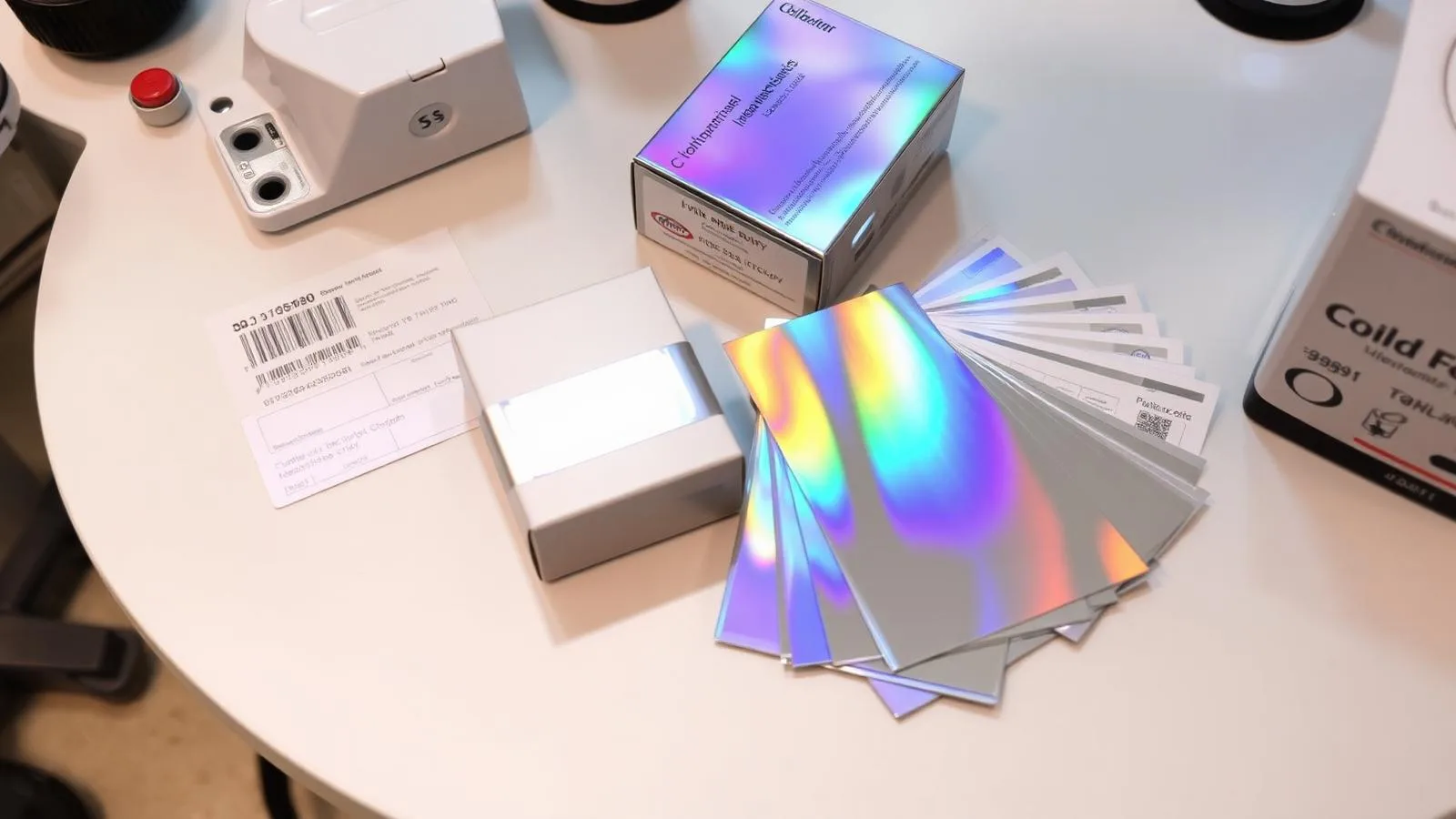
“TL;DR: Cold foil contributes a visible authentication cue, not proof of authenticity. Start from a risk assessment, decide who has to verify the pack, then layer overt, covert and digital elements with documented supplier controls and a real sample-approval workflow.
Cold foil can provide a visible authentication cue, but foil alone does not establish product authenticity. A defensible brand-protection design starts with a counterfeiting risk assessment and combines controlled physical features with traceability or digital verification where appropriate.
This checklist is written for packaging buyers who have to specify and approve such a design. It separates what decorative foil realistically achieves from what an authentication system requires, and lists the evidence worth requesting before production.
What can anti-counterfeit cold foil actually do?
Cold foil gives a package a distinctive metallic or diffractive appearance that is immediately visible on shelf and difficult to reproduce convincingly with printing alone. That makes it useful as a first-line visual cue, particularly where inspectors or consumers compare a suspect pack against a genuine one.
What it does not do is prove origin. Widely available holographic patterns can be imitated closely enough to deceive an untrained observer, and a visual feature that is not controlled, documented and verifiable is a design element rather than a security feature. The security value comes from control over the feature and from the layers combined with it.
Decorative holographic foil versus authentication features
Decorative holographic foil uses standard, catalogue diffraction patterns available to many buyers. It raises the effort required to copy a pack, but it is not exclusive and should not be described as an authentication feature in a specification.
Authentication features rely on controlled origination, restricted supply and documented traceability of the tooling and material. The important distinction for a buyer is not how the feature looks but who can obtain it, how its production is recorded, and how a verifier can distinguish it from a look-alike. Our guide to holographic cold stamping foil covers the technical characteristics of these materials, and the holographic product page lists the grades available for standard decorative work.
Who needs to authenticate the package?
The verification audience determines the feature set, so define it before selecting technology. Consumers can only use features they can see or check with a phone, and they need an unambiguous instruction to do so.
Trade inspectors, customs officers and field investigators can be trained and equipped, which makes covert or tool-assisted features viable for them. Forensic examination in a laboratory supports the strongest evidence but is slow and only relevant to legal cases. A design intended for all three audiences must include a distinct, appropriate layer for each; a single feature rarely serves all of them.
How to select overt, covert and digital security layers
Layering is the accepted approach because each layer covers a different failure mode. Overt features support fast field checks, covert features resist imitation by parties who do not know they exist, and digital or traceability layers connect the physical pack to records.
ISO 22383:2020, Security and resilience — Authenticity, integrity and trust for products and documents — Guidelines for the selection and performance evaluation of authentication solutions, is the current reference for selecting and evaluating authentication solutions; it replaces the withdrawn ISO 12931. Using its structure keeps the discussion focused on threat, verification context and performance criteria rather than on product marketing.
When selecting layers, decide for each one who verifies it, what a positive and negative result look like, and how a failed verification is escalated.
What controls should a foil supplier document?
Ask for documentation rather than assurances. The relevant questions are practical:
- Which pattern or grade is supplied, and is it a catalogue item or restricted?
- What batch identification and traceability records accompany each delivery?
- How are order records, samples and retained references stored?
- What change-control process applies if a pattern, master or coating is modified?
- What quality-inspection records are produced for each production lot?
- Which of these controls can be provided in writing to support an audit?
CFS supplies cold foil material and application support. We do not represent ourselves as a certified authentication platform and do not offer covert, forensic or serialized authentication services; any such capability in your programme should come from a specialist provider whose controls are documented and auditable.
Artwork, origination and production-control checklist
Security-relevant artwork requires stricter handling than decorative work. Keep origination files under access control, record every revision, and make sure the approved version is the only one released to production.
On press, define what an acceptable transfer looks like for the security element specifically — registration tolerance, edge definition and the visibility of any fine detail that the verification method depends on. Waste and reject handling matters as much as production: unaccounted foiled material is a supply route for counterfeiters, so agree reconciliation and destruction procedures in advance.
Sample testing and approval workflow
A workable approval sequence keeps physical samples and written criteria together:
- 1Define the verification method and acceptance criteria before samples are produced.
- 2Produce trial samples on the intended substrate and press configuration.
- 3Verify the security element using the intended method and audience, not only under studio conditions.
- 4Check durability through the pack's real handling — converting, filling, transit and shelf.
- 5Retain signed reference samples with batch identification for later comparison.
- 6Record the approval decision, including anything explicitly excluded from the claim.
A cold foil sample kit is a reasonable starting point for the material selection stage, before the full security specification is fixed.
Cold foil combined with serialized or digital verification
Digital layers add value when they are correctly understood. GS1 Digital Link provides a standardised way to identify an item with a web URI and connect it to online information; it identifies and links, but it does not by itself authenticate a product, since a URI can be copied.
Where cryptographic assurance is needed, GS1 Digital Signatures or another controlled verification system can add authentication functionality on top of identification. Combined with a controlled physical feature, this gives an inspector both something to look at and something to check against a record.
Serialization at item or case level supports investigation and supply-chain analysis, but only if the data is actually monitored and acted on.
Packaging buyer checklist
Before releasing a security-relevant cold foil specification, confirm:
- A documented counterfeiting risk assessment exists for the product and market.
- The verification audiences are defined, with a feature assigned to each.
- Overt, covert and digital layers are specified separately, with owners.
- Supplier controls, traceability and change control are documented in writing.
- Artwork access control and version control are in place.
- Waste, reject and reconciliation procedures are agreed.
- Acceptance criteria and retained reference samples are signed off.
- Claims in marketing and legal documents match what the system can actually demonstrate.
The anti-counterfeit cold foil application page describes how the material options fit into this structure.
Frequently asked questions
Does cold foil prevent counterfeiting? +
No. Cold foil can supply a visible authentication cue that makes casual copying harder, but it does not prove authenticity on its own. It should be one layer within a designed programme that also covers verification, supplier controls and record keeping.
Is holographic foil the same as a security feature? +
Not necessarily. Catalogue holographic patterns are widely available and are primarily decorative. A feature becomes security-relevant when its origination and supply are controlled, documented and verifiable.
Which standard applies to authentication solutions? +
ISO 22383:2020 provides guidelines for selecting and evaluating authentication solutions for products and documents. It replaces the withdrawn ISO 12931.
Does a GS1 Digital Link QR code authenticate a product? +
No. GS1 Digital Link identifies an item and connects it to online information; the URI itself can be copied. Authentication requires an additional controlled mechanism, such as GS1 Digital Signatures or another verification system.
What can CFS provide for a security project? +
CFS supplies cold foil material, including holographic grades, plus application support and samples. We are a foil supplier, not a certified authentication platform, so covert, forensic and serialized authentication capabilities should be sourced from a specialist provider.
Current references
- ISO 22383:2020 — Guidelines for the selection and performance evaluation of authentication solutions
- GS1 — Digital Link standard
- GS1 — Digital Signatures, current standard
Start with material qualification
If a security concept is still being defined, begin by qualifying the foil on your substrate and press. Request a cold foil sample kit with your pack details and we will suggest grades to include.