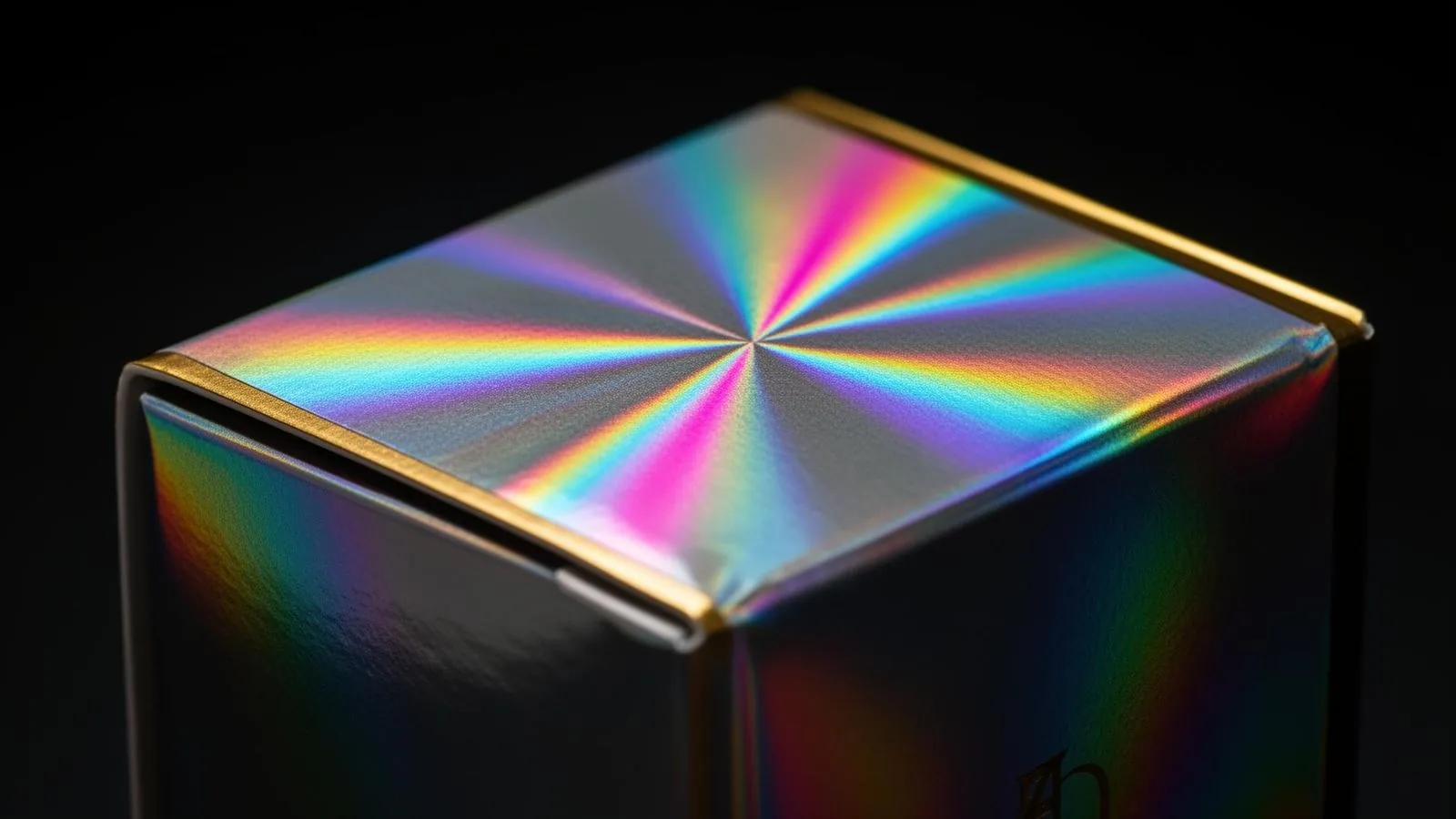
“TL;DR: Holographic cold stamping foil is a metallised PET transfer film carrying a nano-scale diffraction grating (1,000–1,400 lines/mm) embossed into its release lacquer. It is applied inline through a UV-curable adhesive on flexo or offset presses at 150–250 m/min — no heat, no die, no second pass — and CMYK overprints in the same impression at ±0.15 mm register with ~80 µm minimum line widths. This is the technical guide: patterns, press windows, artwork rules, finishing compatibility, security features and how to buy. Sourcing rolls? See holographic cold foil products or the holographic cold foil effect page.
Holographic cold foil has moved from novelty packaging into mainstream cosmetics, spirits, confectionery and anti-counterfeit labels, driven primarily by inline cold foil adoption on UV-flexo and sheetfed offset presses.
This guide explains what holographic cold stamping foil is, how the diffraction effect is engineered, how to prepare artwork, how to set the press, and how to specify and buy it.
What is holographic cold stamping foil?
Holographic cold stamping foil is a multi-layer transfer film identical in construction to plain cold foil — except the release coat carries a microscopic surface relief (typically 0.5–2 µm deep) that diffracts visible light into spectral colours when viewed at different angles. The pattern is mastered into a nickel shim, then embossed at high speed into the release layer before metallisation.
A standard holographic cold foil stack from carrier to substrate:
| Layer | Thickness | Function |
|---|---|---|
| PET carrier | 12–23 µm | Mechanical support, tension control |
| Release coat (embossed) | 0.5–1 µm | Holds the diffraction grating; releases foil under nip pressure |
| Aluminium metallisation | 30–50 nm (350–500 Å) | Reflective base — what makes the rainbow visible |
| Colour/protective lacquer | 1–2 µm | Tints the silver to gold, blue, copper, etc. |
| Adhesive-receptive primer | 0.5–1 µm | Bonds to the UV-curable adhesive printed inline |
On press the converter prints the UV adhesive (cationic or radical, 80–200 cP) in the exact image area, nips the foil web against the wet adhesive at 2–6 bar, cures through the transparent carrier with UV-LED or mercury lamps (200–400 mJ/cm²), and rewinds the spent carrier. For the underlying transfer mechanics, see how cold foil stamping works step by step and what cold foil stamping is.
Datasheet values worth demanding on every lot:
| Spec | Typical range | Why it matters |
|---|---|---|
| Total film thickness | 12–23 µm | Thinner = better register; thicker = easier handling and edge definition |
| Aluminium optical density | 2.2–2.6 | Reflectivity and opacity over dark ink |
| Release value (peel) | 5–25 cN/25 mm | Too high = dropouts; too low = pre-release on the web |
| Adhesive viscosity | 80–200 cP @ 25 °C | Drives transfer sharpness on fine type |
| Cure energy | 200–400 mJ/cm² | Under-cure = poor adhesion; over-cure = brittle film |
| Press speed window | 60–300 m/min | Production economics vs. pattern fidelity |
How the holographic effect is made
The rainbow is pure physics — diffraction, not pigment. The embossed grating acts like thousands of microscopic prisms: white light striking the metallised surface is reflected wavelength-by-wavelength at different angles, producing the shifting spectral effect.
Three commercial pattern families dominate:
- 1Generic holograms — repeating rainbow stars, dots, micro-text or geometric grids held on master cylinders. Lowest cost, fastest lead time, no origination fee. Suited to confectionery, gift wrap and FMCG.
- 2Stock 2D/3D holograms — pre-designed motifs (waves, prisms, lenses) held by the foil manufacturer. Mid-tier cost, no tooling fee.
- 3Custom holograms — brand-specific origination with logos, security micro-text or kinetic effects. Requires a one-time nickel-shim origination and a longer lead time; used for luxury packaging and anti-counterfeit work.
Pattern types and where they fit:
| Pattern | Visual character | Best use | Brightness vs. plain silver |
|---|---|---|---|
| Rainbow / spectral | Continuous colour shift across the area | Confectionery, kids' products, party goods | ~70% |
| Radial (sunburst) | Concentric rays from a focal point | Beverage caps, beauty closures | ~80% |
| Starlight / pixel | Random twinkle, isotropic | Holiday packaging, premium boxes | ~85% |
| Pillar / column | Vertical colour streaks | Wine, spirits, supplement labels | ~75% |
| Motion / 3D | Apparent depth or movement on tilt | Security seals, electronics, anti-counterfeit | ~60% |
| Custom / brand logo | Embossed-to-spec geometry | Perfume, jewellery, security | 60–80% |
Artwork and prepress rules
Designing for holographic cold foil is different from designing for hot stamping because foil follows the adhesive plate, not a die. Register tolerance is therefore the same as any other print station — typically ±0.1–0.15 mm on narrow-web flexo and ±0.05 mm on sheetfed offset — so foil can sit inside or under CMYK without trapping headaches.
Rules that prevent re-runs:
- Build foil as a dedicated spot colour named
ColdFoil(not "Pantone Silver"), Overprint Fill = ON, on its own top-of-stack layer. - Minimum positive line weight 0.25 pt; minimum reverse line weight 0.5 pt. Below that the grating loses pattern fidelity.
- Minimum type size for foil-only text 6 pt sans / 8 pt serif; for foil under CMYK, 8 pt / 10 pt.
- Minimum readable feature width is around 80 µm — finer detail stops diffracting legibly.
- Avoid single solid panels larger than ~25 cm²; pinholing risk rises and the pattern reads visually flat. Break large fields with overprinted gradients or texture.
- Provide a knockout layer for white-only artwork sitting on foil — opaque white needs the foil masked out to read clean.
Pre-flight checklist before files leave the studio:
- 1Foil colour named
ColdFoil, 100% tint, overprint ON. - 23 mm bleed, 3 mm safety margin, crop and registration marks on a dedicated layer.
- 3CMYK + Foil + Varnish + Diecut as separate spot layers; deliver PDF/X-4.
- 4Confirm with the converter whether lamination or overprint varnish is planned — some matte chemistries dull the diffraction and need test pulls.
Press setup: what changes vs. plain cold foil
Holographic foil runs on the same inline cold foil module as plain silver, but four parameters need tightening:
- Adhesive coverage — increase 5–10% vs. plain foil. The relief pattern reduces effective contact area, so compensation prevents pinholing.
- UV cure dose — raise lamp output by 10–15 mJ/cm². The metallised + lacquered stack absorbs slightly more UV.
- Nip pressure — reduce 5–8%. Excess pressure flattens the embossed grating and dulls the rainbow.
- Press speed — cap at 150–250 m/min for holographic vs. 250–300 m/min for plain silver.
Platform windows (typical narrow-web converter):
| Press type | Foil web tension | Transfer pressure | Cure source | Best applications |
|---|---|---|---|---|
| Narrow-web UV flexo | 1.5–3.0 N/cm | 2–4 bar | UV-LED 395 nm, 8–16 W/cm² | Pressure-sensitive labels |
| Sheetfed UV offset | n/a (sheet feed) | 3–6 bar impression | UV-Hg, 120 W/cm | Folding cartons, premium board |
| Hybrid digital + inline foil | 1.0–2.5 N/cm | 2–3 bar | UV-LED | Short-run beauty, beverage |
| Rotary letterpress (legacy) | 2.0–3.5 N/cm | 3–5 bar | UV-Hg | Wine labels, decorative |
Converters running retrofit cold foil modules should validate these on the first holographic job — the OEM's standard cold-foil setup card almost always needs adjustment. Work through the cold foil press setup checklist before the run, and the cold foil defects photo guide if transfer goes wrong.
Tinted foils, CMYK overprint, varnish and lamination
Plain holographic foil is silver. Common tinted variants ship as standard SKUs: holographic gold (yellow lacquer, warm rainbow shift), copper / rose gold (orange-red lacquer), blue / teal (cyan lacquer, popular in cosmetics) and black (dark lacquer with rainbow micro-flash on motion).
For full brand-colour flexibility, CMYK overprint is the workhorse: print process inks directly over a silver holographic base in the same pass to reach any Pantone-equivalent colour while preserving the kinetic effect. Ink density typically lands at 70–85% to keep the rainbow visible through the tint.
Finishing compatibility is the most under-discussed pitfall:
- Water-based inks (<34 dyne/cm): wet out cleanly over foil; safest choice for full CMYK on foil.
- UV inks: excellent adhesion and brightness retention; verify with a Sutherland rub test (200 cycles, 4 lb) before committing.
- Aqueous varnish: 5–15% brightness loss, retains the colour shift.
- UV gloss varnish: 0–10% loss; preferred for high-protection labels.
- UV matte varnish: 20–40% diffraction loss — the matte microstructure scatters the light that would otherwise diffract. Use spot matte with foil knocked out beneath it, not flood matte.
- Gloss BOPP/PET lamination: minimal effect (<5%); the safest premium finish.
- Soft-touch lamination: 30–50% loss — treat as effectively non-holographic and specify a flat metallic foil instead.
Compare shades and constructions across the range in the wholesale metallic cold stamping foil rolls buyer's guide.
Specifications buyers should pin down
| Parameter | Typical range | Notes |
|---|---|---|
| Carrier thickness | 12 µm (label), 19–23 µm (carton) | Thinner = better register; thicker = easier handling |
| Roll width | 200–1,650 mm | Match press web width; slit-to-order is standard |
| Roll length | 4,000–8,000 m | Limited by carrier elasticity at thinner gauges |
| Pattern repeat | 2–50 mm | Sets the perceived scale of the rainbow |
| Min. feature width | 80 µm | Below this, diffraction becomes unreadable |
| Register tolerance | ±0.15 mm | Achievable on modern UV-flexo |
| Adhesive | UV-curable cationic or radical | Match to substrate (paper, board, film) |
| Cost premium vs. plain silver | Moderate — quoted per specification | Higher for custom origination |
Supplier vetting checklist before the first PO:
- 1ISO 9001 and ISO 14001 quality and environmental management.
- 2Physical pre-production sample — not a digital proof — on your specified substrate.
- 3Documented Sutherland rub (200 cycles, dry and wet) and Tesa 4154 adhesion results.
- 4Food-contact documentation for the adhesive system where relevant (EU 10/2011 or FDA 21 CFR 175.105).
- 5Heavy-metal compliance declarations for the foil.
- 6Batch traceability: foil lot, adhesive lot and press log per delivery.
- 7A re-run commitment at the same lot colour.
Applications where holographic cold foil wins
- Cosmetics and fragrance cartons — holographic blues and pinks dominate K-beauty and prestige skincare. See the luxury cosmetic cold foil cartons guide.
- Confectionery and seasonal packaging — generic holograms deliver high shelf-pop at low unit cost.
- Spirits and wine labels — tinted holographic golds, particularly effective on dark glass.
- Anti-counterfeit and security — custom holograms with micro-text or kinetic elements on pharmaceutical seals, tax stamps and high-value goods. See anti-counterfeit cold foil.
- Promotional and gift items — notebooks, gift cards and inserts where novelty drives perceived quality.
Security features the process supports: micro-text (50–150 µm character height) embossed into the diffraction master, latent images revealed at specific viewing angles, OVD-style 2D-to-3D motion or colour flip, covert nano-text below 30 µm, and serialisation when combined with inline variable-data inkjet.
Holographic cold foil vs. alternatives
| Method | Effect | Best for | Press speed |
|---|---|---|---|
| Holographic cold foil | Bright rainbow, full overprint compatible | Inline production, medium to long runs | 150–250 m/min |
| Holographic hot foil | Slightly sharper grating, no inline overprint | Short runs, premium short-run packaging | 30–80 m/min |
| Holographic laminate | Full-coverage backgrounds | Sheetfed luxury cartons | Offline pass |
| Metallised board + print | Cheapest "holographic look" alternative | Budget FMCG | n/a |
Cold foil unit cost is built from substrate, foil consumption in running metres, press time, one-time tooling and finishing. Holographic foil costs more per running metre than plain silver because of the embossing master and lower yield, but it removes the engraved-die cost hot stamping requires and needs no second pass. For the full framework, read the cost difference between cold foil and hot foil stamping.
Recyclability
The aluminium layer is only 30–50 nm thick, so foil mass per pack is very small. Paper and board packs with limited foil coverage are generally handled by existing fibre-recycling streams, while heavy coverage and filmic labels need checking: metallised layers can interfere with PET-bottle NIR sorting when the label covers a large share of the bottle, so keep foil area modest and use wash-off adhesives. Ask for repulpability and deinkability test reports on your actual construction rather than relying on a generic claim — see is cold foil recyclable and the cold foil recyclability proof checklist.
Next steps
The diffraction effect is impossible to judge from a spec sheet. Pull your representative substrates and run a real sample. Request a sample and our technical team will match a pattern, tint and adhesive system to your press and substrate.
Frequently asked questions
What is holographic cold stamping foil? +
Holographic cold stamping foil is a metallised PET transfer film carrying an embossed diffraction pattern. It is applied inline with a UV adhesive at 25–40 °C, so it decorates labels and cartons at press speed without a heated die.
Can holographic cold foil be CMYK overprinted? +
Yes — that is one of its main advantages over hot foil. Process inks print directly over the silver holographic base in the same pass. Keep ink density around 70–85% so the diffraction still reads through the tint.
Which substrates suit holographic cold foil? +
Coated paper, cast-coated label stock, SBS/CRB carton board, BOPP, PET and PVC transfer cleanly. Uncoated and textured stocks absorb the adhesive and dull the diffraction, so prime them or move the effect to a coated area — see cold foil on uncoated paper.
How should artwork be prepared for holographic cold foil? +
Deliver foil as a dedicated ColdFoil spot colour set to overprint on its own layer, minimum 0.25 pt lines and 6 pt type, 3 mm bleed, with CMYK, foil, varnish and diecut as separate layers exported as PDF/X-4.
Which varnishes and laminates damage the holographic effect? +
Flood UV matte varnish costs 20–40% of the diffraction and soft-touch lamination 30–50%. Gloss UV varnish and gloss BOPP/PET lamination are safe, losing under 10%.
What is the minimum order for holographic cold foil? +
Stock holographic patterns start at 1,000 linear metres per slit width. A new custom hologram origination typically starts at 5,000 lm and adds several weeks for shim mastering and press trial. Free trial rolls are available for qualified converters.
Is holographic cold foil recyclable? +
The metallised layer is 30–50 nm thick and represents a very small mass fraction, so paperboard with limited foil coverage generally stays compatible with fibre recycling. Confirm with repulpability testing on your own construction before making a recyclability claim.
See the diffraction on your own stock before you specify it
Related reading: cold foil sample kit and swatch book, holographic cold foil rolls, cold stamping foil manufacturer, flexo cold foil stamping materials, cold foil labels complete guide, anti-counterfeit cold foil checklist.