Technology

How cold foil
stamping works.

Inline UV-cured metallic decoration at 300 m/min. No heated dies, no offline pass, no compromise on detail. Explore the chemistry, the press integration and the engineering data behind every roll of CFS foil.

Speed
273m/min
Detail
45µm
VOC
0g/L
Process

Three inline steps. One pass through the press.

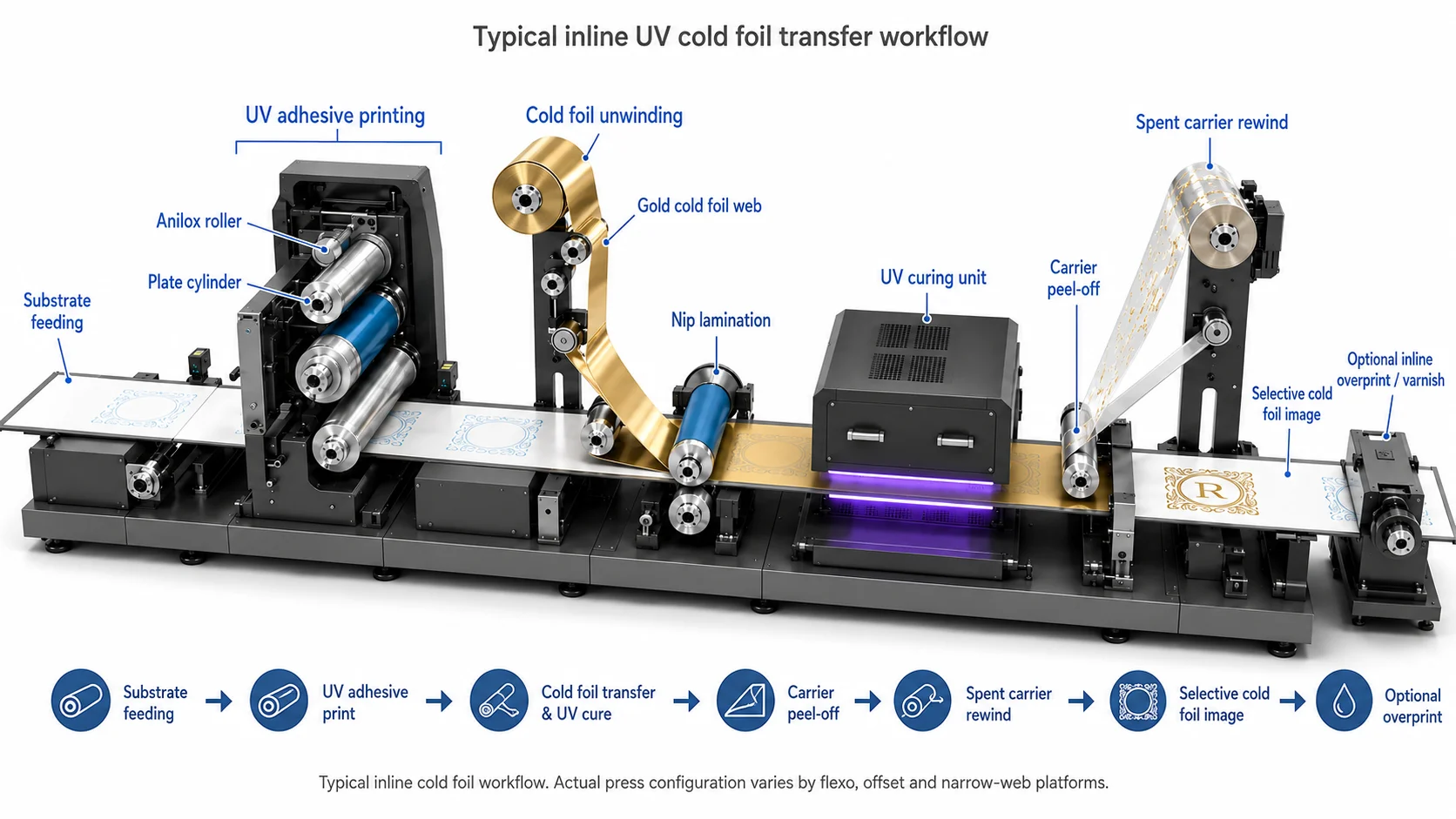
Cold foil stamping happens in line with conventional flexo or offset printing — no offline finishing, no second machine, no cooling time.

01

UV Adhesive Print

A flexo or rotogravure unit lays a UV-curable adhesive in the exact shape of the artwork. Image fidelity down to 50 µm is preserved at full press speed.

02

Foil Transfer & Cure

The metallized PET web is nipped against the wet adhesive. UV LED lamps cure instantly, locking the metal layer onto the substrate while the carrier rewinds clean.

03

Inline Overprint

Subsequent CMYK or special-color stations print directly over the foil — enabling tints, gradients and brand color overlays without a second pass.

Construction

Six engineered layers, thinner than a human hair.

Hover or tap any layer of the foil construction to inspect its thickness, function and material chemistry.

12 µmPET Carrier Film0.5 µmRelease Layer0.8 µmColor Lacquer35–50 nmAluminium Metallization1.5–3 µmUV Adhesive60–450 gsmSubstrateCarrier rewinds ↺Press direction
Compared

Cold foil vs hot stamping vs digital metallic.

A side-by-side look at the three dominant metallic decoration processes — measured on the metrics that matter to print buyers, packaging engineers and brand owners.

ParameterCold foilHot stampingDigital metallic
Process speedUp to 300 m/min60–120 m/min20–40 m/min
Tooling requiredPhotopolymer plateEngraved metal dieNone (digital plate)
Tooling lead timeHoursDays to weeksMinutes
Energy consumptionLow (UV LED)High (heated dies)Medium
VOC emissions0 g/L0 g/LVariable
Min. line width50 µm80 µm120 µm
OverprintableYesNoYes
Heat-sensitive substratesYesNoYes
Cost per m² (long runs)LowMediumHigh
Recyclable carrier programYesNoNo
Engineering

Press-ready specifications.

Per-product specs
Press speed
Up to 300 m/min

Validated on Gallus, Bobst M5, MPS EF Symjet and Nilpeter FA narrow-web platforms.

UV cure energy
80–150 mJ/cm²

UV LED 385/395 nm. Compatible with mercury arc lamps for legacy lines.

Foil thickness
12 µm carrier

Aluminium metallization 35–50 nm with engineered release for clean separation.

Min. detail
50 µm lines

Crisp micro-typography and security-grade hairlines without breakup.

Working temperature
18–28 °C

Stable transfer across pressroom seasonality. Humidity tolerant 40–65% RH.

Adhesion
≥ 4B (ASTM D3359)

Passes tape pull, scuff, and alkali wash for returnable beverage labels.

Adhesive viscosity
150–250 mPa·s

Tunable to anilox volume; works with 2.5–6.0 BCM rolls.

Substrates
Paper, board, PE, PP, PET

Coated and uncoated stocks, 60–450 gsm. Metallized boards on request.

Sustainability

Cold chemistry,
cleaner pressroom.

No solvents. No heated dies. No offline finishing pass. Cold foil stamping is the lowest-impact path to mirror metallic decoration on modern packaging.

  • Zero VOC, solvent-free formulation
  • Up to 45% lower energy vs hot stamping
  • PET carrier collected for recycling
  • FSC and REACH compliant supply chain
VOC reduction
0%
Energy saving
0%
Recyclable carrier
0%
Faster vs hot
Where it ships

Built for high-volume packaging programs.

FAQ

Questions, answered.

Engineering and procurement questions we hear most often from converters and brand owners evaluating cold foil stamping.

Ask our technical team

Cold foil stamping is an inline decoration process that transfers a metallic layer onto a substrate using a UV-curable adhesive instead of heat and a metal die. The adhesive is printed in the artwork shape, the foil is laminated against it, UV light cures the bond instantly, and the carrier film rewinds — all at full press speed.

Specify cold foil stamping on your next program.

Request samples, technical datasheets or a press validation visit with our engineering team.