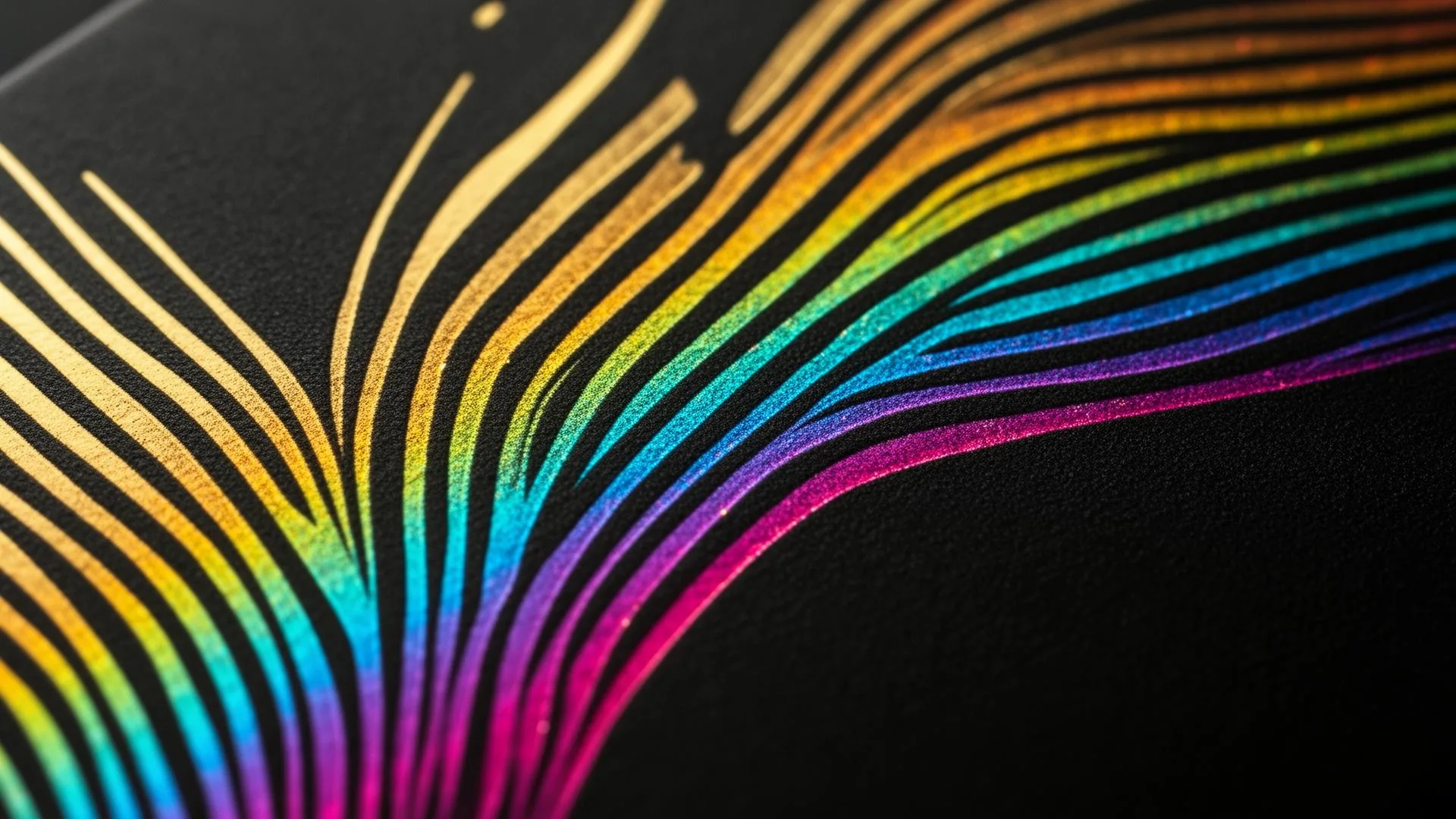
Rainbow / spectrum
Full-spectrum diffraction grating refracts ambient light into a moving rainbow — ideal for limited editions and prismatic brand moments.
Last updated: September 2026
B2B rolls of holographic cold transfer foil for UV-flexo and offset packaging lines — rainbow, pillar, geometric and tinted iridescent patterns. Free samples cut to your press width, low MOQ, worldwide shipping. Want the technical deep-dive? Read how holographic cold foil works.
Specifying holographic foil for brand protection? Work through our security holographic cold foil evaluation checklist before you approve artwork or place a production order.
Quick technical answer
Holographic cold foil combines the metallic reflection of a standard cold transfer foil with an embossed diffraction grating, so the same inline UV-adhesive transfer produces a colour-shifting rainbow or engineered pattern instead of a flat mirror. Because the grating is formed in the foil before it reaches the press, converters run it on the existing cold foil station and can overprint it with CMYK in the same pass. That makes it usable both as a decorative finish and — with a registered or custom pattern — as one layer in an anti-counterfeit packaging programme.
The technology
Holographic cold foil is structurally identical to a standard silver cold transfer foil — PET carrier, release layer, aluminium, adhesive — with one addition: an embossed diffraction grating in the release/aluminium interface. The grating spacing (commonly 1,000–1,400 lines/mm) acts as a wavelength-selective mirror, splitting white light into spectral colors that shift with viewing angle.
Because the grating is fully formed before the foil reaches your press, the optical effect is independent of the printing process. The cold-foil station only handles transfer; the holographic effect is "baked into" the foil itself.
The same anilox, adhesive coat-weight and UV cure profile you use for plain silver cold foil will work for the holographic version. See our anilox selection guide and CMYK-over-cold-foil note for the press-side details.
Effect library
Full-spectrum diffraction grating refracts ambient light into a moving rainbow — ideal for limited editions and prismatic brand moments.
Concentrated point-light reflections that twinkle as the package rotates. High visual impact under retail spotlighting.
Engineered diffraction patterns (3D dots, waves, brick) for security, anti-counterfeit and structured holographic backgrounds.
Holographic base over-printed with translucent CMYK to lock in brand colors — gold-tinted rainbow, rose holographic, emerald holographic.
Same UV-flexo / offset press, same anilox window as standard silver cold foil. No dedicated holographic line required.
<5 g/m² aluminium deposit keeps cold-foil-decorated cartons within the mono-material recyclability thresholds of EU PPWR 2027.
Holographic foil at a glance
| Parameter | Holographic cold foil | Standard metallic cold foil | Hot holographic foil |
|---|---|---|---|
| Optical effect | Diffraction grating: colour shifts with viewing angle | Flat mirror metallic, overprintable to any shade | Diffraction grating with relief from the die |
| Press speed | Inline, at cold foil press speed | Inline, at cold foil press speed | Slower, dedicated stamping station |
| Tooling | Flexo or offset plate | Flexo or offset plate | Engraved brass die |
| Heat required | None | None | Heated die |
| CMYK over-printable inline | Yes, same pass (tinted holographic) | Yes, same pass | No — separate pass |
| Substrate flexibility | Coated board, label stock, BOPP and PET film | Coated board, label stock, BOPP and PET film | Heat-tolerant substrates only |
| Security value | Pattern choice can support authentication | Decorative only | Pattern plus tactile relief |
| Best-fit run length | Medium to long inline production | Medium to long inline production | Short premium runs |
Full breakdown: Hot vs cold foil stamping — 2026 buyer's guide.
Where it shines
Limited-edition palettes, fragrance secondary packaging, K-beauty cartons.
Premium chocolate sleeves, seasonal SKUs, kids' lines, advent calendars.
Pressure-sensitive labels with refractive accents; full-wrap holographic on RTD cans.
Anti-counterfeit holographic backgrounds with brand-locked CMYK overlay.
Registered or custom diffraction patterns used as one verifiable layer inside a wider brand-protection specification.
Filmic and paper labelstock decorated inline, with the holographic panel overprinted in the same pass.
Press setup
Use a dark substrate.
Matte black, deep navy or chocolate brown maximises spectral contrast. White or pastel substrates wash out the rainbow.
Anilox 7–10 cm³/m².
Slightly higher coat-weight than plain silver to fully wet the grating. Confirm with a sample roll.
Calibrate UV dose.
Under-cure dulls reflections; over-cure can shrink and crack the grating. Target the foil supplier's published dose ± 10%.
Keep dwell time low.
Holographic foils transfer well at full press speed — slowing the line below 80 m/min can cause adhesive bleed and edge halos.
Plan CMYK trapping.
Tinted holographic looks best with 30–60% ink density over the foil. Solid 100% over-print kills the rainbow; under 20% looks weak.
Deep-dive press guide: Holographic Cold Stamping Foil — effects, press setup & buyer's guide.
What it looks like in production
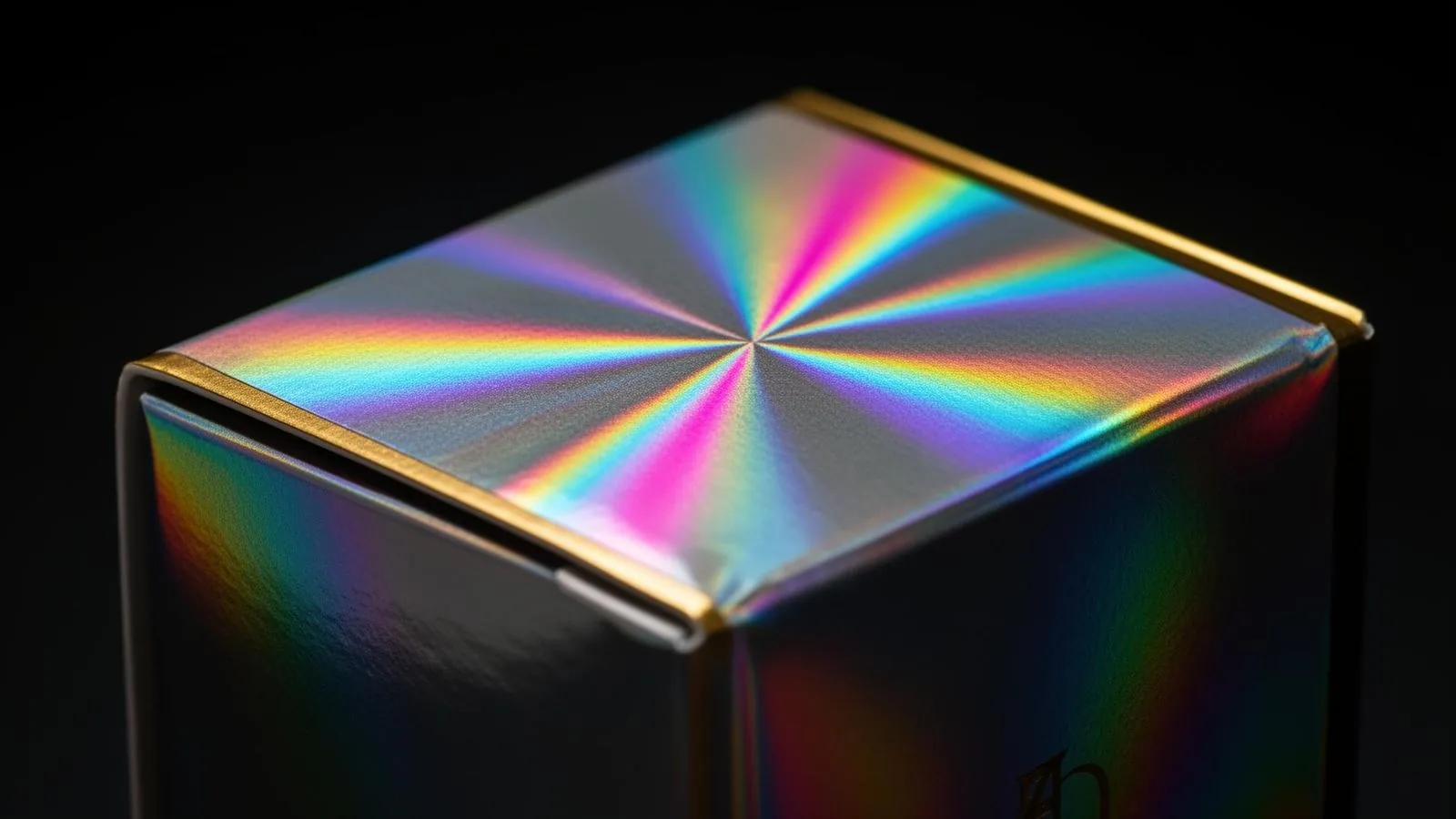
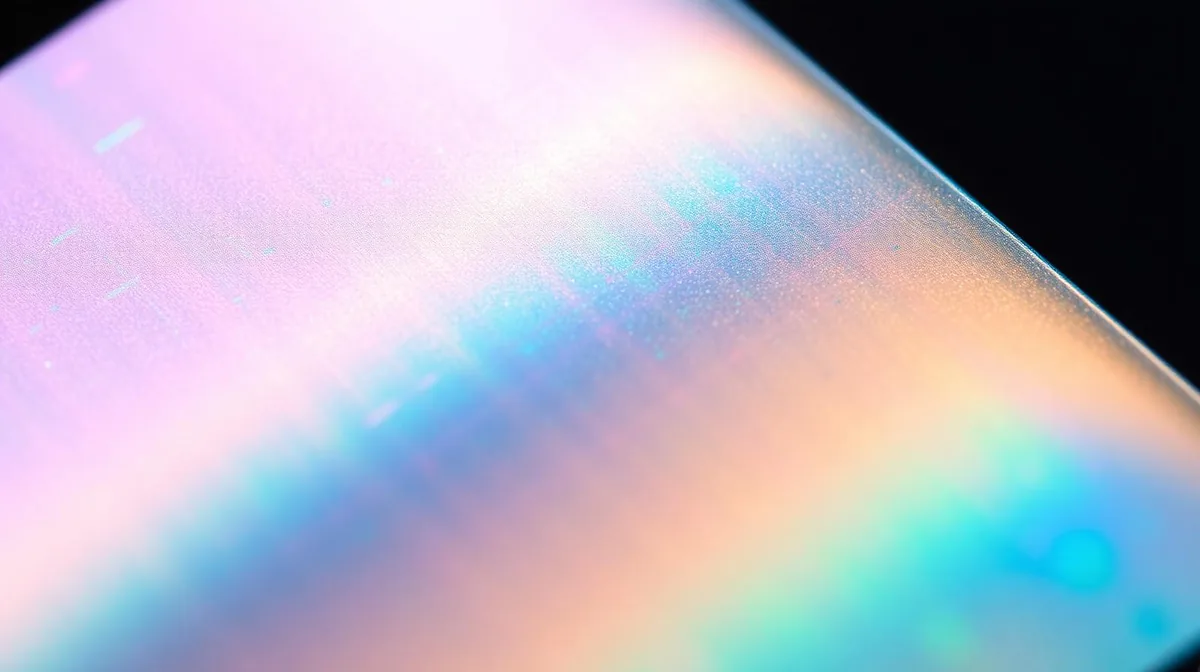
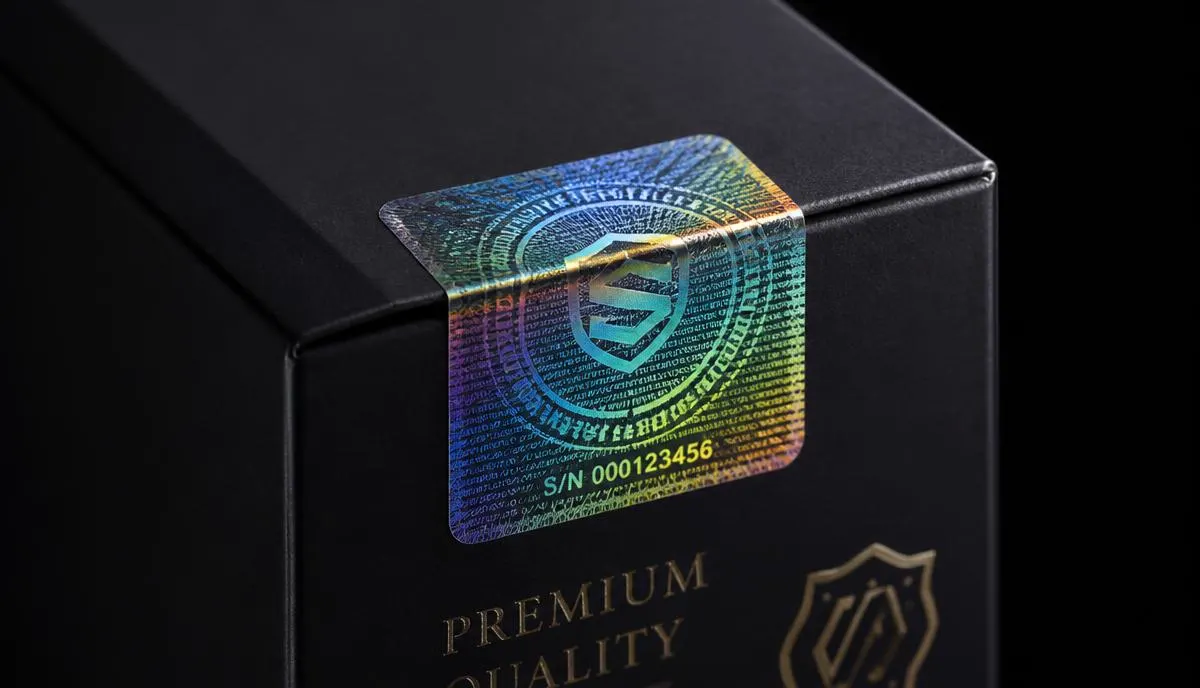
Pressure-sensitive labels. Filmic labelstock gives the cleanest diffraction because the surface is smooth and the metal sits flat. Treatment level matters more than substrate colour here; confirm dyne level and treatment age before a trial, and check the overprint plan against the UV cold foil adhesive grade in use.
Cosmetics and beauty cartons. Dark, matte coated board gives the strongest spectral contrast. Tinted holographic — a translucent CMYK overlay on the foil — is the usual route to a brand-locked colour without abandoning the rainbow shift.
Wine, spirits and RTD. Holographic accents are normally used as borders, crests or sunbursts rather than full flood, because large diffraction areas can read as promotional rather than premium. Varnish choice changes the effect noticeably.
Tobacco, vape and regulated goods. Pattern consistency and repeatability across reruns matter more than peak brightness. Agree the pattern reference, the supplier and the reorder process at qualification.
Anti-counterfeit packaging. A generic stock holographic pattern is decorative, not protective. Security value comes from pattern control and traceability; work through the anti-counterfeit cold foil application guide before specifying.
Evidence & sources
In sample reviews, the most common disappointment with holographic cold foil is not transfer quality but substrate choice: the same roll that looks spectacular on matte black board looks weak on bleached white stock, because the diffraction colours compete with the substrate. The second recurring issue is overprint density — heavy solids over the foil flatten the rainbow, which is why we ask for the overprint plan before recommending a pattern.
Holographic cold foil is not always the right finish. Registration between the diffraction pattern and printed artwork cannot be controlled the way a printed image can, so pattern position varies within the foiled area. Light substrates, heavy overprint density, matte varnishes and lamination all reduce the visible spectrum, and a flat transfer cannot produce the relief of an embossed or hot-stamped holographic finish. Pattern availability is also a supply decision: custom gratings carry origination cost and lead time.
Before requesting a sample or quotation, fix the substrate grade and colour, the press and foil station, the pattern reference, the overprint and varnish plan, the coverage and the run length — and state whether the holographic element has a security role. Ask for the swatch on your own stock, review it under retail lighting, and confirm that the same pattern can be reordered for future runs. A cold foil sample kit is the cheapest way to settle this before artwork is committed.
Holographic cold foil is a cold transfer foil whose metallised layer carries an embossed diffraction grating, applied inline with UV-curable adhesive on flexo or offset presses without heat or an engraved die. It produces angle-dependent rainbow or engineered pattern effects that can be overprinted with process colour in the same pass, and is used for decorative packaging and as one layer of anti-counterfeit specifications. Final appearance depends on substrate colour and smoothness, pattern choice, overprint density, varnish and press setup.
Related CFS references: cold foil press setup checklist, cold foil troubleshooting guide and the full cold foil product range.
FAQ
Holographic cold foil is a cold transfer foil whose aluminium layer carries an embossed diffraction grating (typically 1–1.4 µm deep). When applied inline with UV adhesive on a flexo or offset press, the grating splits ambient light into a moving rainbow or geometric pattern — without heat, dies or a second pass.
Hot holographic foil requires an engraved die, heat (110–140 °C) and a dedicated stamping station — slow and tooling-heavy. Cold holographic foil runs inline on standard UV-flexo and offset presses up to 450 m/min, with the image defined by a flexo plate instead of a die. See our cold-foil-vs-hot-foil guide.
Yes — that is one of the biggest advantages. The cold-foiled holographic layer accepts UV inks in the same pass, enabling tinted rainbow, gold-overlay holographic and full custom-color holographic effects. See the CMYK-over-cold-foil rainbow-effect technical note.
Yes. 'Rainbow foil', 'iridescent foil' and 'holographic foil' are commonly used interchangeably in design and marketing. Technically, a true holographic foil carries an engineered diffraction grating; a basic 'rainbow' or 'pearl' foil may rely on simpler interference layers without a grating.
SBS and FBB folding cartons (matte black and dark substrates give the strongest spectrum), coated label stock, BOPP and PET flexible film, and metallized board. Uncoated paper is technically possible but reduces brightness — we test substrates free of charge.
Holographic cold foil rolls ship from one master roll (~3,000 linear m). For qualification, we send free sample rolls cut to your press width — no minimum on samples.
Spot holographic cold foil applies a holographic effect only to selected areas of the print, not across the whole sheet. The pattern is defined by where the UV adhesive is printed, so the diffraction effect follows the artwork exactly — a crest, a seal, a border — while the rest of the surface stays untouched.
Because placement is controlled by an ordinary flexo or offset plate, spot holographic work costs no more in tooling than any other cold foil image, and it runs inline at production speed. That is the main practical difference from laminated holographic board, where the effect covers the entire panel and the recycling stream changes.
Registration is the thing to watch. A spot holographic element that must sit inside a printed keyline needs the same register discipline as any tight two-colour job, so keep the smallest positive detail at or above roughly 0.15 mm and avoid hairline reverses inside the foil area.
Holographic cold foil is used as an overt security feature: the diffraction pattern is visible without a device, hard to reproduce with a scanner or copier, and difficult to source in a matching pattern. It works best as one layer in a multi-feature scheme rather than as a standalone guarantee.
For brand protection projects, buyers usually pair a holographic element with a covert feature and a serialised code so field inspection has both a look-at check and a verify-it check. Our anti-counterfeit cold foil page sets out how the layers are usually combined and what to specify in a converter brief.
All three run the same way on press — UV adhesive, nip, cure, peel. What changes is the optical layer. Metallic cold foil gives a flat mirror; rainbow grades give a soft iridescent colour shift; holographic grades carry an embossed diffraction grating that splits light into a moving spectrum.
| Effect | Optical layer | Visual result | Security value | Typical use |
|---|---|---|---|---|
| Holographic cold foil | Embossed diffraction grating on the lacquer | Moving rainbow split that shifts with viewing angle | Overt security feature | Spirits, tobacco, pharma, brand protection seals |
| Rainbow / iridescent cold foil | Interference or tinted lacquer, no grating | Soft colour shift, no pattern movement | Decorative only | Cosmetics, confectionery, seasonal packaging |
| Metallic cold foil | Plain metallised aluminium layer | Flat mirror silver or tinted metallic | None | Wine and spirits labels, cartons, everyday FMCG metallics |
Holographic, rainbow and metallic cold foil compared
Test the pattern on your own substrate before approving artwork. Holographic grades have a lacquer and grating layer that behaves slightly differently from plain metallic foil at the nip, so adhesion and edge definition should be confirmed on a short trial rather than assumed from a swatch.
We ship a swatch booklet with rainbow, pillar and geometric holographic foils cut to your press width — anywhere in the world, no charge.