Cold Foil Printing for Labels, Cartonsand Foil Print Projects
The complete guide to foil stamping: what it is, how the cold (UV-cured, inline) and hot (heated-die, offline) methods work, real per-impression costs, press speeds, and a direct side-by-side comparison so you can pick the right one for your packaging job.
Foil stamping is a printing process that transfers a thin aluminium layer from a carrier film onto paper, board or film to create a mirror-bright metallic image. Two methods dominate: hot foil stamping uses a heated brass die (best under ~3,000 sheets), while cold foil stamping prints a UV adhesive and cures it inline with CMYK at 300–450 m/min — typically 30–60% cheaper above 5,000 sheets.
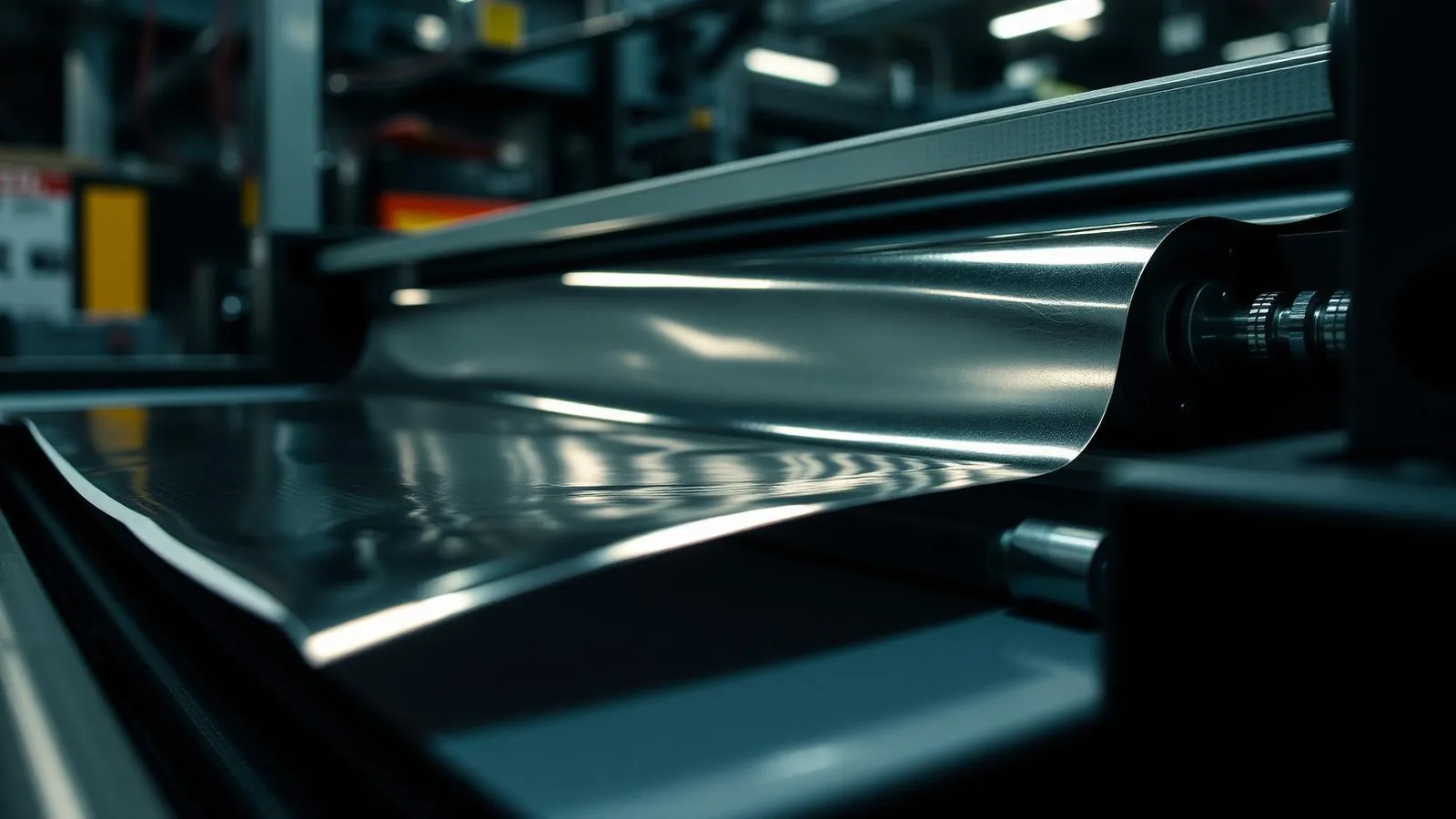
- 450m/min
- Inline web speed
- 5–15min
- Make-ready time
- 30–60%
- Cheaper above 5k sheets
- 0VOC
- UV-cured adhesive
01 · Definition
What is foil stamping?
Foil stamping is a decorative printing process that bonds a thin metallic layer — usually vacuum-metallised aluminium on a polyester carrier — to a substrate to create a highly reflective, mirror-bright image. It is the industry default for luxury packaging, book covers, business cards, wine and spirits labels, and premium folding cartons.
Two methods dominate production today. Hot foil stamping presses a heated brass or magnesium die (120–150 °C) through a pigmented foil roll against the substrate — the classic method, ideal for short runs and tactile emboss-foil combinations. Cold foil stamping prints a UV adhesive on a flexo unit, laminates a metallised PET film, cures the adhesive in milliseconds and peels the spent carrier — all inline with CMYK on a single press pass.
Because cold foil sits upstream of the CMYK stations, the metallic image can be overprinted with process and spot colours in the same pass. That is how packaging brands build tinted golds, copper from silver and the full rainbow metallic effect without ordering custom-colour foil rolls. See the cold foil pillar, hot foil pillar, or the step-by-step process article or the cold foil process overview for deeper reads.
02 · Why printers choose cold foil
Faster, cleaner, overprintable, mono-material
Inline at full press speed
Cold foil printing runs in the same pass as CMYK — no offline second pass, no die changes, no cooling time. UV-flexo lines hit 300–450 m/min; sheet-fed offset cold foil units run 12,000–18,000 sph.
Print colour over the foil
Because the metallic deposit is laid down before the downstream print stations, CMYK and spot inks overprint it directly. That is how tinted golds, copper-from-silver and rainbow metallic effects are built in one pass.
PPWR-friendly mono-material
Aluminium deposit is below 5 g/m² — well under the EU PPWR 2027 threshold for paper and board recyclability. UV adhesives emit zero VOC and the PET carrier film is rewound and recycled.
Lower tooling, lower break-even
A flexo plate costs $50–$200 vs $300–$1,500+ for a brass hot-stamping die. Above ~5,000 sheets, cold foil printing typically lands 30–60% cheaper per impression than hot foil.
03 · How cold foil printing works
Four inline stations, one pass
On a UV-flexo or sheet-fed offset press, cold foil printing is a four-station operation that the substrate never leaves. This is what makes it 5–10× faster than hot foil stamping.
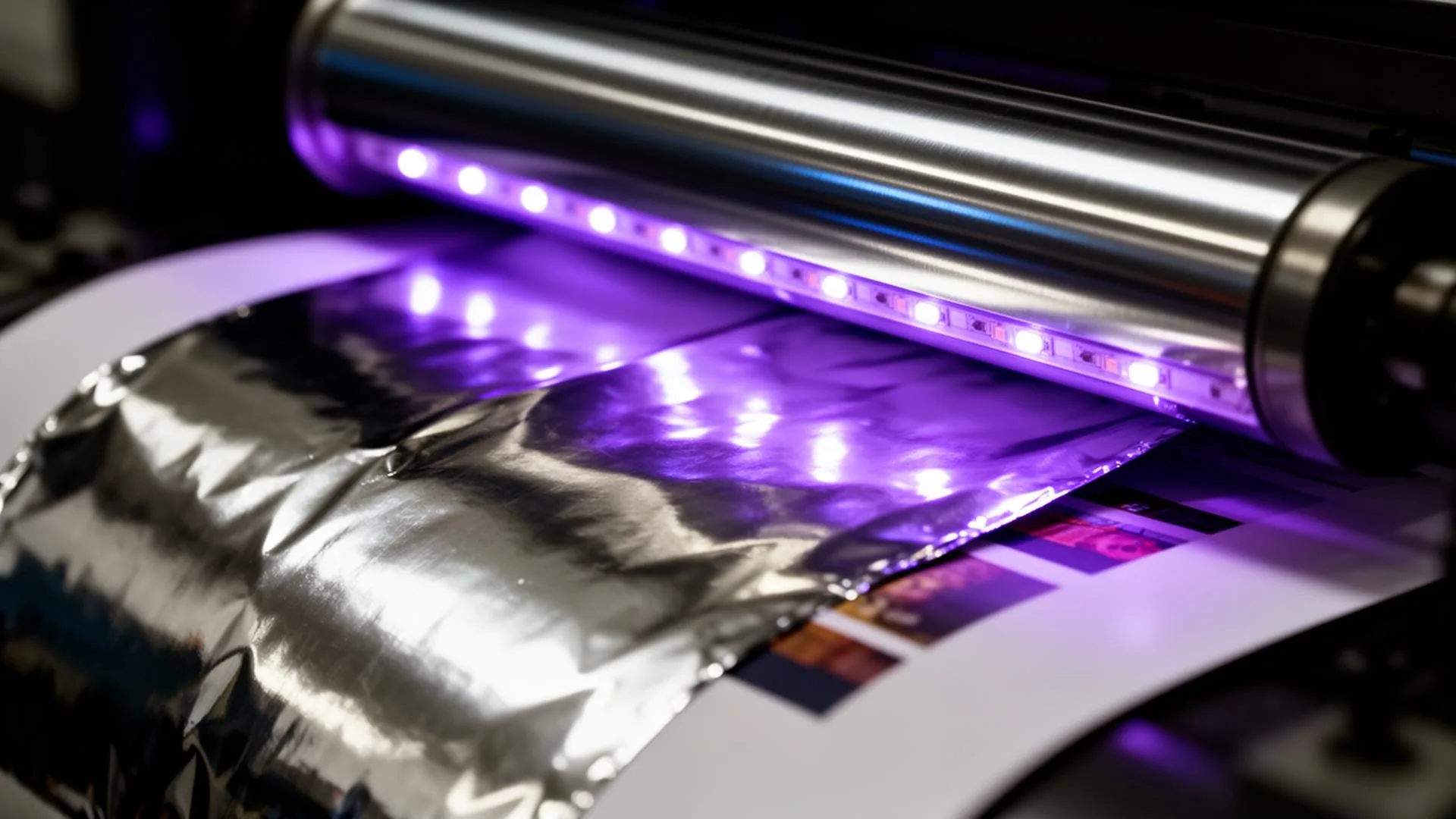
UV-LED lamp curing the adhesive through the PET carrier — the moment the foil locks in.
- 1
Print UV adhesive
A flexo plate prints a tack-free UV adhesive only where foil should appear. Typical coat weight 1.5–3 g/m² via a 7–10 BCM anilox.
- 2
Laminate the foil web
Metallised PET film is nipped against the wet adhesive under a chrome roller. The aluminium layer wets out into the adhesive image.
- 3
UV cure through the carrier
A UV-LED or mercury lamp cures the adhesive through the transparent PET carrier in milliseconds, locking the foil in place.
- 4
Peel the carrier, overprint CMYK
The spent PET carrier peels cleanly and rewinds. Foil sits only on the printed image, ready for CMYK overprint in the next units.
04 · Cold vs hot foil printing
The honest side-by-side
Both processes deliver high-specular metallic decoration. They split on speed, tooling, overprintability and tactile feel. Use the table to size the trade-off, then the two lists below to pick the right process for your job.
| Attribute | Cold foil printing | Hot foil printing |
|---|---|---|
| Process temperature | Room temperature (UV cure) | 120–150 °C heated die |
| Tooling | Flexo plate ($50–$200) | Brass or magnesium die ($300–$1,500+) |
| Setup / make-ready | 5–15 minutes | 30–60 minutes |
| Press speed | 300–450 m/min (web) · 12k–18k sph (sheet) | 20–60 m/min · 4k–8k sph |
| Inline with CMYK? | Yes — single pass | No — offline second pass |
| Over-printable | Yes (CMYK directly on foil) | Limited — overprint over hot foil often crawls |
| Reflectance | 85–92% | 90–95% |
| Tactile relief / emboss | Flat finish | Slight emboss from die pressure |
| Best for short runs (<3k) | Less economical | Better — die cost amortised quickly |
| Best for long runs (>5k) | 30–60% cheaper than hot foil | Tooling and speed penalty grow |
| VOC emissions | Zero (UV cured) | Low |
| Substrate range | Coated SBS/FBB, films (with primer for uncoated) | Coated and uncoated, including textured |
| Recyclability (EU PPWR) | Mono-material friendly | Mono-material friendly |
Pick cold foil printing when…
- Volumes above ~5,000 sheets or any reel-fed converting
- Designs that need CMYK overprint on metallic (rainbow, tinted golds, brand colours)
- Tight changeover windows — multi-SKU folding carton, label and pouch runs
- Sustainability briefs targeting PPWR mono-material and zero-VOC requirements
- Inline UV-flexo and sheet-fed offset lines already equipped with a cold foil module
Stay with hot foil printing when…
- Very short runs under ~2,000 sheets where tooling cost amortises fast
- Designs that need a tactile emboss, deboss, or combined emboss-foil
- Heavily textured uncoated stock where adhesive anchorage is unreliable
- Spot foiling on already-finished products (book covers, leather, certificates)
- Pigment foils and specialty effects (mirror chrome on textured stock, leafing)
Need the deeper read? Hot foil printing pillar (the counterpart guide) · Hot vs cold foil stamping — 2026 buyer's guide · Cost difference between cold and hot foil · Which is better on uncoated paper?
05 · Where cold foil printing is used
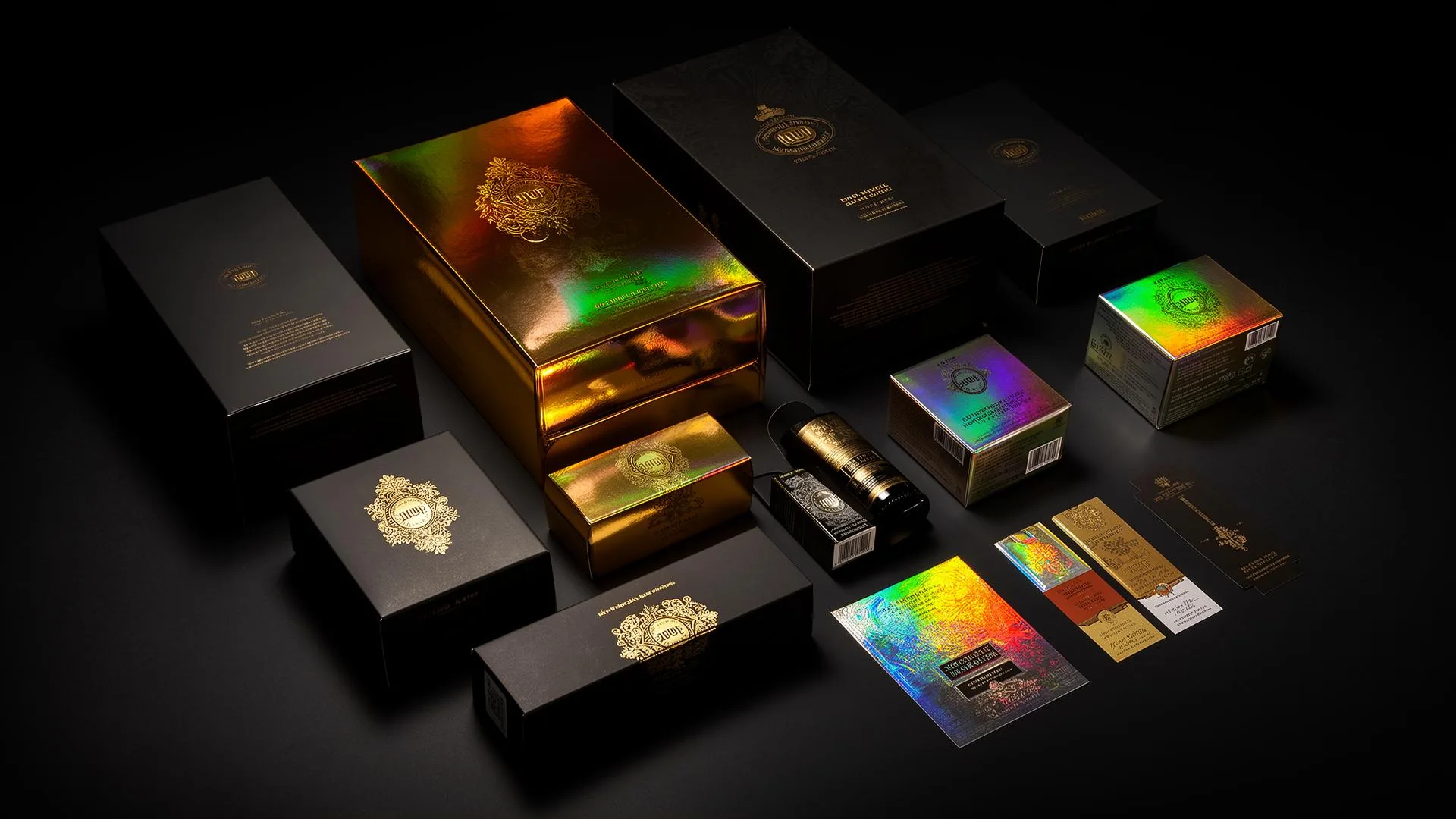
Packaging categories running cold foil today
06 · Related products & guides
Build a working spec
Cold foil rolls — wholesale
PET carriers, mirror gold/silver, holographic, tinted metallics. 320–1,250 mm widths.
Browse cold foil productsCold foil stamping machine
Inline module specs, retrofit checklist, anilox and UV lamp sizing.
Read the machine guideHolographic & rainbow effects
Diffraction, pillar and rainbow patterns built on the same cold foil line.
Explore effectsFoil stamping services
End-to-end production — prepress, plates, press, QC and shipping.
See services07 · FAQ
Common questions
What is foil stamping?
+
Foil stamping is a printing process that transfers a thin metallic (usually aluminium) layer from a carrier film onto paper, board or film to create a mirror-bright image. Two methods dominate: hot foil stamping uses a heated brass die to press pigmented foil onto the substrate, while cold foil stamping prints a UV adhesive, laminates a metallised film and cures it in milliseconds — running inline with CMYK.
How does foil stamping work?
+
Hot foil stamping presses a heated die (120–150 °C) through a pigmented foil roll against the substrate; heat and pressure release the metallic layer only where the die contacts. Cold foil stamping prints a UV adhesive in the image shape, nips a metallised PET film against it, cures the adhesive under a UV lamp, then peels the spent carrier. Cold foil runs at 300–450 m/min inline; hot foil runs at 20–60 m/min offline.
How much does foil stamping cost?
+
Foil stamping typically costs $0.03–$0.15 per impression depending on method, run length and coverage. Hot foil stamping carries $300–$1,500+ brass die tooling and is cheapest under ~3,000 sheets. Cold foil stamping uses a $50–$200 flexo plate, adds no offline pass, and is typically 30–60% cheaper per impression above 5,000 sheets. Foil consumable cost is roughly $0.008–$0.02 per square inch of coverage.
Cold foil vs hot foil stamping — which is better?
+
For volumes above 5,000 sheets, designs that need CMYK overprint on metallic, or briefs targeting EU PPWR mono-material recyclability, cold foil stamping is better — it runs inline with CMYK, has no die, and typically costs 30–60% less per impression. For runs under 2,000 sheets, tactile emboss-foil combinations, or heavily textured uncoated stock, hot foil stamping is better — the die tooling amortises fast and delivers a slight relief cold foil cannot match.
Can you over-print CMYK on foil stamping?
+
Only with cold foil stamping. Because cold foil sits upstream of the CMYK units on an inline press, downstream stations print process colours and spot inks directly onto the silver deposit — that is how rainbow metallic, tinted golds and brand-specific metallic colours are built without a custom foil SKU. Overprinting on hot foil is unreliable because ink crawls on the pigmented surface.
Does foil stamping work on uncoated paper?
+
Yes — both methods run on uncoated stock, but preparation differs. Hot foil stamping handles uncoated and textured papers directly because die pressure forces contact. Cold foil stamping needs a 1.5–2.0 g/m² primer or sealcoat to stop UV adhesive sinking into the fibre; with primer, it runs cleanly on woodfree uncoated and most recycled boards.
Is foil stamping recyclable?
+
Yes for most jobs. Foil stamping deposits less than 5 g/m² of aluminium, below the EU PPWR 2027 mono-material threshold for paper and board recyclability. Cold foil PET carrier film is rewound on-press and recycled separately; hot foil pigmented waste rolls are recycled through the foil supplier's take-back scheme.
What is foil printing?
Foil printing is the broad term for any process that adds a metallic or holographic layer to a printed surface. It covers cold foil printing, hot foil stamping (foil blocking), digital foil and metallic inks. What they share is a thin decorative layer transferred or printed onto paper, board or film — what differs is how that layer is fixed in place.
Cold foil printing is one specific method inside that family. Instead of a heated brass die, a flexo or offset unit prints a UV-curable adhesive in the exact shape of the artwork, a metallised PET web is nipped against the wet adhesive, and a UV lamp cures the bond in milliseconds. The spent carrier peels away and the foil stays only where adhesive was printed.
Because no heat and no tooling are involved, the whole foil print happens inline with the CMYK stations. That is the practical reason converters ask for cold foil on long label and carton work: the metallic image and the process colours come off the same press in one pass.
Cold foil printing vs foil stamping, foil blocking and hot foil
In UK and European print buying, "foil blocking" usually means hot foil stamping — a heated engraved die presses pigmented foil onto the sheet. "Foil stamping" is the same process under a North American name. Cold foil printing is the inline alternative that trades die relief for speed, lower tooling cost and CMYK overprint.
The terminology matters when you brief a supplier. A buyer asking for foil blocking on a 300,000-label run is usually describing the look, not the process, and cold foil printing will normally deliver that look faster and cheaper. A buyer asking for foil blocking on 1,000 embossed invitation cards genuinely needs a die.
| Method | Best for | Tooling | Speed | Fine detail | Typical use |
|---|---|---|---|---|---|
| Cold foil printing | Long label and carton runs, overprinted metallics | Flexo/offset plate, no die | Up to 300–450 m/min inline | Around 50 µm line detail | Wine and spirits labels, cosmetics cartons, FMCG packaging |
| Hot foil stamping / foil blocking | Short runs, tactile luxury accents | Engraved brass or magnesium die | Typically 20–60 m/min offline | Very fine, plus emboss relief | Business cards, book covers, rigid boxes, certificates |
| Digital foil / Scodix | Short runs, versioning, variable data | None — driven by the job file | Sheet-fed digital, slower per sheet | Good, with raised polymer build | Personalised covers, prototypes, sales samples |
| Metallic ink | Low-cost metallic hints | Standard plate or digital | Full press speed | Limited — pigment, not mirror | Body copy accents, background shimmer |
Foil print methods compared for labels, cartons and commercial print
Choosing printing foil for labels and packaging
Printing foil selection starts with the effect, then narrows by substrate and press. Silver is the workhorse because CMYK overprint turns one silver base into gold, copper, red foil printing effects and brand-specific metallics. Direct gold, champagne, copper and holographic grades are used when the shade must be exact without overprint.
- Silver cold foil — the base for overprinted metallics; the most economical way to run several metallic colours from a single foil SKU.
- Gold and champagne — specified when the brand colour must stay stable across suppliers and reprints rather than depend on ink density.
- Red foil printing and other tints — normally produced as magenta or red CMYK over silver cold foil; a dedicated pigmented foil is used when full opacity on dark stock is required.
- Holographic and rainbow/iridescent — diffraction patterns for shelf impact and brand protection; see holographic cold foil for pattern options.
- Overprintable cold foil — grades with a lacquer receptive to UV and conventional inks, essential where CMYK sits directly on the metallic area.
When to request samples before production
Request samples before you commit artwork or a production slot. Adhesion, transfer sharpness and overprint behaviour depend on your exact substrate, adhesive, anilox and UV output — no datasheet can predict them for you. A swatch book settles the shade question; a trial roll settles the press question.
The usual sequence is a swatch book for shade shortlisting, then a trial roll of the two or three shortlisted grades for a short press trial, then a production release once adhesion and rub results are recorded. Send your substrate, press type, adhesive and target effect with the request and the shortlist gets much shorter.
Ready to spec your cold foil job?
Send us your artwork and substrate. We'll return a press-ready spec — adhesive, anilox, foil grade, expected speed and cost per impression — within two working days.