Quick answer (lead block): Cold foil printing and hot foil printing both bond metallic foil to a substrate, but cold foil uses a UV-cured adhesive applied inline on an offset press at ambient temperature, while hot foil uses a heated metal die (≈120 °C) and pressure to transfer foil from a carrier film. Cold foil runs 3–6× faster (up to 300 m/min), costs 35–60% less per impression on runs above 25,000 sheets, and prints photographic CMYK over foil in a single pass. Hot foil produces a deeper, more tactile finish (60–120 µm deboss) on uncoated, textured, or heat-tolerant substrates and remains the standard for short-run luxury work.
“TL;DR: Choose cold foil for high-volume packaging, labels, folding cartons, and CMYK-over-metallic designs. Choose hot foil for short-run premium covers, business cards on uncoated stock, leather, and tactile embossed accents.
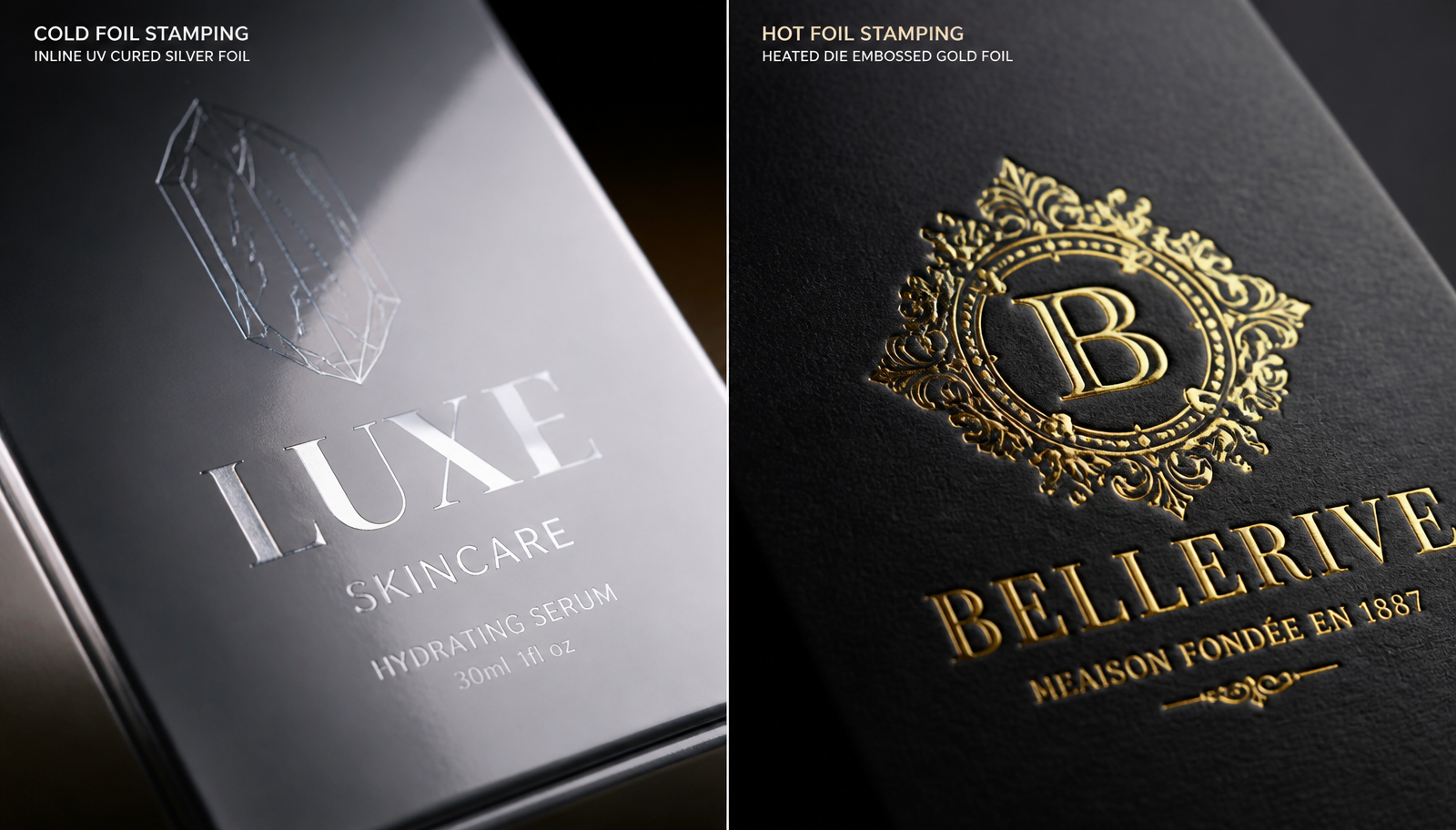
What is cold foil printing?
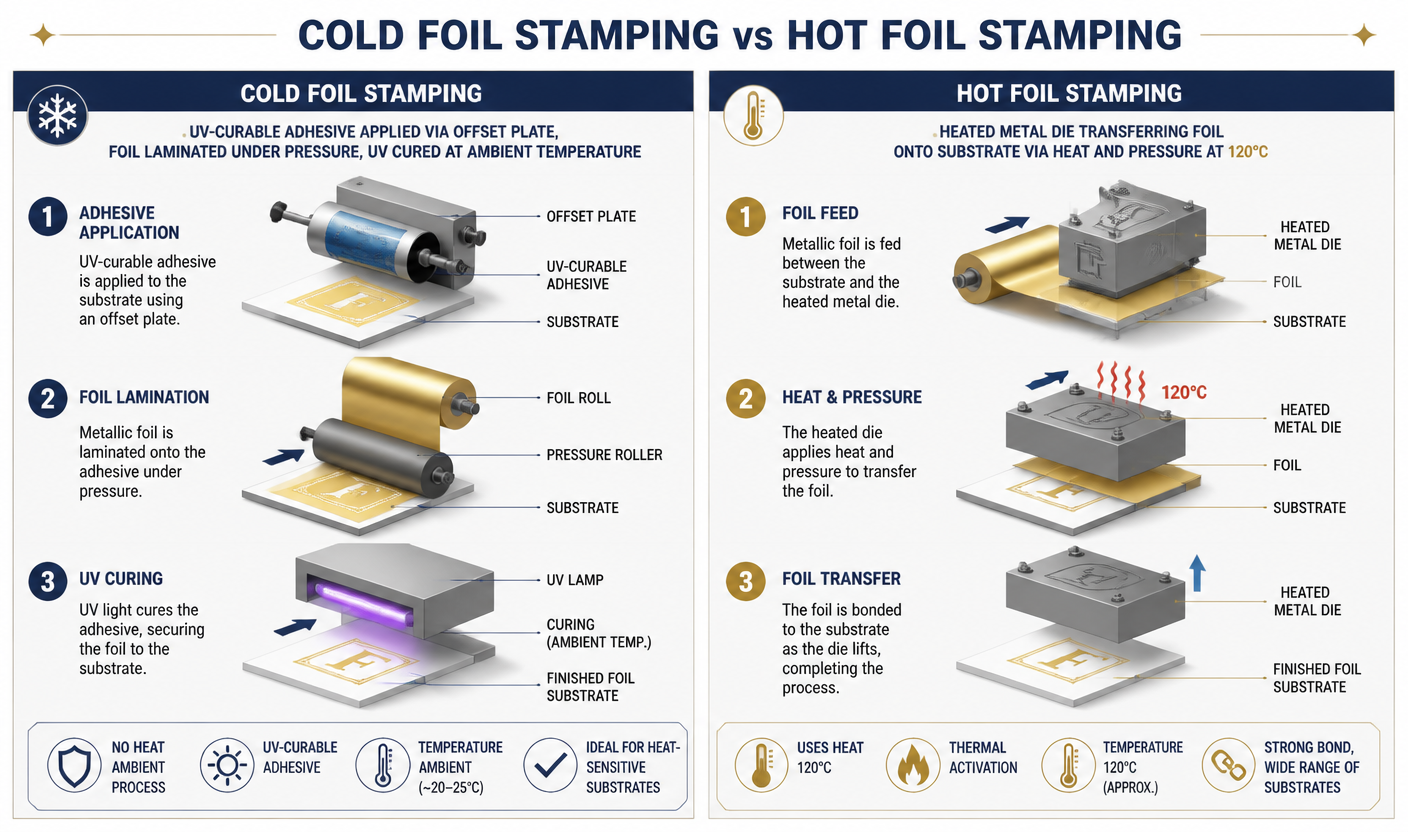
Cold foil printing is an inline metallization process integrated into a sheet-fed or web offset press. A UV-curable adhesive is printed onto the substrate from a standard offset plate in the exact shape of the artwork. A roll of metallic foil is then nipped against the wet adhesive between two rollers, and a UV lamp cures the adhesive in milliseconds. The non-adhered foil peels away on a take-up reel; the foil that touched adhesive stays permanently bonded.
Because cold foil is applied before the CMYK units on the same press, designers can overprint process inks on top of the foil to create gold, copper, pearl, holographic, and custom Pantone metallics from a single silver base. Learn more in our What Is the Cold Foil Technique guide.
What is hot foil printing (hot stamping)?
Hot foil printing — also called hot stamping or foil stamping — is an off-line, die-based process. A custom magnesium, copper, or brass die is engraved with the artwork, heated to roughly 110–135 °C, and pressed into a foil carrier laid over the substrate. The heat activates a thermal adhesive on the back of the foil, and the pressure simultaneously transfers foil and creates a tactile deboss of 60–120 µm.
Hot foil predates cold foil by more than a century and remains the default for premium book covers, wedding stationery, luxury cosmetics cartons, and any project where the buyer wants a finger-readable impression.
Cold foil vs hot foil: process diagram
Cold foil vs hot foil: complete comparison table
| Attribute | Cold Foil Printing | Hot Foil Printing |
|---|---|---|
| Heat required | No (ambient, ~20–25 °C) | Yes (≈120 °C die) |
| Tooling | Standard offset plate (~$50–150) | Custom engraved die ($150–800) |
| Setup time | 15–30 min (inline) | 45–90 min (off-line) |
| Press speed | 200–300 m/min | 30–80 m/min |
| Economical run length | 25,000+ impressions | 500–25,000 impressions |
| CMYK overprint | Yes (single pass) | No (separate pass) |
| Deboss / tactile depth | Flat (0–5 µm) | 60–120 µm |
| Heat-sensitive substrates | Excellent (films, shrink, thin papers) | Limited |
| Uncoated / textured stock | Good with primer | Excellent |
| Holographic foils | Yes | Yes |
| Edge sharpness on fine type <6 pt | Very high | High (depends on die) |
| Energy use per 1,000 sheets | ~0.8 kWh | ~2.4 kWh |
| CO₂e per 1,000 m² | ~45% lower | Baseline |
| Typical cost per impression (50k run) | $0.008–0.015 | $0.020–0.045 |
Cost and speed figures aggregated from FTA 2025 Cold Foil Industry Report and Finat Label Industry Statistics 2025.
How do I choose between cold foil and hot foil?
Answer these five questions in order:
- 1What is the run length? Above 25,000 impressions → cold foil. Below 3,000 → hot foil. Between the two, calculate setup amortisation.
- 2Do you need CMYK over foil? Yes → cold foil (single-pass overprint). No → either works.
- 3Is the substrate heat-sensitive? Films, shrink sleeves, thin papers <60 gsm, or thermal labels → cold foil only.
- 4Do you want a tactile deboss? Yes → hot foil (or hot foil + emboss combo). No → cold foil.
- 5What is the sustainability requirement? Retailer scorecards demanding lower Scope 3 emissions → cold foil.
For a deeper cost model see our Cost Difference Between Cold Foil and Hot Foil Stamping breakdown.
When cold foil wins
- Folding cartons for FMCG (beverages, cereal, cosmetics): inline CMYK + foil eliminates a finishing step.
- Pressure-sensitive labels on wine, spirits, and craft beer: 300 m/min web speeds keep pace with bottling lines.
- Flexible packaging films where heat would warp the substrate.
- Holographic security features on mass-produced cards and tickets.
- High-volume direct mail where unit cost matters more than tactile depth.
See real examples in our Cold Foil for Folding Cartons case study.
When hot foil wins
- Hardcover books, journals, and menus on cloth, leather, or uncoated cover stock.
- Wedding invitations and stationery where the deboss is part of the design language.
- Luxury cosmetics and spirits cartons with metal-effect monograms.
- Business cards on heavyweight uncoated cotton (300–600 gsm).
- Short runs under 3,000 pieces where die cost amortises quickly.
Expert perspective
“"Cold foil has matured into a production-grade process — we now run jobs at 250 m/min with edge definition that rivals hot stamping on coated stocks. For runs above 50,000, the math simply doesn't favour hot foil anymore." — FTA 2025 Cold Foil Industry Report, Section 4.2
“"Hot foil remains irreplaceable when the buyer can feel the finish. The tactile deboss is a brand cue luxury categories will not abandon." — Finat Label Industry Statistics 2025
Sustainability comparison
Cold foil's ambient-temperature curing eliminates the thermal load that dominates hot stamping's energy profile. Independent LCA data from the FTA 2025 Cold Foil Industry Report shows cold foil emits ~45% less CO₂e per 1,000 m² than equivalent hot foil work, and >97% of cold foil PET carrier waste is now recycled through closed-loop reclaim programs. See our Cold Foil Sustainability overview for the full data set.
Frequently asked questions
—Is cold foil cheaper than hot foil?
Yes — for runs above ~25,000 sheets. Cold foil is **35–60% cheaper per impression** at scale because there is no custom die, no warm-up time, and the foil is applied inline with CMYK. Below ~3,000 sheets, hot foil's lower setup overhead wins on unit economics.—Can cold foil match the shine of hot foil?
On coated and primed substrates, cold foil delivers **gloss values within 5–8% of hot foil** measured at 60°. On uncoated or heavily textured stocks, hot foil still produces a brighter, more mirror-like finish because the heat and pressure flow foil into the paper surface.—Does cold foil work on uncoated paper?
Yes, but it requires a sealer or primer coat to prevent the UV adhesive from soaking into the fibres. For pure uncoated work without primer, hot foil remains the safer choice — see [Which Is Better for Uncoated Paper: Cold Foil or Hot Foil?](/blog/which-is-better-cold-foil-or-hot-foil-for-uncoated-paper).—Can I overprint CMYK on hot foil?
No — hot foil is applied off-line after printing. Cold foil is the only process that lets you overprint process colours on top of foil in a single pass to create custom metallic colours.—Which process is more sustainable?
Cold foil. Ambient-temperature curing reduces energy use by ~65% per impression and total carbon emissions by ~45% per 1,000 m² compared with hot foil.—What is the difference between cold foil and digital foil?
Cold foil uses a UV adhesive applied via an offset plate; digital foil (Scodix, MGI JETvarnish) uses a digitally jetted clear coat that foil bonds to. Cold foil is faster at scale; digital foil is unbeatable for short runs and variable data.Bottom line
Cold foil and hot foil are not competing technologies — they are complementary tools in the modern foil-decoration stack. Cold foil owns high-volume packaging, labels, and CMYK-over-foil work. Hot foil owns short-run luxury, tactile deboss, and uncoated specialty stocks. The right choice is dictated by run length, substrate, finish depth, and sustainability targets — not preference.
Need help specifying foil for an upcoming job? Contact our cold foil engineering team for a free run-length and cost analysis.
---
Sources: FTA 2025 Cold Foil Industry Report; Finat Label Industry Statistics 2025; Smithers Pira Foil Decoration Market Forecast 2026–2031; internal benchmarking across 18 cold-foil-equipped offset presses.