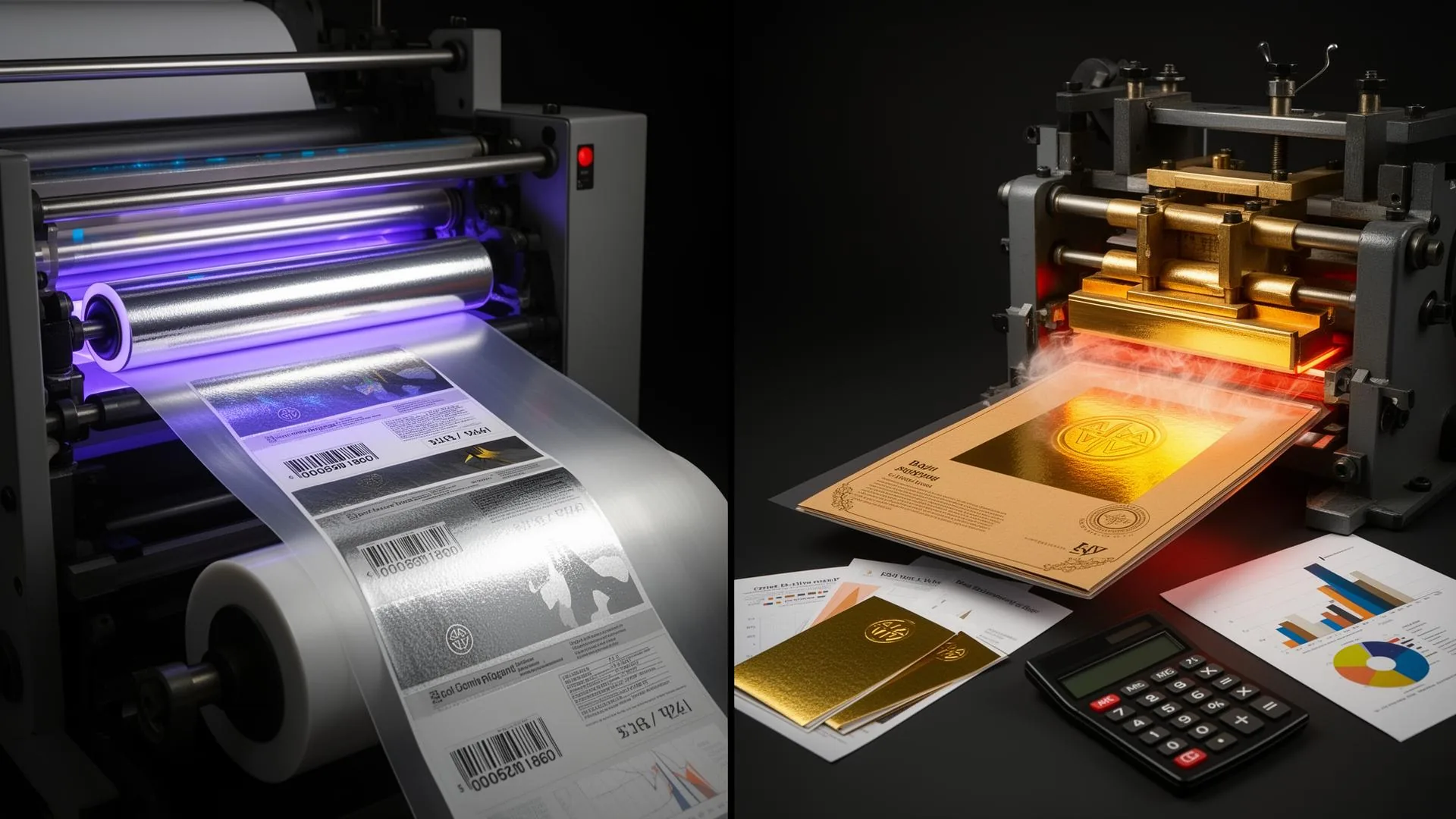
“TL;DR: Cold foil stamping is often more cost-efficient for inline, medium-to-long label or carton runs because it avoids heated metal dies and can run in the print line. Hot foil stamping can still be the better value for short premium jobs, heavy emboss-like effects, opaque coverage, or designs where tactile depth matters more than press speed.
The cost difference between cold foil and hot foil stamping is not a simple “one is cheaper” answer. It depends on tooling, setup time, press route, run length, substrate, waste, artwork coverage, finishing expectations and how many versions the brand needs. A buyer comparing quotes should ask for the total decorated-unit cost, not only the foil price.
Recent search intent around cost difference between cold foil and hot foil stamping shows a practical buyer question: teams are no longer only asking what the methods are; they want to know which process protects margin on real packaging programs. For process background, read How Cold Foil Stamping Works: Step-by-Step and the broader Hot vs Cold Foil Stamping: 2026 Buyer’s Guide.
According to Wikipedia’s overview of cold foil printing, cold foil printing—also called cold foil stamping—is a method for applying metallic foil to a substrate to enhance the final printed result. In practical production terms, that means cold foil uses a printed adhesive and pressure transfer, while hot foil stamping uses a heated die, foil and pressure. Those different mechanics are what drive the cost structure.
Quick cost comparison
| Cost factor | Cold foil stamping | Hot foil stamping |
|---|---|---|
| Tooling | Usually lower; uses printing plates or adhesive image carriers rather than engraved heated dies. | Usually higher; metal dies add cost and lead time, especially for multiple designs. |
| Setup time | Often lower when run inline with printing and UV curing. | Often higher because die mounting, heat, pressure and registration need more setup. |
| Press speed | Strong for high-volume labels and cartons when press conditions are stable. | Can be slower, especially on sheet-fed or post-press stamping routes. |
| Unit cost at volume | Often attractive for medium-to-long runs and versioned designs. | Can rise when die cost, makeready and slower throughput are spread over fewer units. |
| Visual effect | Excellent metallic shine; can be overprinted for color range. | Strong opaque metallic coverage, premium depth and sharper tactile luxury effects. |
| Best value fit | Labels, folding cartons, high SKU variation, inline production, fast turnaround. | Premium cartons, invitations, limited editions, heavy coverage, emboss-like finishing. |
The table shows why the cheapest quote may not be the best economic choice. Cold foil can reduce setup and tooling cost, but it may need careful adhesive control, UV curing and substrate qualification. Hot foil may cost more upfront, but the finish can justify the premium when the design needs dense metallic coverage or tactile impact.
Where cold foil usually saves money
Cold foil stamping usually saves money when the converter can run decoration inline with the main print process. Instead of moving printed sheets or labels to a separate hot stamping station, the foil can be transferred in the same production flow with UV adhesive, foil nip, curing and optional overprinting.
This matters for three reasons:
- 1Less dedicated tooling: cold foil normally avoids custom heated metal dies, which can reduce upfront cost on new designs or frequent SKU changes.
- 2Shorter turnaround: inline production can reduce handling, queue time and secondary finishing steps.
- 3Version flexibility: silver cold foil can often be overprinted to create gold, copper, bronze or brand-tinted metallic colors from one foil base.
A supplier such as K Laser describes the flexo cold foil sequence as printing cold foil adhesive, nipping foil onto the wet adhesive, curing through the foil with UV, and stripping the carrier away. That workflow explains why press integration and curing stability are central to cost control.
Cold foil is especially useful when a brand needs many similar labels or cartons with variable artwork. If every design requires a separate hot foil die, the fixed cost can climb quickly. With cold foil, the artwork change may be handled closer to normal print plate changes, depending on the press and adhesive system.
Where hot foil can be worth the higher cost
Hot foil stamping uses heat, pressure and a die to transfer foil. That extra tooling and setup often makes it more expensive at the start, but it can produce a premium result that cold foil does not always match. For luxury packaging, the business case may be based on shelf impact and brand perception rather than the lowest decorated-unit cost.
Hot foil can be the better value when the job requires:
- bold metallic solids with strong opacity;
- crisp edges on premium paper or board;
- tactile depth, debossing or emboss-like effects;
- small premium runs where appearance outweighs throughput;
- specialty finishes that need heat-and-pressure transfer behavior.
Packaging buyers should treat hot foil as a premium finishing investment. If the packaging sells a luxury product, a higher finishing cost may still be profitable when it supports price positioning, giftability or perceived quality.
Run length changes the answer
Run length is one of the biggest cost drivers. A short run has fewer units to absorb tooling, makeready and waste. A long run spreads fixed cost over more units, so press speed and waste rate become more important.
| Run profile | Cost-sensitive question | Likely direction |
|---|---|---|
| Prototype or sales sample | Which process can produce credible samples fastest? | Either process; choose based on target finish and supplier availability. |
| Short premium run | Is tactile luxury more important than unit cost? | Hot foil may justify the cost if the finish is central to the product. |
| Medium commercial run | Can the job run inline without rework? | Cold foil often becomes attractive if artwork and substrate qualify. |
| Long label run | Which route minimizes downtime, waste and handling? | Cold foil often wins when inline throughput is stable. |
| Many SKU versions | How many dies or setups are required? | Cold foil usually has an advantage when version count is high. |
This is why two suppliers can quote very different numbers for the same artwork. One may price a post-press hot foil route; another may price inline cold foil on a press already configured for metallic decoration. Ask each supplier to separate tooling, setup, material, waste allowance and production speed assumptions.
Hidden costs buyers often miss
The obvious cost items are foil, tooling and press time. The hidden costs are usually where the budget moves.
- Artwork adaptation: fine reverse type, large solids or tight registration can require file changes.
- Substrate testing: films, coated papers and cartons may need corona treatment, primer or different varnish plans.
- Waste during makeready: foil transfer, adhesive laydown and registration may take trial material before approval.
- Post-press protection: varnish, laminate or scuff testing can change the total cost.
- Quality risk: dull transfer, pinholes, lifting or cracking can create rework cost.
For terminology and material selection, see What Is Cold Stamping Foil?. For buyer-side questions before sampling, use Cold Foil Stamping Questions: What Packaging Teams Ask First.
A practical cost model for quotes
When comparing cold foil and hot foil quotes, ask converters to price the same assumptions:
- 1Finished quantity and overs allowance.
- 2Number of SKUs or artwork versions.
- 3Foil coverage percentage and location.
- 4Substrate, coating and post-print protection.
- 5Tooling or plate costs shown separately.
- 6Makeready time and waste assumptions.
- 7Expected production speed.
- 8Test requirements: rub, scuff, tape pull, crease, barcode scan and visual angle checks.
The U.S. EPA sustainable materials management hierarchy is a useful reminder that packaging decisions should consider waste and material efficiency across the whole system. A process that reduces rework, scrap or secondary handling may be more economical even if its foil material price is not the lowest line item.
Which process should packaging teams choose?
Choose cold foil stamping when speed, inline production, version flexibility and medium-to-high volume economics matter most. Choose hot foil stamping when the design depends on tactile luxury, dense foil coverage, specialty effects or a premium finish that justifies more setup and tooling cost.
The strongest buying process is not to ask “Which is cheaper?” but “Which process gives the required finish at the lowest approved total cost?” That keeps the decision tied to brand requirements, production reality and quality risk.
If your team is still defining the method, start with What Is the Cold Foil Technique?. If you are already preparing samples, share substrate, artwork, target finish, run length and quality tests with the supplier before requesting pricing.
Frequently asked questions
Is cold foil stamping cheaper than hot foil stamping? +
Cold foil stamping is often cheaper for inline, medium-to-long runs because it can reduce die cost, secondary handling and setup time. It is not always cheaper for every job; substrate testing, adhesive control and quality requirements still affect total cost.
Why does hot foil stamping cost more? +
Hot foil stamping often costs more because it uses heated dies, more setup control, heat and pressure adjustment, and sometimes a separate post-press operation. Those fixed costs are easier to justify on premium packaging where tactile metallic impact matters.
Which process is better for short runs? +
For short premium runs, hot foil can be worth the higher setup cost if the design needs tactile luxury or dense metallic coverage. For short runs with many versions or fast turnaround needs, cold foil may be more practical if the supplier already has inline capability.
What is the biggest hidden cost in foil stamping? +
The biggest hidden costs are usually makeready waste, artwork changes, substrate qualification and rework from transfer defects. Always ask suppliers to separate tooling, setup, waste allowance and finishing protection in the quote.
How should buyers compare cold foil and hot foil quotes? +
Compare the total decorated-unit cost using the same quantity, artwork, substrate, foil coverage, quality tests and delivery assumptions. Do not compare only the foil material price because tooling, speed, waste and setup often decide the real cost difference.