
Quick answer (lead block): Holographic cold foil is a metallized polyester film with a pre-embossed diffraction pattern, transferred onto a UV-curable adhesive inline on a flexo or offset press — no heat, no separate die. It runs at 180–300 m/min, costs 30–50% less than holographic hot stamping above 10,000 units, and produces full-spectrum rainbow, pattern and 3D holographic effects that overprint cleanly with CMYK. Best fit: premium packaging, security labels, beverage and beauty brands needing iridescent shelf-appeal at scale.
“TL;DR — Holographic cold foil in 2026: Holographic cold foil pairs the speed of cold foil transfer with embossed diffraction-grating films (radial, starlight, pillar, motion, pattern-pixel). It works with PE/PP/BOPP filmics, coated paper boards and SBS folding cartons, accepts water-based / UV inks and most overprint varnishes, and supports anti-counterfeit features like micro-text, hidden images and OVD (optically variable devices). Expect MOQs from 1,000 labels (digital) up to 25,000 (inline conventional), US lead times of 8–18 working days, and unit pricing from $0.05–$0.28 depending on foil coverage, pattern and substrate. This guide explains the process, design rules, finishing compatibility, cost model, recyclability and security applications so you can spec a holographic cold foil job correctly the first time.
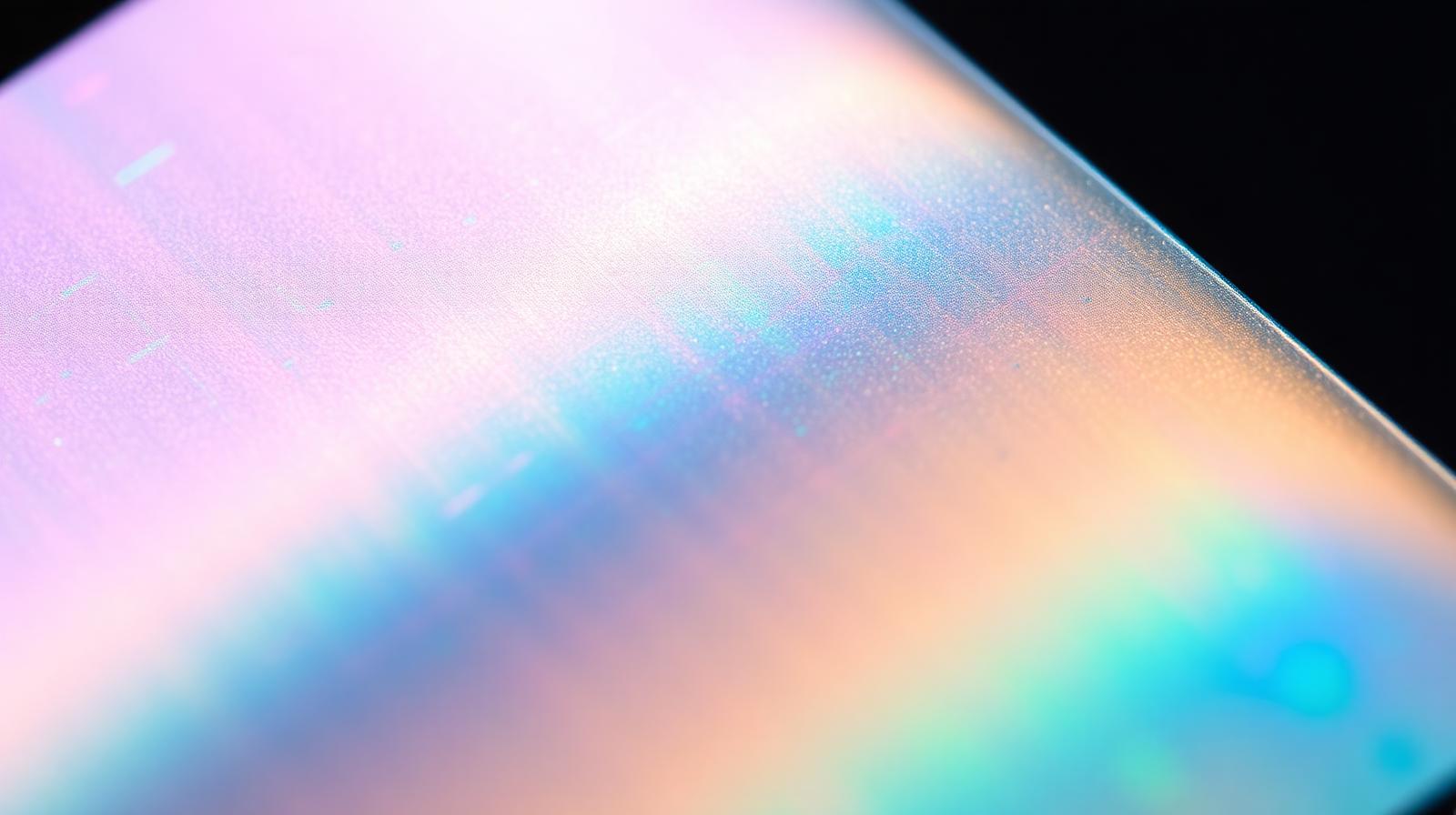
How holographic cold foil works: process and technical specifications
Holographic cold foil is a multi-layer transfer film — typically 12–23 µm total — built as: release layer (0.5–1 µm) on a PET carrier (12–19 µm), an embossed lacquer with the holographic diffraction grating (1–2 µm), a vacuum-deposited aluminum reflective layer (350–500 Å), and a heat/UV-activated sizing layer (0.5–1 µm). On press, the converter prints a UV-curable adhesive (cationic or radical, viscosity 80–200 cP) in the exact image area; the foil web is nipped against the wet adhesive at 2–6 bar transfer pressure; a UV-LED or mercury lamp (200–400 mJ/cm²) cures the adhesive through the transparent carrier; the carrier rewinds and the metallized layer stays bonded to the substrate.
Critical technical specs to request on every datasheet:
| Spec | Typical range | Why it matters |
|---|---|---|
| Total film thickness | 12–23 µm | Thinner = better register, lower cost; thicker = better edge definition |
| Aluminum optical density | 2.2–2.6 | Determines reflectivity and opacity over dark ink |
| Release value (peel) | 5–25 cN/25mm | Too high = dropouts; too low = pre-release on web |
| Adhesive viscosity (UV) | 80–200 cP @ 25 °C | Drives transfer sharpness on fine type |
| Cure energy | 200–400 mJ/cm² | Under-cure = poor adhesion; over-cure = brittle film |
| Press speed window | 60–300 m/min | Production economics vs. inline complexity |
For US food-contact applications, request a FDA 21 CFR 175.105 indirect-contact compliance letter for the adhesive system, and confirm the foil meets CONEG / Toxics in Packaging heavy-metal limits. For children's products, layered substrates also need CPSIA Section 101 / Section 108 documentation (lead and phthalate content). Reputable suppliers ship a 1-page technical data sheet covering thickness, release value, cure window, adhesion class (Tesa 4154 tape test), abrasion (Sutherland rub) and the regulatory letters above — if a supplier won't, treat it as a red flag.
Design and artwork preparation, press compatibility, and die registration
Designing for holographic cold foil is fundamentally different from designing for spot UV or hot stamping because foil follows the adhesive plate, not a die. That means register tolerance is the same as any other print station — typically ±0.1–0.15 mm on narrow-web flexo and ±0.05 mm on sheet-fed offset — so foil can sit inside or under CMYK without trapping nightmares.
Artwork rules that prevent re-runs:
- Build foil as a dedicated spot color named
ColdFoil(not "Pantone Silver"), set to Overprint Fill = ON, on its own top-of-stack layer. - Minimum positive line weight: 0.25 pt; minimum reverse line weight: 0.5 pt. Below that, the diffraction grating loses pattern fidelity.
- Minimum type size for foil-only text: 6 pt sans-serif / 8 pt serif. For foil under CMYK ("foil-on-foil + 4C"), bump to 8 pt / 10 pt.
- Avoid large solid panels >25 cm² in a single image area — pin-holing risk rises and holographic patterns appear visually flat. Break large fields with overprinted gradients or texture.
- Provide a knockout layer for any white-only artwork sitting on top of foil — white ink (titanium dioxide) needs the foil masked out to read clean.
Press compatibility & operating windows (typical narrow-web converter):
| Press type | Foil web tension | Transfer pressure | Cure source | Best applications |
|---|---|---|---|---|
| Narrow-web UV flexo | 1.5–3.0 N/cm | 2–4 bar | UV-LED 395 nm, 8–16 W/cm² | Pressure-sensitive labels |
| Sheet-fed UV offset | n/a (sheet feed) | 3–6 bar (impression) | UV-Hg, 120 W/cm | Folding cartons, premium boards |
| Hybrid digital + inline foil | 1.0–2.5 N/cm | 2–3 bar | UV-LED | Short-run beauty, beverage |
| Rotary letterpress (legacy) | 2.0–3.5 N/cm | 3–5 bar | UV-Hg | Wine labels, decorative |
Pre-flight checklist before sending files:
- 1Foil color named
ColdFoil, 100% tint, overprint ON. - 23 mm bleed, 3 mm safety margin, crop and registration marks on a dedicated layer.
- 3CMYK + Foil + Varnish + Diecut as separate spot layers; deliver as PDF/X-4.
- 4Confirm with the converter whether lamination (BOPP, PET, soft-touch) or overprint varnish is planned — some matte OPV chemistries reduce holographic brightness by 15–30% and need test pulls.
Visual effects, holographic pattern types, lamination and varnish compatibility
Holographic effect comes from the diffraction grating embossed into the lacquer layer before metallization, not from the metal itself. The grating geometry (line frequency, depth, orientation) determines how white light splits into the visible spectrum.
Common pattern types and best-fit applications:
| Pattern | Visual character | Best use | Brightness vs. plain silver |
|---|---|---|---|
| Rainbow / spectral | Continuous color shift across area | Confectionery, kids' products, party goods | 70% |
| Radial (sunburst) | Concentric rays from a focal point | Beverage caps, beauty closures | 80% |
| Starlight / pixel | Random twinkle, isotropic | Holiday packaging, premium boxes | 85% |
| Pillar / column | Vertical color streaks | Wine, spirits, supplement labels | 75% |
| Motion / 3D | Apparent depth or movement with tilt | Security seals, electronics, anti-counterfeit | 60% |
| Custom / brand logo | Embossed-to-spec geometry | High-end perfume, jewelry, security | 60–80% |
Overprint and varnish compatibility is the most under-discussed pitfall:
- Water-based inks (low surface tension <34 dyne/cm): wet out cleanly over foil; safest choice for full CMYK on foil.
- UV inks: excellent adhesion and brightness retention; verify with a Sutherland rub test (200 cycles, 4 lb) before committing the run.
- Aqueous (water-based) varnish: 5–15% brightness loss, retains the rainbow shift.
- UV gloss varnish: 0–10% loss; preferred for high-protection labels.
- UV matte varnish: 20–40% diffraction loss — the matte microstructure scatters the light that would otherwise diffract. Use spot-matte with foil knocked out under it, not flood matte.
- BOPP / PET lamination (gloss): minimal effect (<5%) — gloss lam is the safest premium finish.
- Soft-touch lamination: 30–50% loss; treat as effectively non-holographic — choose a flat metallic foil instead.
For US food packaging, water-based OPV over holographic cold foil with a FDA-compliant adhesive is the most common combination on candy, snack and beverage labels. For pharmaceutical labels (FDA 21 CFR 211), use UV gloss OPV with a documented rub-and-solvent resistance pull and lot-traceable foil.
Cost, lead times, MOQ, supplier selection and cold vs hot foil comparison
Cold foil unit cost is built from five inputs: (1) substrate, (2) foil consumption (running meters), (3) press time, (4) one-time tooling (plates, dies), (5) finishing. Holographic foil typically costs 15–35% more per running meter than plain silver cold foil because of the embossing master and lower yield, but eliminates the engraved-die cost that hot stamping requires.
Indicative US 2026 pricing model (narrow-web flexo, pressure-sensitive label, 4×3 inch, 30% foil coverage):
| Run length | Holographic cold foil | Holographic hot foil | Metallic ink + holographic varnish |
|---|---|---|---|
| 1,000 | $0.34 / label | $0.42 / label (+ $180 die) | $0.18 / label |
| 5,000 | $0.18 | $0.24 (+ die amortized) | $0.12 |
| 25,000 | $0.09 | $0.14 | $0.08 |
| 100,000 | $0.06 | $0.10 | $0.05 |
| 500,000 | $0.04 | $0.08 | $0.04 |
Typical MOQs and lead times (US converters, 2026):
- Digital + inline foil: MOQ 1,000 labels, 7–10 working days.
- Conventional UV flexo: MOQ 5,000–10,000 labels, 10–14 working days.
- Sheet-fed offset folding cartons: MOQ 2,500 sheets / ~10,000 cartons, 12–18 working days.
- Custom-embossed holographic master: +10–15 working days, $2,500–$8,000 tooling.
Cold vs. hot vs. metallic ink — ROI summary:
| Factor | Cold foil (holographic) | Hot foil (holographic) | Metallic ink + holo OPV |
|---|---|---|---|
| Brightness vs. true holographic | 95% | 100% (reference) | 35–45% |
| Inline overprint CMYK | ✅ same pass | ❌ requires second pass | ✅ |
| Tooling cost | $0 (digital plate) | $180–$2,000 per die | $0 |
| Speed | 180–300 m/min | 40–80 m/min | 250 m/min |
| Break-even vs. hot foil | ~3,500 units | reference | n/a (lower brightness) |
| Recyclability | Moderate (see below) | Moderate | High |
Supplier vetting checklist before placing your first PO:
- 1ISO 9001 + ISO 14001 quality and environmental management.
- 2G7 or Fogra PSO color management certification on the press running your job.
- 3Physical pre-production sample (not just a digital proof) on your specified substrate.
- 4Documented Sutherland rub (200 cycles, dry & wet) and Tesa 4154 adhesion results.
- 5FDA 21 CFR 175.105 letter for the UV adhesive (food-contact applications).
- 6CONEG / TPCH heavy-metal compliance for the foil.
- 7Batch traceability — foil lot number, adhesive lot, press log per delivery.
- 8Spare-roll commitment: ability to re-run within 10 working days at the same lot color.
Recyclability, sustainability, security features and practical applications
Recyclability picture (North American streams, 2026):
- Paper labels with cold foil < 4% area coverage: generally accepted in AF&PA Voluntary Standard 11 mixed-paper recycling streams; the aluminum is rejected at hydropulping screens.
- Paper labels with > 8% foil coverage: flagged as contaminant; recommend asking the substrate supplier for How2Recycle "Widely Recyclable" qualification testing.
- PET / PP filmic labels with cold foil: the metallized layer can interfere with PET-bottle NIR sorters when label-to-bottle area exceeds 40%. Use wash-off adhesives (e.g. APR-recognized) and keep foil < 50% of the label area.
- Folding cartons (SBS/CRB): the small foil mass typically meets WERF and CPA / FBA repulpability thresholds when foil is < 5% of board area.
For sustainability claims, request a third-party LCA (life-cycle assessment) comparing cold foil to hot foil on the same SKU — converters running modern UV-LED presses now show 30–60% lower energy use vs. hot stamping for the equivalent foiled area.
Security and anti-counterfeit features holographic cold foil supports:
- Micro-text (50–150 µm character height) embossed into the diffraction master — visible under 10× loupe, unreadable to scanners.
- Hidden images revealed only at specific viewing angles (latent images).
- Kinegram® / OVD-style 2D-to-3D animations with apparent motion or color flip.
- Covert nano-text (< 30 µm) authenticated under high magnification.
- Track-and-trace serialization when paired with inline inkjet variable data + cold foil.
Common US applications today: spirits and wine label decoration, beauty closures and cartons, supplement labels, gift-card and loyalty cards, pharmaceutical anti-counterfeit seals, premium candy and confectionery, electronics warranty seals, event tickets and IDs. Many large US CPG brands now spec holographic cold foil specifically because it gives both shelf-appeal and a hard-to-clone security layer in a single print pass.
Get a holographic cold foil sample pack
We ship A6 holographic cold foil sample swatches (rainbow, radial, starlight, pillar, motion) printed on your spec substrate, plus the technical data sheets, printable artwork templates (PDF/X-4 + AI), an 8-point pre-flight checklist and a FDA 21 CFR 175.105 indirect-contact letter for food-packaging buyers. US destinations typically receive samples within 5–7 business days. Request a sample pack → or send your artwork for a free DFM (design-for-manufacture) review →.
Related reading: Cold Foil Labels: The Complete 2026 Buyer Guide · Hot Stamping vs Cold Foil: Cost, Speed & Sustainability · Cold Foil Printing pillar page.
Frequently asked questions
Frequently asked questions
How does holographic cold foil printing work compared with hot foil stamping? +
Cold foil transfers a metallized holographic film onto a UV-curable adhesive printed inline by a flexo or offset plate, then cures with a UV lamp — no heat, no die, all in one pass. Hot foil uses a heated brass or magnesium die (110–130 °C) pressing foil onto the substrate offline. Cold foil runs 3–5× faster, eliminates per-design die cost, and overprints with CMYK in the same pass. Hot foil delivers slightly higher edge definition on very fine type below 6 pt.
What are the typical technical specs for cold foil (adhesive types, film thickness, release values)? +
Standard holographic cold foil is 12–23 µm total film thickness, with a vacuum-deposited aluminum layer of 350–500 Å (optical density 2.2–2.6), release value 5–25 cN/25mm, paired with a UV-curable adhesive at 80–200 cP viscosity cured at 200–400 mJ/cm². Always request the supplier's datasheet showing these values plus Sutherland rub and Tesa adhesion results.
Which substrates and inks are compatible with cold foil, and what should designers prepare? +
Holographic cold foil works on coated paper labels, BOPP/PE/PP filmics, SBS/CRB folding-carton board, and synthetic stocks like polyester. It accepts water-based, UV-flexo, UV-offset and most digital toner inks for overprint CMYK. Designers should deliver foil as a dedicated spot color called ColdFoil set to overprint, with minimum 0.25 pt line weight, 6 pt type, 3 mm bleed, and PDF/X-4 export.
How common is cold foil usage in packaging and are holographic cold foils rare? +
Cold foil is now the dominant metallic decoration method for narrow-web label converters and accounts for the majority of new metallic-label SKU launches in US beverage, beauty and supplements. Holographic cold foil is a sub-segment — roughly 15–25% of cold foil volume — driven by premium spirits, beauty, kids' products and security applications. It is not rare, but availability of custom-embossed holographic patterns requires 10–15 days extra lead time.
Can holographic foil or vinyl be peeled off, and does application method (hot vs cold) affect removability? +
Cold-foiled labels are decorated as part of the label itself, so the foil cannot be peeled separately — it lifts only if the entire label is removed. Adhesion to the substrate via the UV-cured adhesive typically meets the Tesa 4154 100% retention test. Hot-stamped foil behaves similarly when applied with the correct sizing. Decorative holographic vinyl (a cut-vinyl craft material) is a different product and is intentionally peelable.
What factors most affect the cost, MOQ and lead time for a cold foil project? +
The four biggest cost drivers are foil area coverage (running meters of foil consumed), substrate choice (filmic > coated paper > uncoated), press setup time and minimum run length, and whether a custom holographic master needs to be engraved ($2,500–$8,000 one-time). Digital + inline foil unlocks MOQs as low as 1,000 labels with 7–10 day lead times; conventional UV flexo typically requires 5,000–10,000 units and 10–14 working days.
How can cold foil be used for anti-counterfeiting and what testing or certifications support that use? +
Holographic cold foil supports micro-text (50–150 µm), latent images, OVD 2D-to-3D animation, covert nano-text (<30 µm), and serialization with inline variable data inkjet. Authentication is validated by 10× loupe inspection, UV/IR fluorescence (if taggants are added), and angle-flip verification. For regulated supply chains, pair the foil with ISO 12931 (anti-counterfeit performance) testing and lot-traceable batch documentation from the converter.