UV Cold Foil Adhesive: LED Compatibility and Press Selection
UV cold foil adhesive forms the printed image that bonds a cold foil decoration to paper, board or film. For UV LED cold foil, choose an adhesive grade specified for the actual press and curing source, then qualify it with the foil and substrate. The words "UV-curable" alone do not establish LED compatibility.
For a converter, the useful starting point is the complete job: printing process, film or paper grade, foil, adhesive, curing equipment and downstream ink or varnish. A roll that transfers cleanly still needs to meet the finished label or carton's agreed appearance and adhesion requirements.
Which cold foil adhesive fits your printing process?
Choose by the press and transfer arrangement before comparing chemistry names. UV flexo, UV/LED sheetfed offset and conventional sheetfed offset do not share one universal adhesive specification.
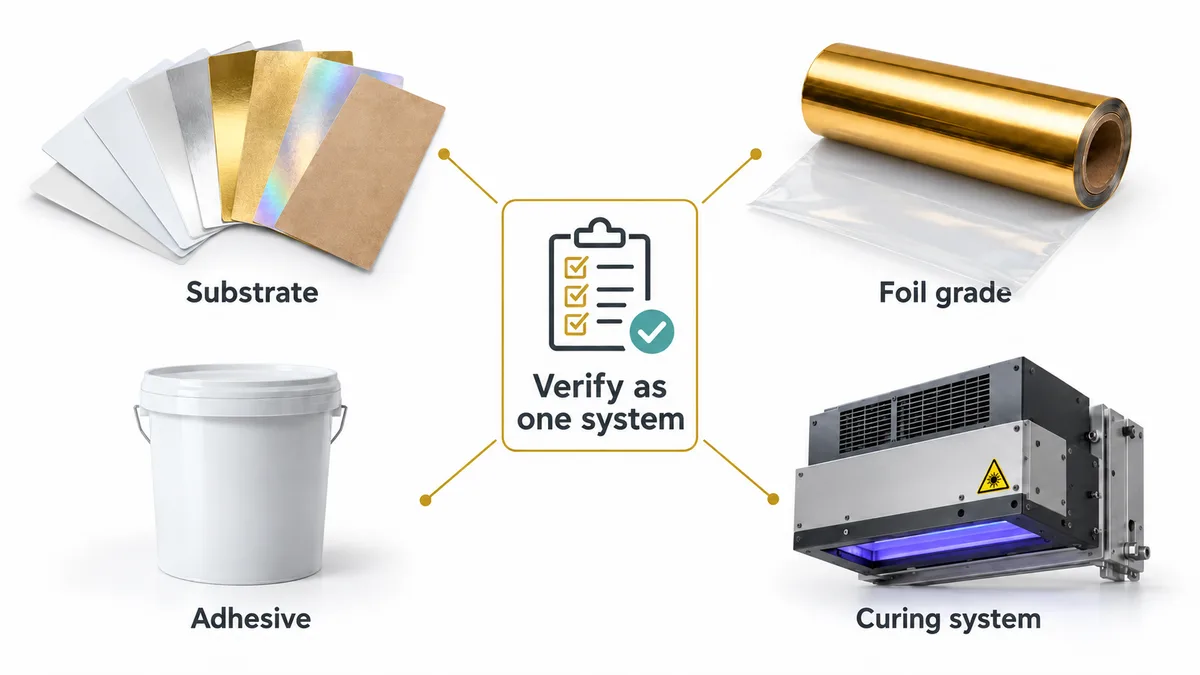
Cold foil is verified as one system: substrate, foil grade, adhesive and curing equipment are confirmed together in a press trial, not as separate approvals.
Cold foil adhesive selection by printing process
Process
What to confirm
What not to assume
UV flexo cold foil
Adhesive grade for flexographic application, foil compatibility and the specified curing arrangement
Do not use offset rheology and settings as the default flexo setup
LED-curing flexo
Supplier confirmation for the installed LED source and the complete transfer system
UV approval does not establish LED approval
UV/LED sheetfed offset
Offset application properties, compatible foil, curing source and overprint sequence
Flexo coating settings do not define an offset setup
Conventional sheetfed offset
Adhesive drying mechanism, foil match and finishing timing for that press
Confirm drying type rather than assuming UV is required
KURZ's sheetfed cold-transfer range distinguishes compatibility with UV and oxidation-conventional systems for its own products. Check which system your press actually uses before requesting material recommendations.
Yes, specifically formulated cold foil adhesives are available for LED or dual UV/LED curing. Approval applies to a particular grade and process, not to every product described as a UV cold foil adhesive.
When evaluating UV LED versus mercury curing, identify the installed source and obtain the adhesive supplier's conditions. Confirm whether the grade is LED-specific, mercury-specific or dual-cure. Follow any instructions concerning oxygen control, conditioning and subsequent printing; a chemistry label alone does not answer those questions.
Press checks before an LED change
Treat an LED conversion as a material-and-process change. Confirm the adhesive, foil and installed lamp arrangement together, even if the previous mercury-cured job ran successfully.
Record the lamp model and wavelength, working distance, press speed, measurement location and measured output using an instrument suitable for the source. Electrical input power is not optical irradiance in W/cm2 or delivered dose in mJ/cm2. A lamp-window specification should not be treated as a substrate-plane measurement. GEW's LeoLED brochure labels irradiance at the window and states its measurement conditions; its equipment figures are not adhesive acceptance limits.
In a through-cure arrangement, ask the suppliers to confirm the relevant foil grade and curing path. Inspect the actual transfer and finished construction at the intended production speed. Clean transfer by itself does not demonstrate that all required cure, adhesion and end-use checks have passed.
UV flexo transfer sequence
In a typical UV flexo through-cure configuration, the press prints an adhesive image, brings the foil into contact, cures the assembly in the specified arrangement and removes the carrier. The decorative layer remains in the selected areas; the PET carrier is rewound rather than left as a permanent laminate.
The detailed lamp position, contact arrangement and peel point follow the equipment and material instructions. Flint Group's archived Foilbond TC product brochure, marked with a 2012 version date, describes a through-cure UV adhesive for cold foiling. It illustrates the process; it does not establish current availability, LED suitability or production settings. Request the current technical sheet for the grade being considered.
Do not confuse transfer pressure with adhesive print pressure, or substrate thickness with foil-carrier thickness. Record each variable separately so a trial can be repeated.
Trial records for anilox, adhesive film and cure
Use the adhesive supplier's technical sheet and the press manufacturer's instructions to establish the trial conditions. The record below is a planning template, not a validated CFS operating window or a table of recommended settings.
Cold foil adhesive trial record template
Variable
Record for the trial
Why it matters
Substrate
Exact grade, coating or treatment, thickness/basis weight and lot
Generic "BOPP" or "paper" is not a complete material specification
Adhesive
Supplier, grade, batch and preparation instructions
Connects the run to a defined formulation
Foil
Grade, finish and batch
Keeps the transfer material identifiable
Adhesive application
Flexo anilox volume/screen and condition, or offset application setup
Defines how the adhesive image is produced
Curing
Lamp/source, wavelength, distance, measurement location, suitable instrument and measured conditions
Makes the curing arrangement reviewable
Running conditions
Speed, contact settings, web tension and peel arrangement as applicable
Helps separate material issues from setup changes
Final construction
Overprint inks, varnish/laminate, conditioning and agreed acceptance checks
Establishes what is actually being approved
Keep a known-good reference where available. Change one investigation variable at a time, record the result and retain labeled trial samples. Use the press setup checklist for the wider production handover.
Adhesion and overprint checks
Agree on checks for the actual construction with the converter, buyer and relevant material suppliers. Assess transfer quality, foil adhesion and ink/topcoat adhesion separately; one satisfactory result does not replace the others.
A tape test can help investigate removal, but record the tape, conditioning, procedure and failure location. ASTM D3359 was developed for coating adhesion on metallic substrates and notes limitations when used on other substrates. Do not turn a coating rating into a universal cold-foil label requirement. See the adhesion test guide for test planning.
Two questions help define the investigation. If foil is missing before overprinting, examine the adhesive image, material match, contact and curing conditions before attributing the loss to one cause. If the foil remains but the overprint ink comes off, investigate the ink/foil/topcoat combination and print sequence rather than automatically increasing adhesive delivery. Document the removed layer and retain a reference sample. For the broader diagnostic workflow, use the cold foil troubleshooting resource.
Send a complete compatibility brief
Send the job specification rather than asking for one adhesive that works on everything. Include the press and foil module, exact substrate, proposed foil and adhesive, curing equipment, target speed, artwork, overprint/topcoat and required trial-roll format.
For cold foil on BOPP labels, identify the specific film and treated printing side. For cartons, identify the board and coating. Include the finished package's acceptance requirements, and request applicable supplier documents where compliance matters. An LED or low-migration description alone is not approval for a food-contact packaging construction.
CFS supplies cold foil materials. When requesting samples, include the existing or proposed adhesive and curing details so the foil request can be evaluated against the actual job.
How much cure energy does cold foil adhesive need?
+
There is no single value for every adhesive, foil and press. Obtain the supplier's conditions for the exact grade, record how output is measured and verify the finished construction. Do not copy a generic mJ/cm² value from another process.
Does LED cold foil curing always require nitrogen?
+
Do not infer that from "LED" or "free-radical" alone. Follow the exact adhesive grade's technical instructions and the equipment arrangement. If the documents do not specify oxygen-control requirements, ask the supplier before defining the trial.
Can one adhesive be used on paper, BOPP and PET?
+
Some grades may cover several substrates, but approval on one material does not establish approval on another. Confirm each substrate's grade and printing surface, then check transfer, adhesion and subsequent printing on that construction.
Should I change anilox volume to solve pinholes?
+
First identify where the missing transfer originates. Adhesive delivery is one possible variable, alongside substrate, material match, contact and curing conditions. Inspect the image and consult the grade instructions before changing volume; record the change and compare the result.
Technical references
The linked supplier documents explain their own products or equipment; they do not establish CFS certification, reseller status or compatibility approval. Use current grade-specific technical sheets and a documented press trial for production decisions.