“Short answer. A credible cold foil recyclability claim should be supported by substrate information, CEPI or equivalent fibre-based packaging test references, 4evergreen-style recyclability evaluation logic, PET carrier handling details, adhesive and ink documentation, and clear limits on where the claim applies. Buyers should verify the full packaging structure, not only the foil layer.
Packaging buyers should not accept a simple "recyclable" claim without evidence. Cold foil recyclability depends on the substrate, adhesive, ink, varnish, transfer layer, PET carrier handling and the recycling stream used in the target market. This checklist explains what to ask for before approving cold foil for labels, folding cartons and premium packaging.
Last updated: July 2026 · Author: ColdFoilStamping technical team

Related reading: - Is cold foil recyclable? — baseline recyclability answer - Mono-material and recyclable packaging with cold foil — structural design considerations - Sustainability at CFS — supplier position and documentation
Why "Recyclable Cold Foil" Needs Proof
Recyclability is a packaging system claim, not only a foil claim. The same cold foil applied to a mono-material paperboard carton, a laminated pouch or a PET label behaves very differently in a recycling stream. Buyers should evaluate the full construction: substrate, adhesive, inks, varnish, coating, foil layer and the local recycling stream the package is disposed in.
Avoid unsupported "100% recyclable" claims. In the EU, UK and US, unsubstantiated environmental claims can be treated as greenwashing under consumer protection and packaging regulations. A defensible position requires valid test reports or protocol-based evaluations for the final packaging structure, not a component in isolation.
The 7 Proof Points Buyers Should Request
Use this table as a checklist when qualifying a cold foil supplier or approving a new SKU for a recyclability-linked claim.
| # | Proof point | Why it matters | What to ask the supplier | Related risk |
|---|---|---|---|---|
| 1 | Substrate specification | The base material (paperboard, BOPP, PET, PE) determines which recycling stream applies | Datasheet with fibre type, coating and basis weight | Claim aimed at the wrong stream |
| 2 | CEPI or equivalent test reference | Fibre-based packaging is typically evaluated with CEPI or similar mill-simulation methods | Whether the full printed structure has been assessed | Foil-only data used to claim full-pack recyclability |
| 3 | 4evergreen evaluation logic | Harmonised protocol for fibre-based packaging in Europe | How the pack maps to 4evergreen categories A–D | Category confusion in EU markets |
| 4 | PET carrier handling | The PET carrier is not part of the finished pack; how it is handled affects the supplier's sustainability profile | Collection, reduction and reuse practices for spent PET carrier | Assuming closed-loop where none exists |
| 5 | Adhesive and coating documentation | UV adhesive, primer and overprint varnish can affect de-inking and fibre yield | Adhesive chemistry, cure state and coating weight | De-inking failure or fibre contamination |
| 6 | Ink and varnish compatibility | Inks and OP varnishes can shift a pack across recyclability categories | Compatibility statement with the target recycling stream | Downgraded recyclability classification |
| 7 | Market-specific claim wording | US, EU and UK regulators use different definitions | Written claim wording the supplier is willing to stand behind | Regulatory or retailer challenge |
CEPI Recyclability Test Method: What Buyers Should Know
The CEPI Recyclability Test Method is a laboratory protocol for evaluating the recyclability of paper and board-based packaging. It emulates key recycling mill steps — pulping, coarse and fine screening, sheet formation and defect analysis — and produces measurable indicators such as fibre yield, sheet adhesion and optical inhomogeneities.
For cold foil specifically, buyers should verify:
- Whether the final printed structure (paperboard + primer + UV adhesive + foil + overprint) has been tested, not only the base board.
- Which version of the CEPI method was used (Version 3 is the current reference).
- Whether results were interpreted against a recognised evaluation scheme, for example the 4evergreen protocol or a national scheme.
A CEPI test on plain paperboard tells you almost nothing about how the finished cold-foiled carton behaves in a mill.
4evergreen Protocol: How It Helps Fibre-Based Packaging Claims
4evergreen is a cross-industry alliance that publishes a harmonised Recyclability Evaluation Protocol for fibre-based packaging in Europe. It uses CEPI-style laboratory results as inputs, then classifies packaging into recyclability categories (broadly A–D) based on how well the structure performs across a set of indicators.
For a cold foil buyer, 4evergreen is useful as a framework for asking better supplier questions:
- Which 4evergreen category does the current pack map to?
- Which structural elements (coating, foil coverage area, adhesive) pull the score down?
- What would need to change to move the pack up a category?
It does not "certify" cold foil. It provides a shared vocabulary so brand, converter and supplier discuss recyclability against the same reference.
PPWR Readiness: What EU Packaging Buyers Should Check
Under the EU Packaging and Packaging Waste framework, packaging placed on the market is moving toward mandatory recyclability by design and future performance grades. See the European Commission's overview of packaging waste rules for the current legislative direction.
For cold foil packaging sold in Europe, buyers should verify — with legal and technical documentation, not marketing copy — that:
- The pack has been evaluated against a recognised recyclability protocol (CEPI + 4evergreen or a national scheme).
- Foil coverage, adhesive and varnish choices do not push the pack out of the intended recyclability grade.
- Claim wording matches what upcoming grades will allow (avoid unqualified "recyclable" absent an approved grade).
Do not overstate PPWR readiness. The safer position is "designed with PPWR alignment in mind, verified against protocol X on date Y."
Cold Foil vs Hot Foil vs Metallized Film: Proof Requirements
Different decoration methods trigger different sustainability questions and different evidence needs.
| Decoration method | Main sustainability question | Evidence buyers should ask for | Best use case |
|---|---|---|---|
| Cold foil | Does the transferred foil + adhesive disrupt fibre recycling? | CEPI-style test on the full structure, adhesive datasheet, PET carrier handling statement | Selective decoration on paperboard, labels and BOPP |
| Hot foil | Does the die-applied foil layer separate cleanly in the mill? | Foil supplier statement, mill trial or protocol test on the printed pack | Small, high-impact decoration on premium cartons |
| Transfer metallizing | Is the metallized layer part of the fibre or applied as a film? | Coating specification, de-inking behaviour report | All-over metallic look on paperboard |
| Metallized film / laminate | Is the final pack mono-material or a multi-layer laminate? | Full layer stack, mechanical or chemical recycling pathway | Flexible packaging where metallic barrier is required |
Deeper comparisons: hot stamping vs cold foil, cold foil vs transfer metallizing and the is cold foil recyclable overview.
PET Carrier: What Happens After Transfer?
Cold foil is transferred from a PET carrier film during printing. The metallic layer releases onto the substrate wherever UV adhesive is applied; the spent carrier film is rewound as a separate waste stream.
Two points buyers often confuse:
- The PET carrier is not laminated onto the final package. This is fundamentally different from a metallized film laminate.
- Because the carrier is a separate waste stream, its recycling story lives with the converter, not with the finished pack.
Ask suppliers concrete questions:
- How is spent PET carrier collected on the press?
- Is it baled and sold to a recycler, downcycled, or landfilled?
- Are there measured reduction targets (grams of carrier per m² of decoration)?
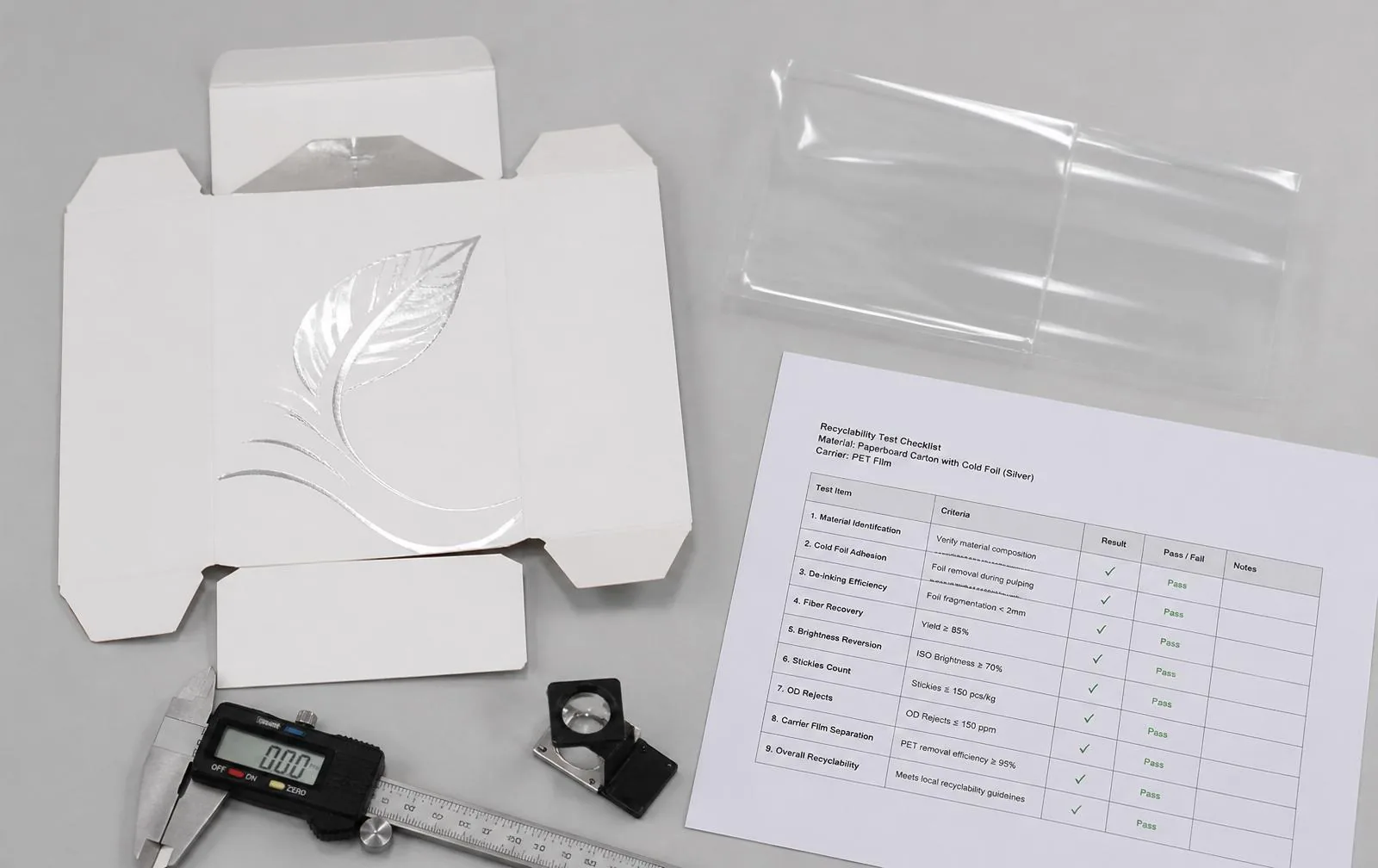
Do not claim "closed-loop PET carrier recycling" unless the supplier can prove the collection, transport and reprocessing chain end-to-end.
What Documents Should a Cold Foil Supplier Provide?
Use this checklist during supplier qualification. Not every document is relevant to every project — treat it as a menu of evidence to request based on the application.
- \u00a0Technical datasheet for each foil family and shade
- \u00a0Safety data sheet (SDS) where applicable
- \u00a0REACH declaration (EU market)
- \u00a0RoHS declaration (electronics and gifting)
- \u00a0FSC-related documentation for the paper substrate, where applicable
- \u00a0Food-contact or low-migration documentation for food, cosmetics and pharma packaging
- \u00a0PET carrier handling statement
- \u00a0Adhesive and coating compatibility statement
- \u00a0Recyclability test report or reference (CEPI, 4evergreen, national scheme)
- \u00a0Written claim wording the supplier will stand behind
Related resources: documentation library, sustainability position and the cold stamping foil quote checklist.
Buyer Checklist Before Making a Recyclability Claim
Before signing off on public copy, packaging artwork or a brand sustainability report, walk through this list with brand, legal and technical stakeholders.
- \u00a0Is the claim about the foil, the printed substrate or the final package?
- \u00a0Which market is the claim for (US, EU, UK, other)?
- \u00a0Which recycling stream is assumed (paper, PET, PE-flex, mixed)?
- \u00a0Has the full structure been tested, not only the substrate?
- \u00a0Are inks, varnishes and adhesives included in the evaluation?
- \u00a0Has the claim been approved by brand, legal and sustainability teams?
- \u00a0Can the supplier provide documents on request for an audit?
If any answer is "no" or "not sure", the safer route is to soften the claim wording until the evidence is in place.
Claim Wording: Safer Phrases vs Risky Phrases
Claim wording is where most cold foil sustainability disputes start. The table below compares common phrasing.
| Risky claim | Safer claim | Why |
|---|---|---|
| "100% recyclable cold foil packaging" | "Designed for recyclability when applied to compatible paperboard structures and verified against the target recycling stream." | Recyclability depends on the full structure and local stream |
| "Cold foil is always sustainable" | "Cold foil can reduce heat and tooling requirements compared with hot foil, but recyclability should be verified for the full packaging structure." | Sustainability is multi-factor, not a single-attribute label |
| "Fully compliant with PPWR" | "Designed with PPWR alignment in mind, verified against protocol X on date Y." | PPWR grades and thresholds are still being finalised |
| "Closed-loop PET carrier recycling" | "Spent PET carrier is collected and sent to a downstream reprocessor." | Closed-loop requires a verified end-to-end chain |
Third-party industry references such as the KURZ cold transfer sustainability benchmark can support the technical side of the claim, but they do not substitute for structure-specific test data.
When to Request Testing or Documentation
Request additional proof when any of the following applies:
- Selling into EU markets or preparing for PPWR grades
- Packaging for food, cosmetics or pharma end-uses
- Using BOPP, PET or coated films as the substrate
- Making any public recyclability claim (pack, website, brand report)
- Changing the substrate, adhesive, coating or varnish on an approved SKU
- Preparing a sustainability claim on behalf of a brand owner
For substrate- and application-specific starting points, see the cold foil sample kit, UV cold foil adhesive guidance and cold foil on BOPP labels. End-use pages that cover recyclability trade-offs include cosmetics, pharmaceuticals and cold foil packaging for food brands.
FAQ
—Is cold foil packaging recyclable?
Cold foil packaging can be recyclable when applied to a compatible substrate — most often paperboard — and evaluated against the target recycling stream. The metallic layer is very thin, but recyclability still depends on adhesive, varnish and local mill conditions. Verify with a structure-specific test rather than assuming.
—What proof should I ask for before claiming cold foil is recyclable?
Ask the supplier for: substrate specification, a CEPI or equivalent test reference on the full printed structure, mapping to a recognised evaluation protocol such as 4evergreen, PET carrier handling details, adhesive and varnish documentation and written claim wording. Combine these into a single evidence pack for brand and legal review.
—Does CEPI certify cold foil packaging?
No. CEPI publishes a test method, not a certification. Laboratories run the CEPI method on a specific packaging structure and produce measurable indicators. Interpretation against a recyclability grade is done through schemes such as 4evergreen or national protocols.
—What is the 4evergreen recyclability protocol?
4evergreen is a harmonised Recyclability Evaluation Protocol for fibre-based packaging in Europe. It uses CEPI-style laboratory data to classify packaging into recyclability categories. For cold foil buyers it is a framework for asking better questions, not a stand-alone certification.
—Does the PET carrier stay on the final package?
No. The PET carrier is a process film used to transfer the metallic layer during printing. Only the thin metallic layer (and adhesive) end up on the finished package. Spent PET carrier is a separate waste stream handled by the converter.
—Can cold foil be used for PPWR-ready packaging?
Cold foil can support PPWR-aligned packaging when applied to a recyclable substrate and evaluated against the intended grade. The safer position is to state alignment plus the specific protocol and test date, rather than claim blanket PPWR compliance.
—What documents should a cold foil supplier provide?
At minimum: technical datasheet, SDS where applicable, REACH and RoHS declarations, PET carrier handling statement, adhesive and coating compatibility statement, and a recyclability test report or reference for the final structure. Food, cosmetic and pharma applications should add low-migration or food-contact documentation.
Need documents for a cold foil sustainability review?
Send your substrate, application, destination market and claim wording. CFS can help you identify which cold foil documents, sample tests and supplier statements are relevant before brand approval.