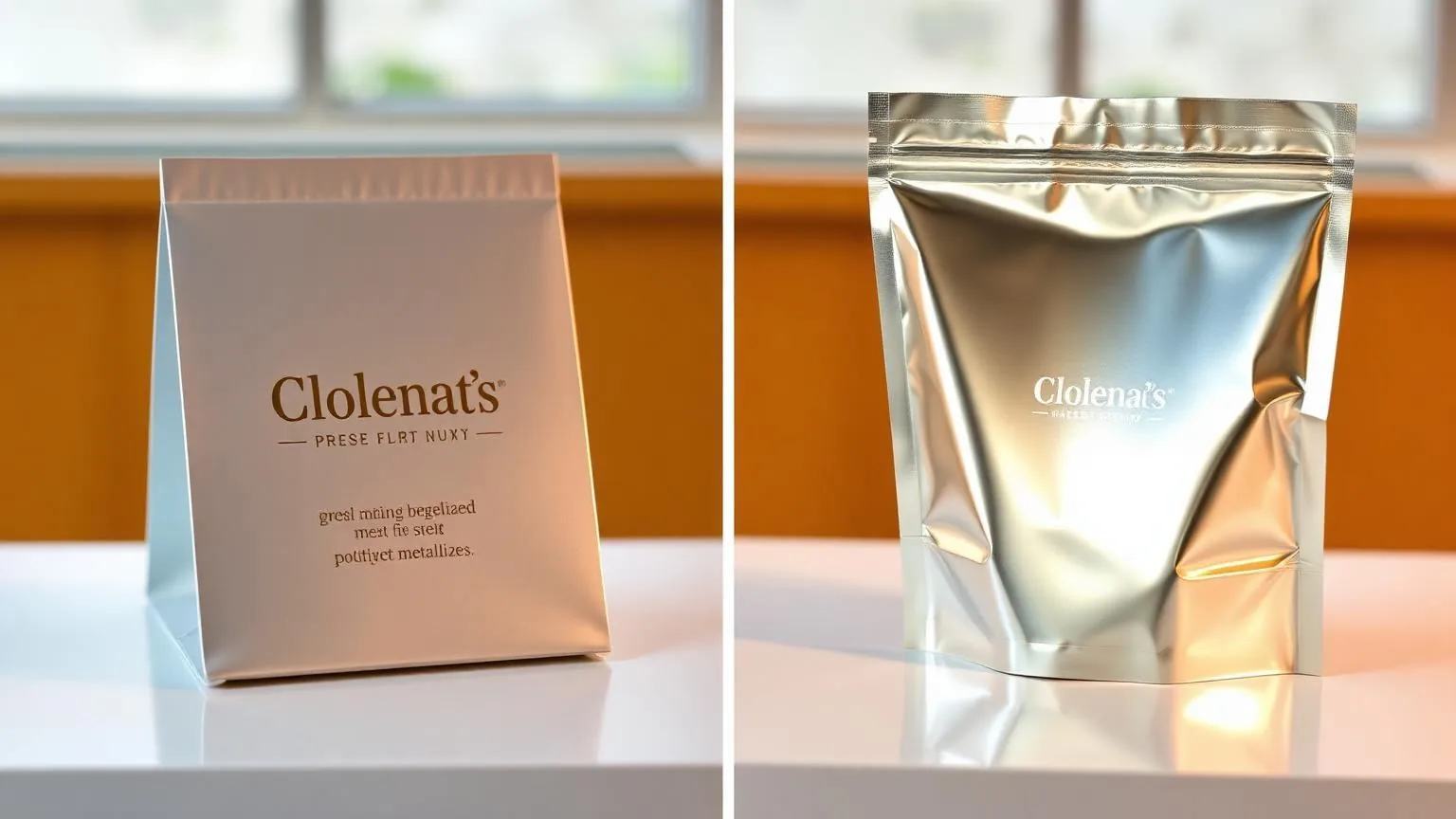
TL;DR. Cold foil stamping and transfer metallizing are not the same process, even though both transfer a thin aluminium layer from a PET carrier to a substrate. Cold foil is a selective, image-based decoration applied inline at the press where a UV-curable adhesive is printed only in the metallic image areas. Transfer metallizing — sometimes called transfer metallisation or metal transfer coating — is an all-over surface conversion done offline, where the entire web is laminated to a metallised PET carrier and the aluminium layer is released onto a continuous wet adhesive or lacquer to create a fully metallic substrate that is then overprinted. According to Smithers' 2026 decorative print outlook, the two technologies overlap in less than 8% of jobs — most packaging briefs map clearly to one or the other based on coverage area, substrate, and recyclability targets.
“"Cold foil and transfer metallizing share the same physics of release, but the press economics, coverage logic, and recycling pathway are completely different. Confusing them is the single most common error we see in packaging RFQs." — FlexoTech, Cold foil vs metallised laminates report 2025
---
1. The one-line difference
| Cold foil stamping | Transfer metallizing | |
|---|---|---|
| Where the adhesive sits | Printed only in the image | Coated over the entire web |
| What you get | A selective metallic logo, pattern, or text | A fully metallic surface ready to overprint |
| Stage | Inline on press | Offline, before printing |
| Typical coverage | 2–25% of the sheet | 100% of the sheet |
| Comparable alternative | Hot foil stamping | Metallised PET lamination |
If you only remember one thing: cold foil decorates an image; transfer metallizing converts a substrate.
2. How each process actually works
—Cold foil stamping (selective)
- 1UV-curable adhesive is printed by a flexo or offset plate only in the metallic image areas.
- 2A metallised PET carrier (the "cold foil web") is nipped against the wet adhesive.
- 3The aluminium release layer transfers wherever adhesive is present.
- 4UV lamps cure the adhesive; the spent PET carrier rewinds; the substrate continues into downstream printing units for overprint.
The full sequence is broken down in how cold foil stamping works step by step and the press hardware in our cold foil stamping machine guide.
—Transfer metallizing (all-over)
- 1The substrate (paper, board, film) is fed through an offline coater where a continuous wet lacquer or water-based adhesive is applied across the entire web width.
- 2A metallised PET donor film is laminated to the wet coating in a calender nip.
- 3Adhesive cures (thermal, UV, or air-dry depending on chemistry); the PET carrier is peeled and rewound.
- 4The result is a fully metallised substrate — visually identical to a metallised PET laminate but without the second plastic layer, since the aluminium sits directly on the paper or film.
- 5The metallised substrate is then sent to the printing press and run as a normal job.
Transfer metallizing was developed in the 1980s by Leonhard Kurz and API Group as a recyclable replacement for metallised PET laminates on paperboard. It is documented in the European Cartonboard Decoration Standards (ECMA).
3. Decision matrix — which one fits your job
| If your brief says… | Choose |
|---|---|
| "Metallic logo and a few accent rules" | Cold foil |
| "Metallic background across the whole pack" | Transfer metallizing |
| "Holographic pattern in a specific window" | Cold foil (often holographic cold foil) |
| "Replace our metallised PET laminate, keep board recyclable" | Transfer metallizing |
| "Short run, inline, no extra lead time" | Cold foil |
| "Long run, full coverage, 1M+ impressions" | Transfer metallizing |
| "Metallic under CMYK for rainbow effects" | Either — depends on coverage |
| "Mono-material flexible pouch" | Cold foil (see cold foil on flexible films) |
4. Cost, speed, and minimum run
Based on 2025 European converter benchmarks (FlexoTech 2025 cold foil report, PrintWeek decorative print survey):
- Cold foil unit cost for a 20% coverage carton: €0.018–€0.032 per impression at 250 m/min on a UV flexo line. Foil yield (the "foil economy") is the dominant variable — see our cold foil cost calculator.
- Transfer metallizing unit cost for a 100% coverage sheet: €0.045–€0.080 per impression at 80–120 m/min offline. Higher per-impression but vastly cheaper than cold foiling 100% coverage, where foil consumption would be prohibitive.
- Minimum economical run: cold foil starts around 3,000 impressions; transfer metallizing typically needs 20,000+ to justify the offline setup and donor-film changeover.
“Rule of thumb: cross over to transfer metallizing when metallic coverage exceeds roughly 35–40% of the sheet. Below that, cold foil wins on cost and lead time. Above that, the cold foil web waste collapses the economics.
5. Recyclability and EU PPWR 2027
Both technologies leave less than 5 g/m² of aluminium on the substrate — well under the 5% non-paper threshold tolerated by major European paper-recycling streams (CEPI recyclability guidelines 2024). That keeps cartonboard with cold foil or transfer metallizing classified as mono-material recyclable under EU PPWR 2027.
Both are therefore valid replacements for metallised PET lamination, which is not PPWR-compliant. The recyclability angle is covered in depth in Is Cold Foil Recyclable? and the mono-material conversion playbook in our mono-material recyclable packaging guide.
6. Visual differences a buyer will notice
- Edge sharpness: cold foil edges are as sharp as the printing plate — typically ±0.05 mm. Transfer metallised surfaces have no edges (full coverage) but show slight web-tension banding at very low magnification.
- Gloss level: transfer metallizing usually has higher gloss (mirror-bright) because the lacquer is laid down wet and the metal sits on a glassy film. Cold foil gloss depends on UV adhesive rheology and is roughly 5–10 GU lower at 60°.
- Tactile feel: transfer metallized substrates feel like a continuous film; cold foil leaves a barely perceptible embossed step at the image edge (~3–5 µm) — sometimes desirable, sometimes a complaint.
7. FAQ
Is transfer metallizing the same as vacuum metallisation? No. Vacuum metallisation evaporates aluminium directly onto a substrate inside a vacuum chamber — used to make the metallised PET film that feeds both cold foil and transfer metallizing. Transfer metallizing is the release step that moves that aluminium onto your packaging substrate.
Can I do both on the same job? Yes, and it is increasingly common for luxury wine and spirits — a transfer-metallised front panel for the background, then cold foil for a holographic seal or anti-counterfeit mark.
Which one prints CMYK better? Transfer metallizing — because the surface is uniform, ink film thickness stays constant. Cold foil overprinting requires tuning to avoid the "step" at the foil edge; the technique is in our CMYK over cold foil guide.
Does either work on uncoated paper? Cold foil — yes, with caveats covered in cold foil vs hot foil on uncoated paper. Transfer metallizing — generally no; it needs a coated or sized surface to hold the lacquer film.
8. The buyer's checklist
Before issuing an RFQ, confirm:
- 1Coverage area as a percentage of the sheet — drives the cold foil vs transfer metallizing fork.
- 2Substrate (cartonboard grade, film type) — drives adhesive chemistry.
- 3Print run length — drives minimum economical process.
- 4Recyclability target (PPWR, EPR, FSC chain of custody) — both qualify, but document it.
- 5Overprint requirements — CMYK on cold foil needs prepress prep (designer guide).
- 6Lead time — cold foil is inline; transfer metallizing adds 5–10 working days offline.
If you have a live brief and you are not sure which technology fits, send us the artwork and substrate — we will reply within one business day with a recommendation, a coverage calc, and a sample swatch.