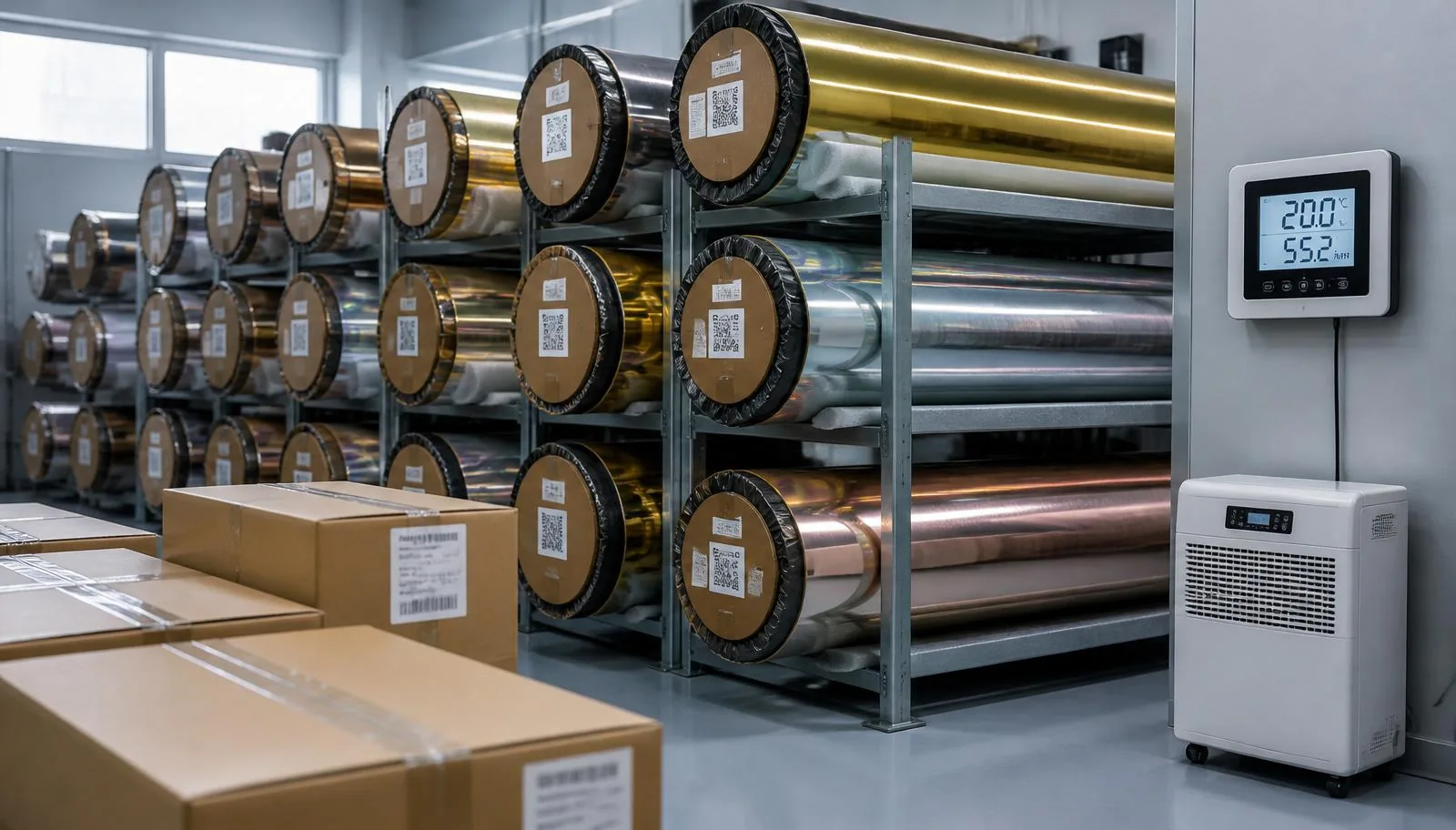
“TL;DR: Cold stamping foil is a layered polyester–aluminum composite with a shelf-sensitive release coat and size coat. Store rolls upright on end, sealed in original moisture-barrier packaging, at 20 ± 3 °C (68 ± 5 °F) and 50–60 % RH, away from UV, ozone and solvent vapours. Under those conditions, unopened rolls hold 12 months of full performance; opened rolls should be consumed within 6 months and re-sealed after each shift. Bad storage — heat, humidity swings, horizontal stacking — is the single most common root cause of pinholing, tunneling and adhesion loss on press.
Cold foil looks like a simple metallic film, but it is really a micro-engineered stack: a 12–23 µm PET carrier, a release layer that must let go at the right shear, a vapour-deposited aluminum layer ~40 nm thick, a colour lacquer, and a size (adhesive-receptive) coat. Every one of those layers ages — some faster than the roll's outer wrapper suggests. This guide gives US and EU converters, brand owners and print buyers a defensible storage and shelf-life protocol so the foil that arrives at your dock in January still prints cleanly in December.
For adjacent decisions, see our cold foil troubleshooting guide, cold foil for folding cartons and the cold vs hot foil printing guide.
Why cold foil shelf life is a chemistry problem, not a logistics one
The release and size coats are thermoset acrylic/urethane systems whose surface energy and tack are tuned during manufacture. Once the roll is unwrapped, three ageing mechanisms start:
- 1Moisture uptake — the size coat is mildly hygroscopic; above ~65 % RH it swells and softens, dropping cure speed and 180° peel strength on UV-adhesive presses.
- 2Oxidation of the aluminum layer — the 40 nm aluminium is protected by the colour lacquer, but edge exposure and pinholes in the lacquer let oxygen creep in and dull the L\* value over months.
- 3Migration between adjacent wraps — plasticisers from the size coat can migrate into the back of the neighbouring wrap; heat above 30 °C accelerates this into blocking (layers stuck together, foil tears on unwind).
A widely cited industry rule of thumb — echoed by Kurz technical bulletins and API Group storage notes — is the Arrhenius 10 °C rule: every 10 °C above 25 °C roughly halves the usable shelf life of a release-coated transfer foil. A roll rated 12 months at 20 °C may last only 3 months stored at 40 °C in an un-air-conditioned warehouse — a common failure mode in summer freight and Gulf-coast facilities.
Environmental targets and tolerances
| Parameter | Target | Absolute limit | Why it matters |
|---|---|---|---|
| Temperature | 20 ± 3 °C (68 ± 5 °F) | 5–30 °C | Above 30 °C accelerates blocking; below 5 °C the size coat embrittles |
| Relative humidity | 50–60 % RH | 40–70 % RH | High RH → soft size coat, adhesion loss. Low RH → static, dust pickup |
| Temperature swing | ≤ 5 °C / 24 h | ≤ 10 °C / 24 h | Cycling drives condensation between wraps |
| Light | Dark storage | No direct UV | UV embrittles PET and yellows lacquer |
| Airborne contaminants | Solvent-free, ozone < 0.05 ppm | — | Ozone from laser printers and forklift arcs pits the aluminium |
| Floor clearance | ≥ 100 mm off concrete | — | Concrete wicks moisture; pallets prevent bottom-wrap damp |
Log temperature and humidity continuously — a $30 Bluetooth data logger (e.g., Govee H5075, SensorPush HT1) placed on the foil rack gives 12 months of traceable data that satisfies most cosmetic and pharma packaging audits.
How to store rolls physically
- Upright on end, never horizontal. Horizontal stacking creates a flat spot on the bottom wrap after 2–3 weeks that prints as a repeating banded density defect every roll circumference.
- Original packaging until use — the black PE moisture-barrier bag and kraft end caps are engineered as a system. Once cut, re-seal with a foil-lined bag and desiccant, not household plastic wrap.
- First-In-First-Out (FIFO) — label every incoming roll with the arrival date and manufacture date (printed on the core sticker); pick oldest first.
- Segregate by shade family — never store fresh foil next to solvent-based inks, plasticised PVC, or fragrance concentrates. Vapour migration causes shade drift measurable at ΔE₀₀ 2–4 within 30 days.
- Do not stack pallets more than two high. Compression on the bottom pallet deforms cores and causes coning on unwind.
Shelf-life table by condition
| Storage condition | Unopened shelf life | Opened / re-sealed |
|---|---|---|
| Climate-controlled (20 °C, 55 % RH) | 12 months | 6 months |
| Ambient warehouse (25 °C, 60 % RH) | 9 months | 4 months |
| Un-air-conditioned (30–35 °C summer) | 4–6 months | 2 months |
| Cold storage (< 10 °C) | Not recommended | — |
These figures align with published guidance from major foil producers such as Kurz and Univacco, and with ISO 12647 print-quality expectations for commercial packaging.
Acclimation before running the press
Foil pulled from a cool store into a hot pressroom must acclimate before mounting, or condensation on the release layer will cause tunneling and dot loss.
- ≥ 24 h acclimation for full pallets or when the temperature delta > 10 °C.
- ≥ 8 h for individual rolls with a delta of 5–10 °C.
- Acclimate inside the sealed bag — opening early defeats the purpose by letting warm humid air condense directly on the foil.
A Fogra research summary on print material conditioning notes that "condensation on the running web is responsible for up to 30 % of unexplained coating failures in UV flexo lines" — cold foil is squarely in that risk band because its size coat is the first surface the UV adhesive contacts.
Warning signs that a roll has aged out
Before mounting, inspect every roll for:
- Edge oxidation — a dull grey halo 2–5 mm in from the roll edge indicates aluminium oxidation; expect ΔE shift and pinholing.
- Blocking — layers audibly "crackle" on unwind or the release feels heavier than a control roll of the same shade.
- Coning or telescoping — the wound roll no longer sits flat; caused by improper stacking or temperature shock.
- Lacquer haze — a milky bloom on the metallic surface; often reversible with 24 h at 25 °C / 50 % RH, otherwise scrap.
- Adhesion drop — a bench 180° peel test on a UV-adhesive coupon returning < 2.5 N/15 mm where the spec is 3.0+ N/15 mm.
Document every scrap decision with a photograph and the storage log — this closes the loop with the supplier for warranty claims and, for GMP-adjacent cosmetic and pharma cartons, satisfies traceability.
Practical storage room checklist
- Dedicated foil room or caged area, thermally isolated from the press hall
- HVAC setpoint 20 °C, humidifier + dehumidifier both plumbed
- Two data loggers on opposite walls, weekly download
- Racking with individual roll cradles, upright orientation
- No cardboard on the floor; epoxy or sealed concrete
- Dust curtains at doorways; sticky mats at entry
- Visible FIFO board and QR-scan pick log
- Ozone-generating equipment (laser printers, welders) excluded
- Quarterly audit: pull a random opened roll, run a peel test, log the number
FAQ
—What is the shelf life of cold stamping foil?
Under recommended storage (20 ± 3 °C, 50–60 % RH, sealed), unopened cold stamping foil rolls hold **12 months** of full performance. Opened rolls should be re-sealed with desiccant and consumed within **6 months**. Poorly stored rolls can degrade in as little as **3 months**.—Can cold foil be stored in a refrigerator or freezer?
No. Refrigeration causes condensation on the release and size coats when the roll is rewarmed, permanently damaging cure behaviour and adhesion. Store in a controlled ambient environment (18–23 °C) instead.—How should cold foil rolls be stored — upright or horizontal?
Always **upright on end**. Horizontal storage creates a flat spot on the bottom wrap after 2–3 weeks that prints as a repeating banded defect every roll circumference and can also deform the core.—Does humidity affect cold foil?
Yes. The size (adhesive-receptive) coat is mildly hygroscopic. Above 65 % RH it softens and loses UV-adhesive peel strength; below 40 % RH static electricity attracts dust and causes pinholing. Target **50–60 % RH**.—How long should cold foil acclimate before printing?
At least **24 hours** for full pallets or when the temperature difference between storage and pressroom exceeds 10 °C, and **8 hours** for individual rolls with a smaller delta. Acclimate inside the sealed moisture-barrier bag.—How do I know if a cold foil roll has expired?
Look for edge oxidation (dull grey halo), audible crackling on unwind (blocking), lacquer haze, coning, or a bench peel test result under 2.5 N/15 mm. Any one of these is grounds to quarantine the roll and file a supplier claim.Where to go next
- Match foil grade to substrate with our cold foil products catalogue
- Diagnose press-side defects using the cold foil troubleshooting guide
- Compare process economics in the cold vs hot foil printing guide
- Cosmetic-carton specific shade and adhesion targets: cold foil for cosmetic cartons
Reviewed by the ColdFoilStamping production and QC team, July 2026.