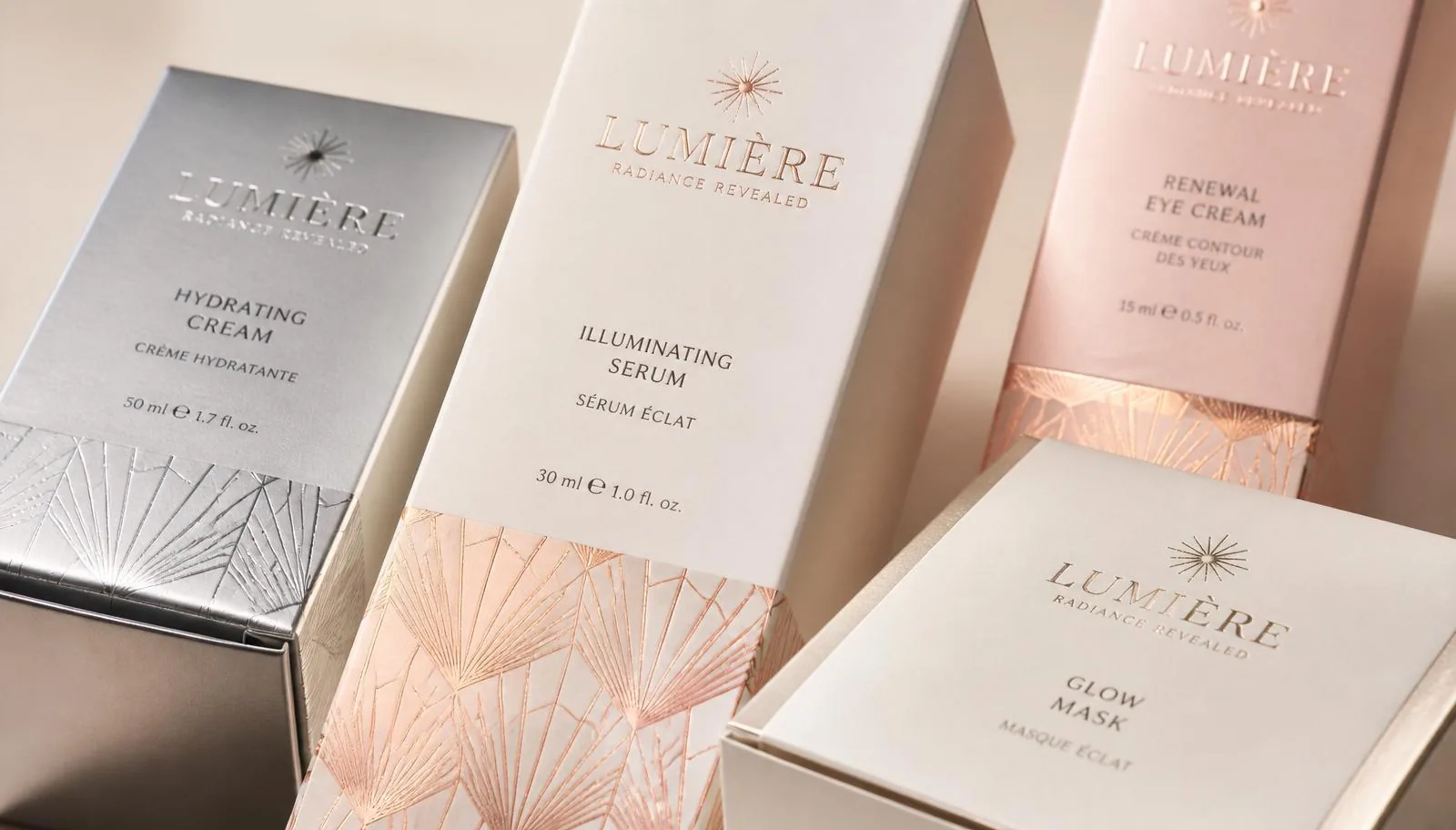
“TL;DR: For US cosmetic cartons, treat cold foil as a controlled color system, not a finish. Map every Pantone metallic to a physical foil swatch with a ΔE₀₀ ≤ 2.0 shelf tolerance, hold 180° peel strength ≥ 3.0 N/15 mm on SBS/CCNB stocks, and pre-qualify overprint inks and clearcoats on the exact foil–substrate–adhesive stack before pilot. Get those three variables under measurement and shelf consistency follows.
Beauty buyers make a pack decision in ~0.4 seconds on shelf, and metallic uniformity is the single strongest cue for perceived quality. Yet most cold-foil briefs for cosmetic cartons — lipstick, mascara, serum, prestige skincare — still ship without quantified shade tolerances, without measured adhesion targets, and without a documented overprint compatibility matrix. This guide closes those three gaps for US-market cosmetic packaging teams. For adjacent decisions (heat-sensitive films vs board, cost curve, versioning), see our hot vs cold foil stamping guide and the cold foil stamping cost calculator.
Shade matching and color consistency for cosmetic cartons
Metallic cold foil does not behave like a process color: it has a specular (mirror) component plus a diffuse component, and the visible shade shifts with viewing geometry. A rigorous shade programme for cosmetic cartons therefore controls four variables in parallel: foil base tone (silver, pale gold, bright gold, rose, holographic), CMYK tint printed on top, substrate whiteness, and clearcoat gloss.
Build a measurable Pantone-to-foil map. For each Pantone Metallic or brand PMS spot, pull down at least three foil-plus-tint candidates on the actual carton stock and measure with a multi-angle spectrophotometer (e.g., X-Rite MA-5 QC or BYK-mac i) at 15°, 45°, and 75°. Record Lab* at each angle and compute ΔE₀₀ against the brand master. For shelf-critical shades — nudes, roses, warm golds keyed to skin tones — hold ΔE₀₀ ≤ 2.0 at 45° and ≤ 3.0 at grazing angles; commodity metallics can run ΔE₀₀ ≤ 3.5.
Three-stage sign-off, not one. A defensible cosmetic-carton shade workflow runs (1) a digital proof with an ICC profile that includes metallic substrate simulation, (2) a physical drawdown of the exact foil-plus-tint on production board, and (3) a press-side critical-color OK sheet approved under D65 at 45°/0° viewing, per ISO 3664. Log the spectrophotometer serial and a gloss reading (60° gloss units) alongside each approval so re-orders anchor to measured data, not memory.
Our foil products catalogue lists the base shades that anchor cosmetic ranges — pale gold and rose for warm skincare, bright silver for prestige serums, holographic for limited editions — and the cosmetics application page shows worked examples.
Adhesion: substrates, primers, and quantitative testing
Adhesion is where most cold-foil cosmetic programmes silently under-perform. The bond depends on substrate surface energy, UV-adhesive chemistry, foil release value, and line speed — and few converters publish target numbers by board type.
Board-by-board baseline peel targets:
| Substrate | Surface energy target | 180° peel target (N/15 mm) | Primer recommendation |
|---|---|---|---|
| SBS (bleached sulphate) | ≥ 40 dyne/cm | ≥ 3.5 | Optional — UV acrylate direct |
| CCNB (coated recycled) | ≥ 38 dyne/cm | ≥ 3.0 | Water-based sealer, 1.5–2.5 gsm |
| FBB / GC1 coated board | ≥ 40 dyne/cm | ≥ 3.2 | Optional |
| Recycled fibre (uncoated top) | ≥ 36 dyne/cm | ≥ 2.5 | UV primer, 2–4 gsm mandatory |
| Metallised PET liner | ≥ 42 dyne/cm (post-corona) | ≥ 2.8 | Corona ≥ 42 dyne + tie-coat |
Run three physical tests every job, not just eyeball:
- 1Surface energy (dyne) — test inks per ASTM D2578; corona-treat or apply primer if any single face reads below target.
- 2180° peel per ASTM D903 — cut 15 mm strips, condition 24 h, pull at 300 mm/min on an Instron or Chatillon frame. Log the average peel and the mode of failure (cohesive within adhesive is ideal; interfacial at the foil-substrate boundary is a fail).
- 3Sutherland rub, 4 lb, 200 cycles per TAPPI T830 — pass criterion is ≤ 5% metallic loss versus a fresh sample under D65 visual inspection.
If any test fails, the corrective ladder is: primer weight up → corona re-treat → adhesive chemistry change → substrate change. Skipping the ladder and jumping straight to a new foil almost never solves an adhesion problem.
Overprintability: inks, varnishes, and drying/curing interactions
Overprinting cold foil is where cosmetic brands unlock coloured metallics — rose gold from silver-plus-magenta, warm bronze from silver-plus-yellow-plus-tint — but it is also where most flaking, discolouration and clearcoat-lift complaints originate. The physics: cold-foil aluminium is only 30–80 nm thick with a UV-adhesive tie-coat underneath, so overprinted inks and clearcoats must not swell the adhesive, migrate through the metal, or exceed the peel bond during cure.
Ink chemistry, ranked by cosmetic-carton track record:
- LED-UV inks — first choice. Low heat load, high double-bond conversion, minimal photoinitiator migration. Compatible with low-migration series (e.g., Sun Chemical SunLit LED-UV MP, Flint EkoCure LED). Set cure at 500–800 mJ/cm² measured with an EIT Power Puck.
- Conventional UV (mercury lamp) — strong performer if lamp output is controlled; risk is over-cure yellowing on pale gold and rose bases. Cure at 150–220 mJ/cm² UVA.
- Water-based flexo — safe on coated SBS/FBB, but requires hot-air drying that can lift edges on wide foil coverage. Limit to accent tints, not full-flood overprint.
- Solvent-based — avoid on cold foil for beauty. Solvents can swell UV-cure adhesives and cause micro-blistering under gloss varnish within 30–60 days.
Clearcoats and varnishes. Use low-migration UV gloss or matte rated for direct food/cosmetic contact, applied at 3–6 gsm. In-line matte-over-gloss and spot-gloss-on-matte are both viable on cold foil, provided the underlying foil–adhesive stack has cured a minimum 500 mJ/cm² before the varnish station. Validate every combination with a methyl ethyl ketone (MEK) double-rub test (100 rubs), a cross-hatch tape pull per ASTM D3359, and a 40 °C / 75% RH accelerated ageing panel for 7 days before signing off.
Press setup, process control, and die-cutting durability
Cold foil for cosmetic cartons is nearly always run inline on a UV flexo or hybrid offset+flexo carton press. The parameters that separate consistent shelf output from intermittent flaking are the ones converters rarely publish:
- Line speed: 100–250 m/min is the sweet spot for cosmetic-grade coverage. Above 250 m/min, adhesive dwell under the nip drops and edge definition softens.
- Nip pressure at the transfer station: 2.5–4.0 bar, tuned to hit ~0.15 mm compression on 300 gsm board. Under-pressure gives voids; over-pressure crushes board and telegraphs to the finished lid.
- Foil web tension: 8–14 N across a 340 mm web, held to ±0.5 N. Higher tension causes tear at fine hairlines; lower causes wrinkle.
- Anilox for UV adhesive: 8–12 cm³/m² volume, 400–500 lpi, 60° hexagonal. Adjust up 1–2 cm³/m² on uncoated or recycled stocks.
- UV cure between adhesive and foil transfer: 180–260 mJ/cm² UVA measured at web height, immediately before the peel roller.
Die-cutting and creasing on cold-foiled cartons. The failure mode to defend against is hairline cracking along creases and micro-flaking at the cut edge. Best practice:
- Score-first, foil-second is not possible inline — instead, use rounded creasing rules (0.71 mm tip radius) at the finishing station and back the crease with a matrix 0.4 mm deeper than a non-foiled equivalent.
- Die-cut on a magnetic cylinder with a rotary die at 4–7° oblique to the foil grain — perpendicular cuts amplify flake.
- On embossed foil areas, keep emboss depth ≤ 0.4 mm and use a female counter made from fibreboard, not phenolic, to reduce foil abrasion.
A QC checklist on every make-ready: peel strip test, MEK 100-rub, cross-hatch, 45° gloss reading, ΔE₀₀ on the OK sheet, and a torn-crease inspection at 10× magnification. Reject and re-set on any single fail.
For a full press-side walkthrough of the underlying process, see our step-by-step cold foil stamping guide.
Regulatory, sustainability, storage and supplier specifications
For US-market cosmetic packaging, cold foil sits under FDA 21 CFR 175/176 indirect-food-contact framing where the carton contacts inner sachets, and under CTFA/PCPC industry guidance for outer decoration. Ask every foil supplier for: (1) a migration statement referencing EU 10/2011 as a proxy where applicable and confirming compliance with US indirect-contact thresholds; (2) a heavy-metal report covering Pb, Cd, Hg, Cr(VI) below CONEG 100 ppm total; (3) a photoinitiator list for the UV adhesive with proof of low-migration grade (e.g., no benzophenone in the food-contact stack); (4) an MSDS for adhesive and release layer; and (5) shelf-life and storage data.
Sustainability language must be defensible. Cold-foiled paperboard cartons are repulpable in most US mill streams because the aluminium load is a fraction of a gram per pack and the PET carrier is stripped as production waste; they are not compostable and should not be described as such. See our is cold foil recyclable? guide for the full argument and supporting data.
Storage & handling — cold-foil rolls: 18–24 °C, 40–60% RH, upright, away from direct sunlight, used within 12 months. Finished cartons: palletise foil-face-to-foil-face with slip sheets, no shrink-wrap in direct contact with metallised areas.
Next steps
If you are specifying cold foil for a US cosmetic carton programme, request a cold foil sample pack with your target Pantone metallics and board grade — we return physical drawdowns with measured Lab* and peel data on your substrate within 10 business days. Bring three inputs to the first call: (1) a Pantone or brand-master target with an acceptable ΔE tolerance, (2) a substrate spec sheet including surface energy and coating type, and (3) the overprint ink and clearcoat you intend to run. That triage collapses six weeks of iteration into two.
For adjacent cosmetic-decoration decisions — folding cartons in general, luxury pack construction, and pharma/dermo crossover — see /applications/folding-cartons and /applications/cosmetics.
FAQ
—How do I match a Pantone metallic or skin-tone shade with cold foil and measure acceptability?
Pull three foil-plus-tint candidates on the actual carton board, measure Lab* with a multi-angle spectrophotometer at 15°/45°/75°, and hold ΔE₀₀ ≤ 2.0 at 45° for shelf-critical shades (nudes, warm golds, roses) and ≤ 3.5 for commodity metallics. Sign off under D65 at 45°/0° per ISO 3664 and archive gloss (60° GU) alongside each approval so re-orders anchor to measured data.
—What are target peel strength values for cold foil on common folding carton stocks and how are they tested?
Test 180° peel per ASTM D903 / ISO 29862, 15 mm strips, 300 mm/min, 23 °C / 50% RH, 24 h post-cure. Targets: SBS ≥ 3.5 N/15 mm, coated FBB ≥ 3.2, CCNB ≥ 3.0, recycled uncoated ≥ 2.5, metallised PET liner ≥ 2.8. Failure mode must be cohesive within the adhesive layer; interfacial failure at the foil–substrate boundary is a reject.
—Which ink types and clearcoats are reliably compatible for overprinting cold foil without flaking or discoloration?
LED-UV inks are the safest first choice (500–800 mJ/cm² cure) with low-migration photoinitiator packages; conventional UV works with tight lamp control (150–220 mJ/cm² UVA); water-based flexo is fine for accent tints on coated board; solvent inks should be avoided — they swell UV adhesives and cause micro-blistering over 30–60 days. Pair with low-migration UV gloss or matte varnish at 3–6 gsm, validated by MEK 100-rub, ASTM D3359 cross-hatch, and 7-day 40 °C / 75% RH ageing.
—What press settings reduce delamination during inline cold-foil application?
Hold line speed 100–250 m/min, nip pressure 2.5–4.0 bar, foil web tension 8–14 N ± 0.5 N across a 340 mm web, UV adhesive anilox 8–12 cm³/m², and adhesive cure 180–260 mJ/cm² UVA just before the peel roller. Every make-ready gets a peel strip, MEK 100-rub, cross-hatch, and ΔE₀₀ on the OK sheet before running production.
—How does cold foil affect die-cutting, folding, embossing durability and what process tweaks prevent cracking?
Use rounded creasing rules (0.71 mm tip radius) with a matrix 0.4 mm deeper than a non-foiled equivalent, orient rotary die cuts 4–7° oblique to the foil grain, and cap emboss depth at 0.4 mm with fibreboard female counters. Inspect creases at 10× magnification for hairline cracks and edge flake — either is an immediate reject.
—What regulatory tests or manufacturer declarations are needed to confirm cold foil is safe for cosmetic packaging in the US?
Request from your foil supplier: (1) a migration statement against FDA 21 CFR 175/176 for indirect food contact and EU 10/2011 as a proxy where relevant; (2) a CONEG heavy-metal report (Pb, Cd, Hg, Cr(VI) ≤ 100 ppm total); (3) the UV adhesive photoinitiator list with low-migration grade evidence; (4) MSDS for adhesive and release; and (5) shelf-life and storage data. For cosmetic-only outer decoration, align to CTFA/PCPC industry guidance.
—How should cold-foiled cartons be stored and handled to preserve adhesion, shade, and shelf-life?
Store foil rolls upright at 18–24 °C and 40–60% RH, out of direct sunlight, and consume within 12 months of manufacture. Palletise finished cartons foil-face-to-foil-face with slip sheets and avoid shrink-wrap in direct contact with metallised areas. Ship in temperature-controlled trailers where transit exceeds 32 °C to prevent adhesive softening and gloss shift.
Reviewed by the ColdFoilStamping technical team — press engineers commissioning inline cold-foil lines for US and EU cosmetic-carton converters. Last updated 2026-07-16.