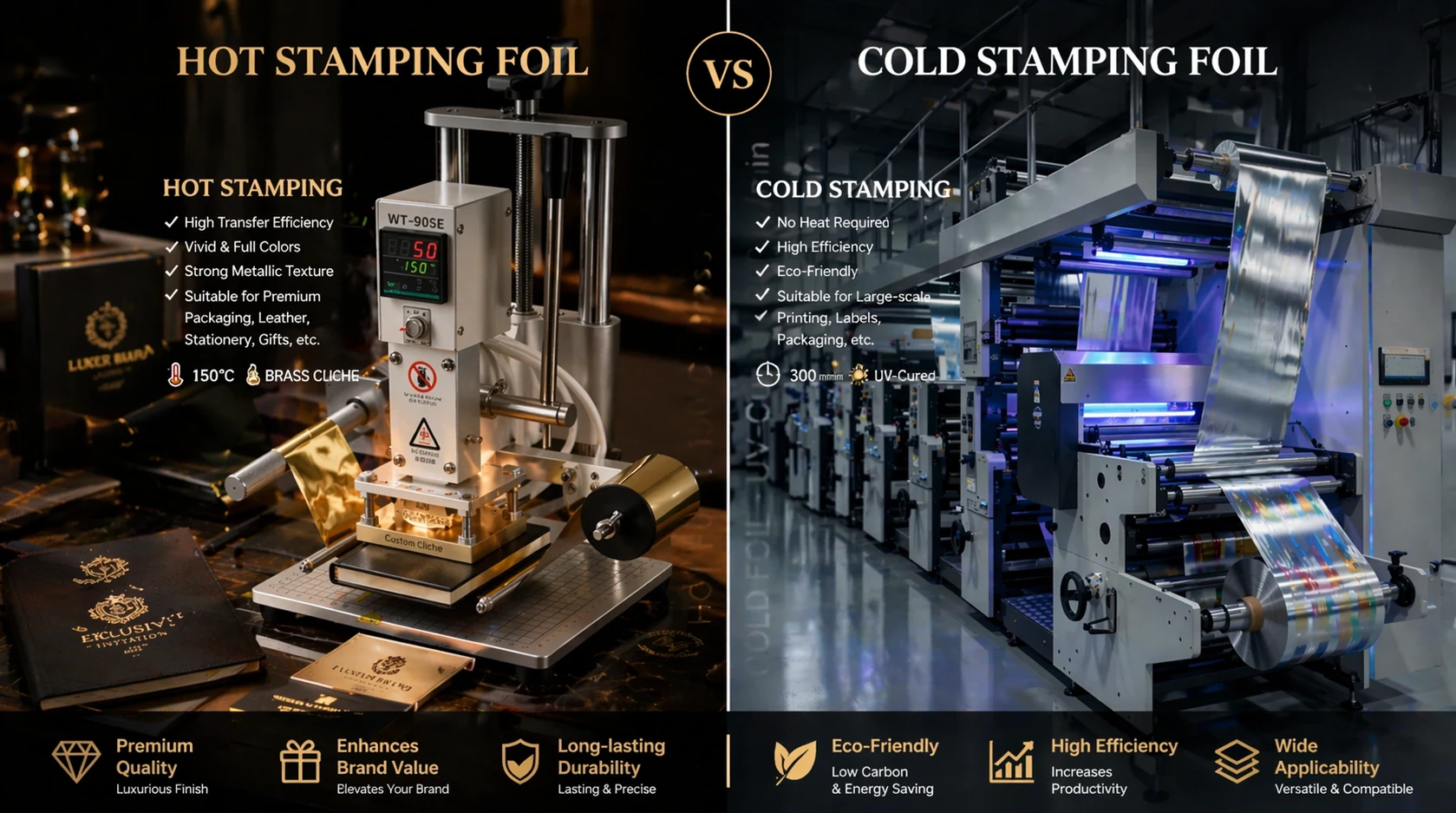
Hot foil vs cold foil stamping in one line: hot foil uses a heated engraved die to press pigmented foil onto a substrate at 90–150 °C and 30–80 m/min; cold foil prints a UV-curable adhesive on a flexo or offset press, nips foil against it, and cures the bond at ambient temperature at up to 300 m/min. Cold foil wins on speed, fine detail (~50 µm), CMYK overprint, heat-sensitive substrates and ~45 % lower energy use; hot foil still wins on tactile embossed luxury accents and very short runs where a die amortises quickly.

TL;DR: Cold foil stamping is the modern, high-speed way to apply real metallic foil to packaging and labels. A UV-curable adhesive is printed inline on a flexo or offset press, foil is nipped against it, and a UV lamp instantly cures the bond — at up to 300 m/min, with ~50 µm detail and full CMYK overprint on a single silver foil base. Compared with traditional hot foil stamping, cold foil is faster, cheaper at volume, kinder to heat-sensitive substrates, and far more flexible for coloured metallics. This guide explains how cold foil works, where it wins, and answers the eight questions buyers ask most when comparing it to hot stamping.

If you are sourcing labels for a wine launch, designing a cosmetics secondary carton, or briefing a converter, cold foil stamping is almost certainly the technology you should be specifying first. Hot foil keeps a niche for tactile embossed luxury work, but for everything else — speed, detail, colour metallics, sustainability, cost-per-unit — cold foil is the default in 2026.

This guide is built around cold foil. We use hot foil as the reference point only because that is how most buyers frame the question.

Cold foil stamping at full press speed compared with a bench-top hot foil stamping machine
Cold foil stamping (right) runs inline at 300 m/min with UV-cured adhesive. Hot foil stamping (left) is a slower, die-based bench process kept for tactile luxury work.

What is cold foil stamping?

Cold foil stamping is a wet, in-line printing process that transfers a real, vapour-deposited aluminium foil onto a substrate using a UV-curable adhesive — without heat and without an engraved die.

A flexo or offset unit prints the adhesive in the exact shape of the artwork. A foil web is nipped against the wet adhesive, a UV lamp cures the bond in milliseconds, and the carrier film is peeled away. Foil stays only where adhesive was printed. The entire transfer happens inside a normal press run, between the printing units and the varnish or die-cut units.

Because the image is defined by a printing plate — not a metal die — cold foil inherits the resolution and registration of modern flexo and offset:

  • Press speed up to 300 m/min on inline web presses
  • Minimum line width ~50 µm with high-line anilox rollers
  • Full CMYK overprint on top of the cured foil for coloured metallics
  • No tooling lead time — plate change is the same as any printing job
  • Ambient temperature — safe on heat-sensitive films, metallised papers, and thin coated stocks

That combination is why cold foil now dominates premium label and folding-carton work where designers want metallic gradients, micro-text, photographic overprints, or holographic effects.

How does cold foil stamping work, step by step?

Cold foil sits inside a normal press run. The five-step transfer is what makes it so fast:

  1. 1Print adhesive. A flexo or offset unit lays a UV-curable adhesive in the exact image of the foil graphic onto the substrate. Adhesive film weight is controlled by an anilox roller, typically 8–12 BCM.
  2. 2Nip foil web. A continuous foil web is fed into a transfer roller and pressed against the wet adhesive at the nip.
  3. 3UV cure. A UV lamp flashes through the foil carrier (or the substrate, in some configurations) and instantly cures the adhesive — locking the metal layer onto the print at full press speed.
  4. 4Strip carrier. The PET carrier film is peeled away. Foil only stays where adhesive was printed; everything else lifts off cleanly and rewinds onto the take-up reel.
  5. 5Overprint. Downstream CMYK or spot-colour units print directly on top of the cured foil to create coloured metallics — pearl gold, rose copper, holographic blues, brushed bronze — from a single silver foil base.
Macro view of a cold foil press transferring silver foil onto a paper web with blue UV LED curing light
A cold foil unit at full speed: foil web, transfer roller, UV lamp, paper web — all running inline.

The result is the brilliance of foil with the fine resolution of a printing plate, which is why cold foil now leads premium label and folding-carton work where designers want metallic gradients, micro-text, or four-colour overprints.

For a deeper press-side walk-through, see our cold foiling process guide and our cold foil applications overview.

Why is it called "cold" foil?

Because no heat is used to release the foil from its carrier. The traditional process invented in the 19th century — what we now call hot foil stamping — relied on heated dies; the foil pigment layer is bonded to a release layer that softens under heat. Cold foil swaps that thermal release for a chemical release: a UV-cured adhesive holds the metal layer to the substrate, and the carrier film is peeled away mechanically at room temperature.

The terminology stuck as the process commercialised in the early 2000s on web-fed and later sheet-fed presses, and is now standard vocabulary across the FTA (Flexographic Technical Association) and major converter networks.

Why is cold foil stamping better than hot foil for most modern packaging?

Cold foil is not "always better" — but for the vast majority of commercial packaging in 2026, it wins on every metric that matters at scale.

Attribute Cold foil stamping Hot foil stamping
ToolingStandard flexo/offset printing plateCustom engraved metal die per design
HeatAmbient (UV-cured)90–150 °C
Press speedUp to 300 m/min inline30–80 m/min sheetfed
Setup timeSame as a printing plate change30–90 min per die
Tooling lead timeNone — digital plate3–7 days die engraving
Tooling costStandard plate costUS$80–400+ per die
Minimum line width~50 µm with high-line anilox~80–100 µm
Over-printable with CMYKYes — designed for CMYK overprintLimited (post-print only)
Heat-sensitive substratesSafe (no heat)Risk of warp / blister
Energy footprint~45% lower (pulsed UV)Continuous die heat load
Best forHigh-volume, fine-detail, multi-colour metallicsTactile embossed luxury (small runs)

The headline numbers come from inline cold foil press benchmarks reported by Packaging Europe and converter case studies from Smithers and LabelExpo.

Both processes transfer a real aluminium-vapour-deposited foil layer, so brilliance is comparable. Cold foil's advantage is everything that surrounds the metal: speed, detail, colour, cost, and substrate freedom.

When should you specify cold foil stamping?

Cold foil is the right call when you need any of the following — and most premium packaging briefs hit several of them at once:

  • High volumes (>100,000 impressions) at low cost-per-unit
  • Fine detail under ~80 µm — micro-text, hairlines, intricate filigree, security patterns
  • Coloured metallics from a single silver foil — pearl gold, rose, copper, holographic
  • CMYK photography overprinted on metal — common for cosmetics, spirits, FMCG launches
  • Inline production: print + foil + varnish + die-cut in one pass
  • Fast turnaround — no die engraving wait, plate is digital
  • Heat-sensitive substrates — thin films, metallised papers, certain coated stocks
  • Sustainability targets — lower energy per impression, no die scrap, single-pass workflow

Hot foil still earns its keep on a narrow set of jobs: a tactile embossed or debossed brand mark in the same hit (combo dies), specialty pigmented or diffraction foils not yet stocked as cold-foil rolls, or short prototype runs where the die cost amortises across a few hundred sheets.

In practice, most premium brands now run cold foil for label graphics and large coverage, plus a small hot-foil hit on the secondary carton for the surfaces a customer's fingers actually touch. Cold foil is the workhorse; hot foil is the accent.

Can you use a normal laminator for cold foil stamping?

No — not for production-grade results. A desktop pouch laminator can fuse a "toner-reactive" foil (sometimes sold as "deco foil") onto laser-printed text because the foil bonds to heated toner. That is a craft technique, not a packaging process, and it has nothing to do with industrial cold foil.

Production cold foil stamping requires:

  • A flexo or offset press with a dedicated cold foil unit (e.g. Heidelberg FoilStar, KBA ColdFoiler, Bobst inline modules)
  • A UV curing lamp rated for the press web speed
  • An anilox roller with the right line count to lay down a precise adhesive film (typically 8–12 BCM)
  • Cold-foil-grade rolls — the release coating is engineered for chemical, not thermal, release
  • A trained operator to manage adhesive viscosity, anilox cleanliness, web tension, and UV dose

For prototypes or very short runs, digital sleeking systems are the right alternative — not a laminator.

Do luxury brands like Louis Vuitton use cold foil stamping?

Yes — increasingly so for their secondary cartons, paper bags, and label work. Most luxury brands have moved volume runs to cold foil because it lets them pair fine metallic typography with full-colour photography in a single inline pass — something a hot-foil press cannot do efficiently.

Heritage maisons in leather goods and hard-luxury packaging still specify hot foil or blind embossing with foil for monogram canvases, gift-box lids, and authenticity stamps where the debossed depth is part of the brand language. But the share of total foil-decorated packaging running on cold foil keeps growing each year, a trend documented in industry coverage from Packaging Europe and the FTA.

So the honest summary: hot stamping is alive in the luxury world, but cold foil stamping is what scales luxury aesthetics to volume packaging.

What are the disadvantages of hot foil stamping that cold foil solves?

Cold foil exists because hot foil has real trade-offs at scale. Each of the constraints below disappears when you switch to cold foil:

  • Tooling cost and lead time. Hot foil needs an engraved brass or magnesium die per design (US$80–400+, 3–7 days). Cold foil uses a standard printing plate produced in hours.
  • Slower throughput. Sheet-fed hot stamping runs at 30–80 m/min, roughly 3–4× slower than inline cold foil at 300 m/min. Cold foil collapses per-unit cost on long runs.
  • Heat damage risk. Heat-sensitive substrates (some PE/PP films, thin metallised papers, certain coated stocks) can warp, blister or yellow under a heated die. Cold foil runs ambient.
  • Limited fine detail. Hot foil tends to fill in or break up below ~80 µm. Cold foil routinely holds 50 µm with the right anilox.
  • No native CMYK overprint. You cannot easily print four-colour graphics on top of hot-stamped foil in the same pass. Cold foil is designed for CMYK overprint.
  • Energy use. Maintaining die temperature is a continuous load; cold foil's pulsed UV cure contributes to the ~45% lower energy footprint widely cited for inline cold foil decoration.
  • Die storage and reorders. Hot-foil dies must be stored, catalogued, and reordered when designs change. A cold foil plate is the same digital asset as any other printing job.

For projects where these constraints bite, switching to cold foil typically pays back inside the first production run. Our cold foil products page lists the foil grades that match common substrate and press combinations.

Which is better, hot or cold lamination — and why might I choose cold lamination?

Quick clarification: lamination is a different process from foiling. Lamination bonds a clear film to a printed sheet to protect it; foiling deposits a metallic image. People often conflate the two because both can use heat or "cold" adhesive systems.

  • Hot lamination uses heat-activated adhesive films and rollers around 100–110 °C. Best for office documents, ID cards, and book covers.
  • Cold lamination uses pressure-sensitive adhesive films and no heat. Best for heat-sensitive prints (inkjet photos, vinyl, wide-format graphics) and oversized panels where heated rollers are impractical.

You would choose cold lamination when the substrate or ink set cannot survive heat — for example, ecosolvent prints, certain photo papers, or laminating onto rigid foamboard.

The lamination logic mirrors the foil logic: cold = gentler, faster setup, better for sensitive materials; hot = more permanent bond, better tactile finish.

Is cold foil stamping the future of decorated packaging?

The market data points firmly that way. Cold foil already leads in pressure-sensitive labels, in-mould labels, folding cartons, and flexible packaging — and its share keeps growing each year as converter capacity is built out and sustainability targets pressure brand owners away from continuous-heat decoration.

Industry analysis from Smithers and reporting from LabelExpo puts hot foil at roughly 25–35% of global decorated-packaging foil volume, concentrated in premium spirits cartons, greeting cards, book covers, and security stamps. Cold foil holds the rest — and is the only of the two technologies whose share is increasing.

"Cold foil has moved from 'alternative' to 'default' for premium label decoration. The remaining hot-foil work is increasingly about touch, not just shine." — paraphrased from converter feedback at recent LabelExpo events.

So which should you specify?

Use this decision shortcut, weighted toward cold foil because that is where the modern packaging market sits:

  1. 1Run length over 50,000 impressions? Cold foil.
  2. 2Need CMYK or spot colours overprinted on the metallic area? Cold foil.
  3. 3Detail finer than 80 µm — micro-type, hairlines, security patterns? Cold foil.
  4. 4Heat-sensitive or thin metallised substrate? Cold foil.
  5. 5Inline production target — print + foil + varnish in one pass? Cold foil.
  6. 6Sustainability or energy-per-impression target? Cold foil.
  7. 7Tactile raised effect non-negotiable for the brand? Hot foil — or cold foil + a small hot-foil accent on the secondary carton.
  8. 8Prototype or short run under 1,000 sheets? Hot foil or digital sleeking can be cheaper.

For most modern packaging — cosmetics secondary cartons, wine and spirits labels, FMCG promotional packs, pharma cartons, premium beverage labels — cold foil stamping is the default specification. Hot foil earns its keep only on the surfaces a customer's fingers actually touch.

If you are ready to spec, request a free cold foil sample pack calibrated to your substrate and press, or read our technical documentation for adhesive, anilox and curing recommendations.

FAQ

Frequently asked questions

Hot foil vs cold foil stamping — what's the difference? +

Hot foil stamping uses a heated engraved metal die (90–150 °C) to press pigmented foil onto a substrate at 30–80 m/min, with a 3–7 day die lead time. Cold foil stamping prints a UV-curable adhesive on a flexo or offset press, nips foil against the wet adhesive, and cures the bond at ambient temperature at up to 300 m/min — using a standard printing plate instead of a die, and supporting full CMYK overprint for coloured metallics from a single silver foil base.

What is cold foil stamping? +

Cold foil stamping is an inline printing process that transfers real metallic foil to a substrate using a UV-curable adhesive instead of heat. A flexo or offset unit prints the adhesive, foil is nipped against it, a UV lamp cures the bond, and the carrier film is peeled away — all at up to 300 m/min on a printing press.

How does cold foil stamping work? +

A printing unit lays UV-curable adhesive in the shape of the artwork. A foil web is pressed against the wet adhesive, a UV lamp cures it instantly, and the PET carrier is stripped away. Foil only stays where adhesive was printed. Downstream CMYK units can then overprint coloured metallics on top of the cured foil.

Why is cold foil stamping better than hot foil for most packaging? +

Cold foil runs at up to 300 m/min versus 30–80 m/min for hot foil, holds finer detail (~50 µm vs ~80 µm), needs no engraved die, supports full CMYK overprint, runs cool on heat-sensitive substrates, and uses roughly 45% less energy per impression. For high-volume, fine-detail or multi-colour metallic work, cold foil wins on every metric.

Can you use a normal laminator for cold foil stamping? +

No. Production cold foil requires a press with a dedicated cold foil unit, an anilox roller, UV curing lamps, and cold-foil-grade rolls. A desktop pouch laminator can only fuse craft-grade toner-reactive foils onto laser-printed text — not industrial cold foil onto packaging.

Why is it called cold foil? +

Because the foil transfers without heat. A UV-curable adhesive — not a heated die — releases the metal layer from its carrier film, so the entire process runs at ambient temperature on a printing press.

Do luxury brands use cold foil stamping? +

Yes. Most luxury brands now run cold foil for secondary cartons, paper bags, and labels because it pairs fine metallic typography with full-colour photography in a single inline pass. Hot foil is reserved for tactile applications like leather monograms, hardcover gift boxes, and authenticity marks.

What are the disadvantages of hot foiling that cold foil solves? +

High die cost (US$80–400+) and 3–7 day engraving lead time, throughput of only 30–80 m/min, risk of heat damage on sensitive substrates, limited fine detail below 80 µm, no native CMYK overprint, and continuous energy use to keep dies hot. Cold foil eliminates all of these.

Which is better, hot or cold lamination? +

Hot lamination produces a stronger, more permanent bond and is preferred for documents, ID cards, and book covers. Cold lamination uses pressure-sensitive adhesive with no heat and is preferred for heat-sensitive prints, large panels, and inkjet or vinyl graphics. Lamination is a separate process from foil decoration.