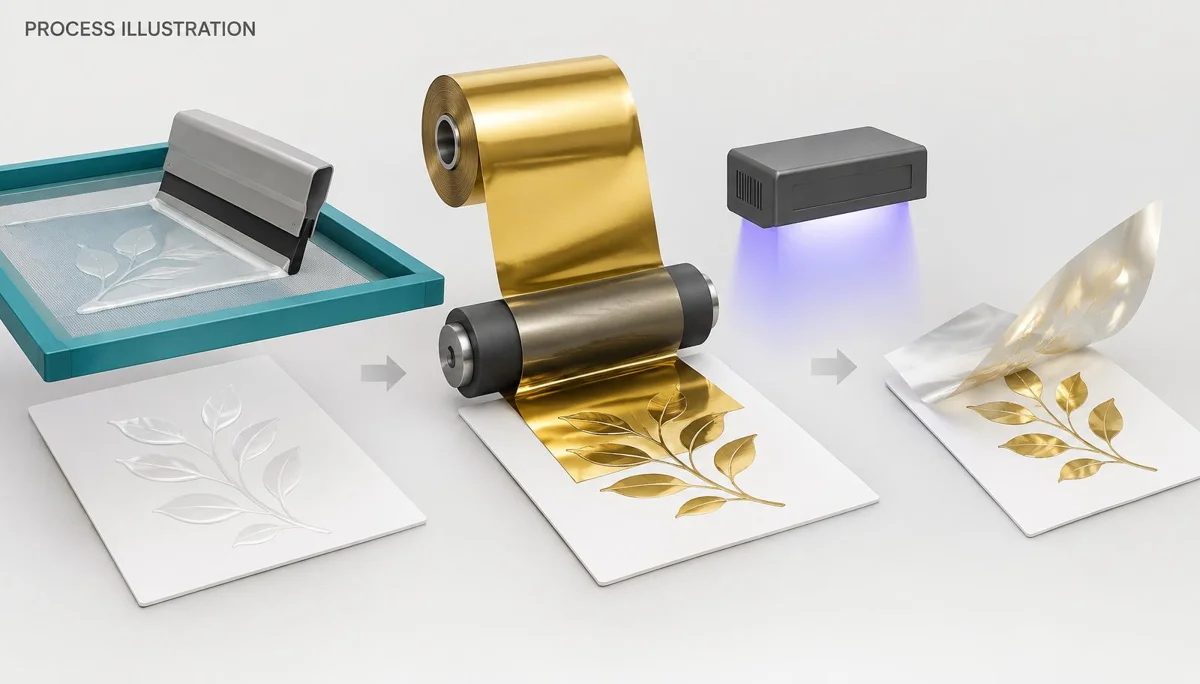
Screen cold foiling creates a metallic or decorative image by transferring foil onto an adhesive pattern printed through a screen. It is used in print finishing for packaging and cards, with some systems also capable of raised metallic effects. The screen, adhesive, foil and curing arrangement must work together; a foil that runs well on a flexo press is not automatically suitable.
The term also appears as silk screen cold foil or screen-printed cold foil. Here it means UV adhesive-based print finishing, not a garment process that screen-prints glue and then applies foil in a heat press.
How does screen cold foiling work?
A stencil defines where the screen deposits adhesive, and a transfer unit brings the foil into contact with that image. The decorative layer separates from its carrier in the selected areas. Curing and carrier removal follow the specified adhesive and equipment configuration, not a universal sequence copied from another line.
The method has a documented technical basis. Pawellek's published patent application describes screen application of cold-foil adhesive followed by pressure-assisted transfer. This is a historical process disclosure, not a current operating instruction, certification or recommendation to copy a particular machine design.
For a job discussion, break the workflow into these practical stages:
- 1Prepare the receiving surface. Identify the paper, board, coating or laminate and the artwork already printed on it.
- 2Print the adhesive image. Select the screen/stencil and adhesive application conditions for that material and design.
- 3Transfer and cure in the specified arrangement. Confirm how foil contact, any intermediate exposure, final cure and separation fit the installed system.
- 4Inspect the finished construction. Review the transferred image and any later varnishing, folding or other conversion relevant to the job.
Equipment suppliers describe different layouts. CooPrinter, for example, describes partial curing before foil contact and a later cure. That description should not become a rule for every screen cold-foil installation. Obtain the current instructions for the actual adhesive, foil and equipment combination.
Can screen cold foil create a raised metallic effect?
Yes, with a suitable high-build construction, but the foil itself does not create the height. The printed deposit establishes the profile, and the transferred decoration follows it. A flat foil image and a tactile raised image therefore need different sample and acceptance discussions.
Shengtu's screen cold-foil line description identifies raised effects using a thicker screen-printed deposit. It does not establish one relief height for all equipment, adhesives or designs. Increasing deposit thickness without checking transfer and cure is not a reliable shortcut to a better tactile finish.
Ask for a physical sample with the relevant fine detail, solid areas and raised profile. View it under agreed lighting and handle it as the finished card or pack will be handled. Raised screen foil is also different from mechanically embossing the paper or board with a die.
Screen cold foiling vs flexo, digital foil and hot stamping
The useful distinction is how the selective image is formed and how the decoration is transferred. A metallic appearance alone does not identify the process, and the same shade name does not prove that a roll can move between systems.
| Process | How the image is formed | Main question when choosing the route |
|---|---|---|
| Screen cold foiling | Adhesive is printed through a screen/stencil before foil transfer. | Can the screen deposit, foil and cure arrangement reproduce the intended flat or raised image? |
| UV flexo cold foil | A flexographic plate prints the adhesive image, with adhesive metered through an anilox system. | Does the combination work on the label web, including its intended overprint and finishing? |
| Digital foil enhancement | A digital system forms the selective image, for example by inkjet-depositing a polymer in a Scodix configuration. | Is the foil compatible with that equipment and polymer, and does the job need variable images or a digital workflow? |
| Conventional hot foil stamping | A heated die forms the transferred foil image through heat and contact pressure. | Does the substrate, foil and tooling deliver the required metallic detail and any specified embossing? |
KURZ's flexo FAQ and Scodix's process explanation describe their respective routes. For the broader choice, see our hot foil vs cold foil guide or digital cold foiling article.
Screen cold foiling avoids the heated stamping die used in conventional hot foil work; it does not eliminate screen preparation or all equipment heat. Cost comparisons should include setup, foil use, screen preparation, handling and finishing rather than assuming one route always wins.
Where does it fit in packaging and card finishing?
Consider screen cold foiling when the proposed job benefits from a screen-defined metallic image or a qualified tactile construction. Cosmetic cartons, presentation pieces and cards are useful discussions to have with a converter, but an application label is not proof that every stock or foil will work.
A published example of combining techniques appears in FESPA's 2025 winners listing. Kumazawa Printing Crafts' Fine Paper x Silk Screen Sample Book & Design Index, made with Takeo Paper and Mori Design, brought together screen printing, cold foil transfer, offset lithography and other finishing. FESPA describes 39 special effects across the project, not 39 cold-foil effects.
This is an external multi-process example, not a CFS project or a controlled performance experiment. Its practical lesson is to specify the whole construction and processing order, rather than approving an effect name in isolation.
Which foil, adhesive and screen details need checking?
Confirm the process with the suppliers before substituting materials. A screen-printable UV varnish is not automatically a cold-transfer adhesive, and an adhesive described as UV-curable is not automatically suitable for an installed LED source.
Identify the foil grade and batch, adhesive grade, actual receiving surface, screen mesh and thread specification, stencil build and relevant application conditions. Record the mesh units as well: a number without threads per centimeter or threads per inch can be misread. Obtain the preparation and curing requirements from the suppliers rather than choosing a mesh or UV dose from a generic blog.
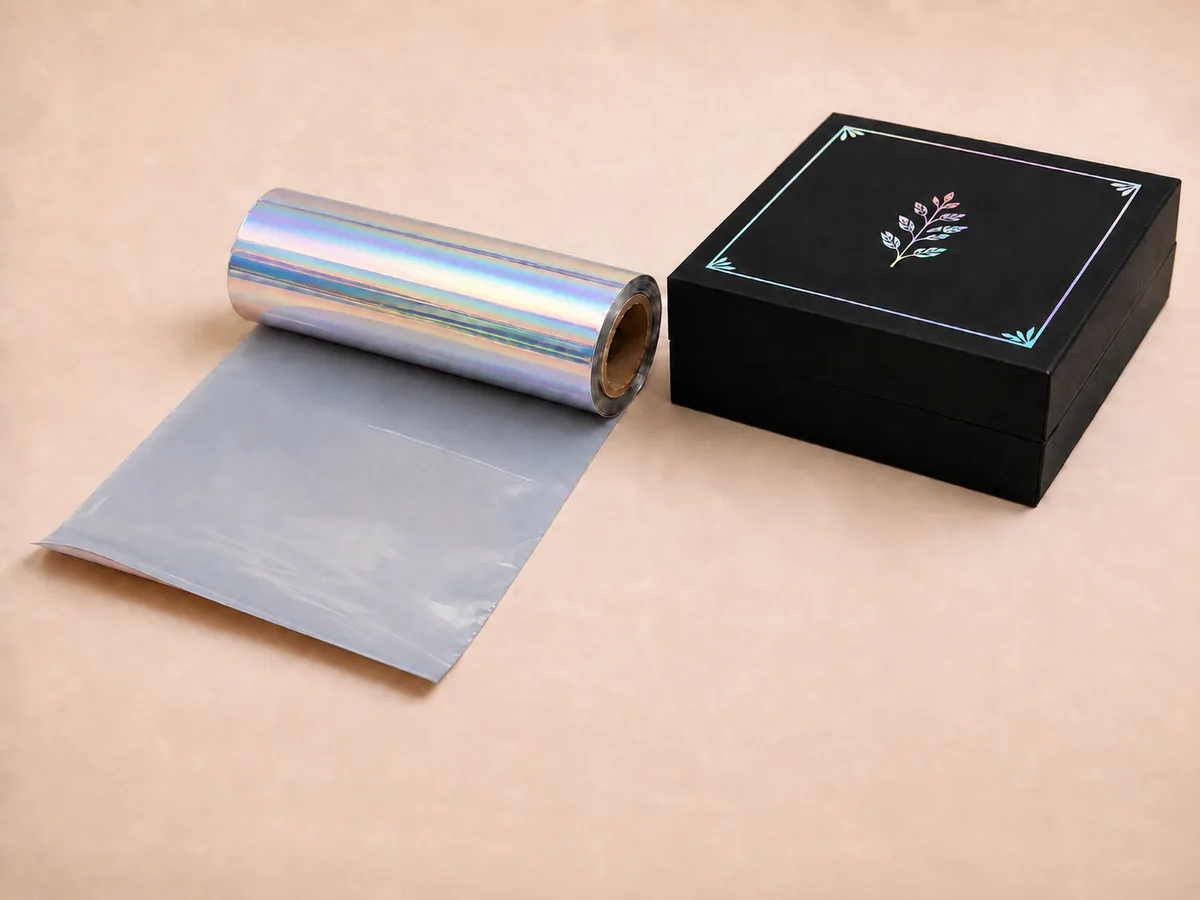
The foil's release behavior and receiving adhesive must suit the transfer route. Foilco's cold-foil overview explains that grades relate to adhesive and application. Do not infer screen suitability from a silver or gold color name, a product photograph, or success with a different adhesive.
For process questions, our UV adhesive and LED guide explains the information needed for a compatibility discussion. Its flexo or offset examples are not screen-printing settings.
How should a screen cold-foil trial be evaluated?
Use the intended surface and representative artwork, then check the construction after the relevant finishing stages. Retain material identities, settings and samples so an observation can be traced to the trial that produced it. The following is an investigation framework, not a tested CFS recipe or a list of guaranteed causes.
| Observation | What to investigate | Evidence that helps narrow the issue |
|---|---|---|
| Missing foil in solid areas | Adhesive-image continuity, surface condition and transfer contact. | Compare the adhesive image and transferred area at the same sheet position. |
| Ragged edges or filled fine gaps | Screen/stencil reproduction, deposit behavior and contact conditions. | Compare the artwork, printed adhesive detail and resulting foil detail. |
| Uneven raised appearance | Deposit consistency, surface variation and the specified curing arrangement. | Compare the same feature across the sheet and retain the recorded application conditions. |
| Scuffing or lifting after finishing | Material compatibility, cure and the actual handling or finishing operation. | Retain samples before and after the operation and apply the agreed checks. |
For a comparison trial, agree the baseline, change one relevant variable at a time, retain labeled samples and record both improvements and remaining defects. Acceptance methods and limits should be agreed by the converter and buyer for the actual job. No universal scratch, tape, mesh, relief-height or cure threshold is supplied here.
The cold-foil defects guide can help organize observations, but its examples do not qualify a screen process. Without a material-matched trial, a more complete foil image is still not proof that every durability requirement has passed.
Further questions
Does a combination press with screen and cold-foil units necessarily use screen-printed adhesive?
No. A list of installed units does not show which station forms the adhesive image. Confirm the job's actual station sequence before calling it screen cold foiling; a separate screen varnish effect may coexist with foil applied through another route.
—Does a successful silver trial also qualify gold or holographic foil?
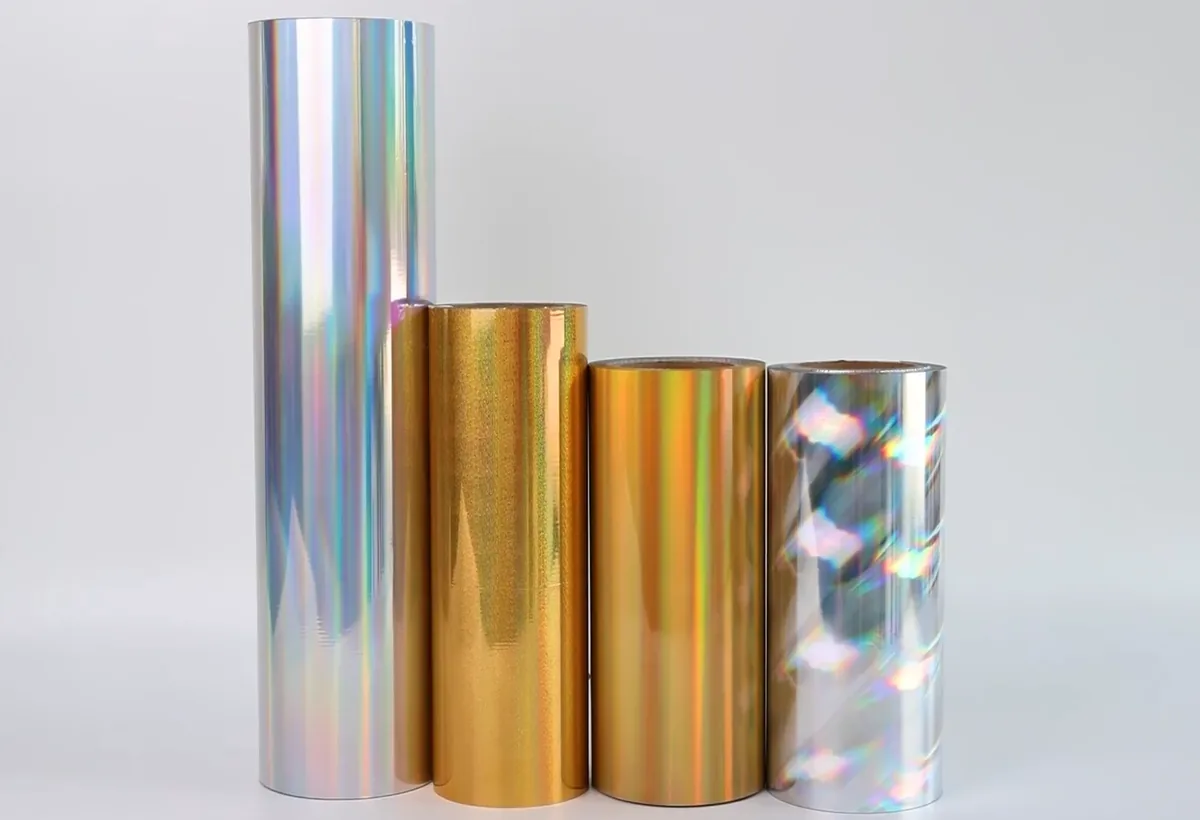
Not automatically. Identify the actual grade and proposed change with the suppliers. Decide what further comparison is needed rather than assuming the appearance is the only difference between materials.
Discuss the material requirement, not just the effect
CFS supplies cold transfer foil rolls, with its confirmed supply focus on UV flexographic label materials. This technical article does not establish a qualified CFS screen-printing grade. For a material enquiry, contact CFS with the process, receiving surface and effect you need; suitability and availability must be confirmed rather than inferred from this guide.