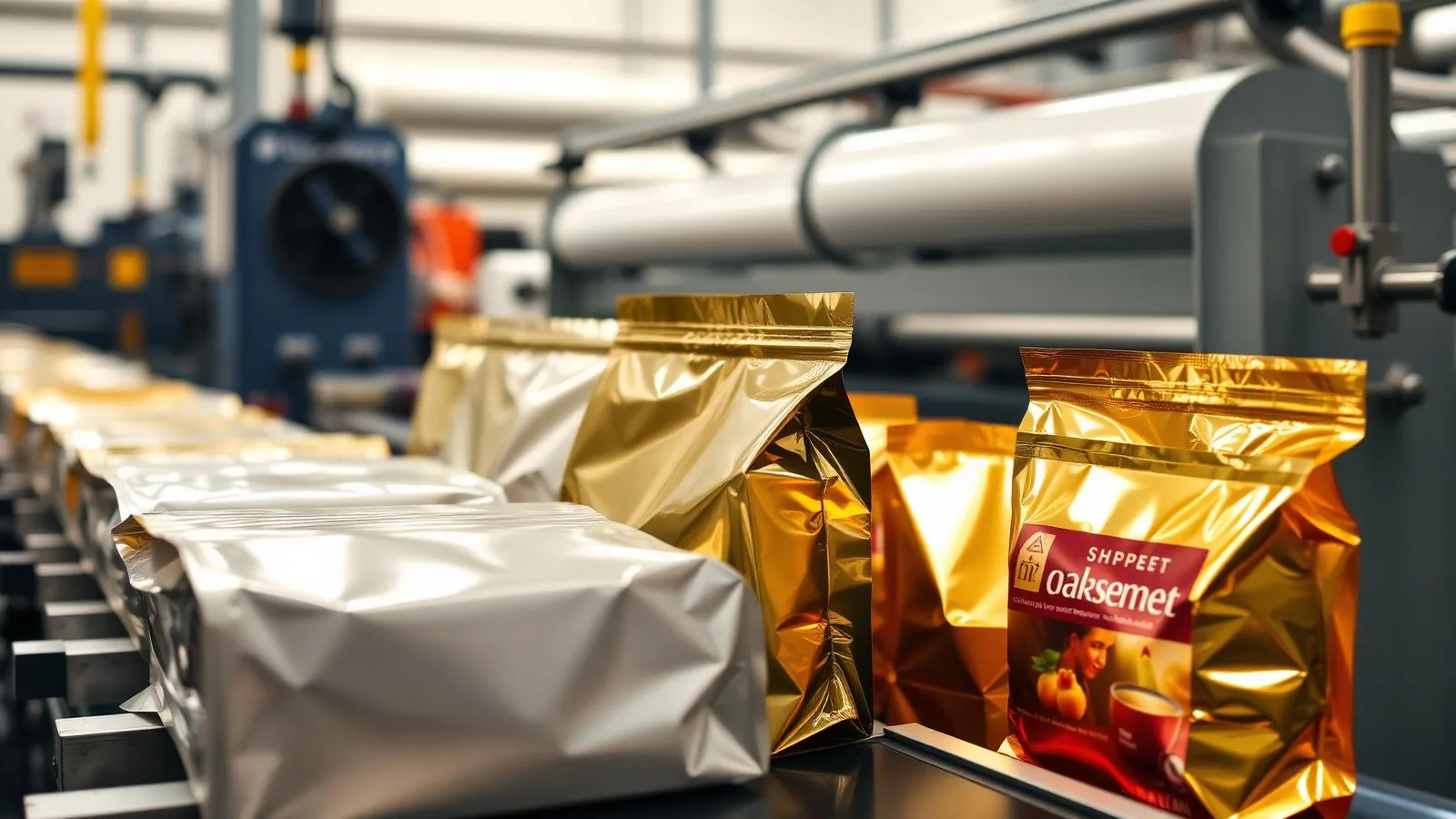
TL;DR. Cold foil on flexible films — BOPP, PET, PE, and metallised PP used for snack bags, coffee pouches, pet food sachets, and lidding films — is the fastest-growing cold foil segment for 2026 according to Smithers' flexible packaging market outlook. It works on any printable film, runs inline on narrow-web UV flexo and CI flexo presses up to 300 m/min, and produces a brilliant metallic finish without metallised laminates. The trade-offs vs rigid substrate work: lower adhesive coat weight (1.0–1.5 g/m² vs 1.5–2.0 g/m²), tighter tension control (±2 N vs ±5 N), and corona treatment to ≥ 38 dyne/cm on the film before adhesive application.
“"Cold foil is moving off folding cartons and onto flexible films faster than any other decoration technology — coffee, pet food and confectionery pouches are leading the conversion from metallised PET laminates to mono-material BOPP with cold foil." — PAWI Verpackungen, Cold stamping news 2026
---
1. Why cold foil on flexible film, and why now
The traditional way to put metallic shine on a coffee bag was to laminate a metallised PET layer to the printable film. That laminate is great visually but creates a multi-layer plastic structure that is non-recyclable under EU PPWR 2027 and most US extended producer responsibility (EPR) schemes coming into force 2025–2027.
Brand owners now want mono-material BOPP or PE pouches that still hold premium shelf presence. Cold foil delivers that: a 10–50 nm aluminium layer transferred by UV adhesive does not break the mono-material classification of the underlying film, because the metallic content stays well under the 5% threshold most recycling streams tolerate. (Pair this with our mono-material recyclable packaging guide for the cartonboard equivalent.)
The second driver is press economics. Cold foil runs inline at full press speed — no offline foiling step, no laminate stock, no minimum-quantity laminate roll. For short-run flexible jobs (10,000–250,000 pouches), cold foil is the only metallic decoration that does not collapse the unit cost.
2. Which films take cold foil
| Film | Suitable? | Surface prep | Notes |
|---|---|---|---|
| BOPP (biaxially oriented polypropylene) | ✅ Excellent | Corona to ≥ 38 dyne/cm | Most common; mono-material PP brief |
| PE (polyethylene, mono-material pouches) | ✅ Good | Corona to ≥ 40 dyne/cm | Slower UV cure; check adhesive |
| PET (polyester) | ✅ Excellent | Corona to ≥ 42 dyne/cm | Sharpest edges; used for lidding |
| Metallised PP/PET | ⚠️ Limited | Skip — already metallic | Only for spot-foil-over-metallic effects |
| Paper-based flexibles (heat-seal kraft, glassine) | ✅ Excellent | None | Behaves like coated paperboard |
| PLA (compostable bio-films) | ⚠️ Test | Corona + UV adhesive validation | New, supplier-specific |
| Cellulose film (NatureFlex) | ✅ Good | None | Compostable mono-material option |
3. Press setup differences vs rigid substrates
If your line is set up for cold foil on folding cartons, here is what changes when you run flexible film:
- Adhesive coat weight — reduce from 1.5–2.0 g/m² (cartonboard) to 1.0–1.5 g/m² on film. Films are non-absorbent; excess adhesive squeezes out at the foil nip and contaminates the foil web.
- Anilox roll — move to a finer cell volume, typically 5–8 BCM instead of 8–12 BCM on cartonboard. See anilox roller selection for the full BCM table.
- Web tension — tighten to ±2 N control. Films stretch under tension; foil placement drifts if tension wobbles. Most film failures are tension-related, not adhesive-related.
- UV cure dose — 180–250 mJ/cm² (vs 200–300 on coated board). Films cannot absorb the heat from over-curing; LED-UV lamps are the safer choice.
- Corona treatment — every flexible film needs inline corona to the dyne level in the table above. Aged film (more than 60 days post-corona at the mill) needs re-corona on the press.
- Foil web tension — slacker than on cartonboard runs (≈ 30% lower) to allow the foil to conform to the soft film without micro-tunnelling.
- Press speed — most converters run 200–300 m/min on cold foil flexibles, vs 100–200 m/min on cartonboard rotary, because film webs are thinner and faster to cure.
4. The defect map for cold foil on film
Different failures appear on film than on board. Run this against any pilot job:
| Defect | Probable cause | Fix |
|---|---|---|
| Foil lifts off in finger-rub test | Low corona dyne level | Re-corona to ≥ 38 (BOPP) / 42 (PET) dyne/cm |
| Tunnelling / micro-bubbles | Foil web tension too high or film tension too low | Slacken foil web 20–30%; tighten film web |
| Patchy transfer / pinholing | Adhesive coat too thin, anilox volume too low | Step up to next BCM anilox; check viscosity |
| Edge ghosting | Anilox cell wear, dot gain on adhesive plate | Replace anilox; reduce plate dot gain |
| Foil cracks on creased pouch | Foil over-cured; brittle aluminium layer | Reduce UV dose 15–20%; switch to LED-UV |
| Foil flakes in seal jaw | Foil at seal zone; aluminium prevents heat seal | Pull foil 3 mm back from seal area in artwork |
For the full diagnostic flowchart, cross-reference cold foil pinholing & ghosting diagnosis.
5. The seal zone rule — most important design constraint
Aluminium does not heat-seal. If foil runs into the heat-seal jaw zone of a pouch, the seal will fail and product will leak.
- Keep foil at least 3 mm back from any heat-seal area (top, bottom, and side gussets).
- For zipper or peel-reseal pouches, keep foil 5 mm back from the zipper track.
- Mark seal zones explicitly in the artwork file on a dedicated
SEAL_ZONElayer. - The designer prepress guide covers the layer setup; add
SEAL_ZONEas a non-printing spot color when the job is flexible film.
6. Sector growth — where the volume is
| Segment | 2026 growth (Smithers) | Why cold foil wins |
|---|---|---|
| Coffee bags | +14% YoY | Mono-material BOPP brief; metallic shelf-presence |
| Pet food pouches | +12% YoY | Premium positioning, lighter than tin |
| Snack & confectionery films | +9% YoY | Replace metallised PET laminates |
| Pharma lidding films | +6% YoY | Tactile + visual differentiation |
| Sachets (cosmetics samples, condiments) | +18% YoY | Very short runs — cold foil's setup economics |
The fastest-growing segments are the ones where a multi-layer laminate is being replaced by a single film + cold foil decoration. That is the brief 2026 buyers are writing.
7. Cost compared to alternatives
For a 200,000-pouch run of a 100 g coffee bag, 20% metallised area:
| Decoration | Cost per pouch | Mono-material compatible? |
|---|---|---|
| Metallised PET laminate | €0.062 | ❌ No |
| Cold foil on BOPP | €0.048 | ✅ Yes |
| Metallic ink | €0.041 | ⚠️ Partial (pigment contamination) |
| Spot UV varnish only | €0.029 | ✅ Yes |
| Plain printed film | €0.024 | ✅ Yes |
Cold foil is 22% cheaper than metallised laminate at this run length, and solves the recyclability brief. That is the dual benefit pushing the segment.
See the full breakdown approach in the cold foil stamping cost calculator.
FAQ
Can I cold foil a fully sealed pouch after filling? No. Cold foil applies inline on the reel before pouch forming. After-fill decoration uses different technologies (digital metallic ink, hot foil on labels).
Does cold foil survive the boil-in-bag step for ready meals? Yes, with the right adhesive. Standard UV cold foil adhesives are food-contact safe (indirect, outer layer) and survive 100 °C wet conditions. Confirm with your converter against the EU food contact regulation 10/2011.
What about retort packaging (121 °C, 30 min)? Retort is harder. Some specialist UV cold foil adhesives survive retort; most do not. Validate every retort job individually — there is no generic answer.
Can I cold foil on stand-up pouches with a transparent window? Yes. The foil prints on the printable side of the film; the unprinted window area passes through unfoiled. Mark window zones explicitly in artwork.
Is cold foil on BOPP recyclable in EU PP-only streams? Yes, when foil coverage stays under the threshold of the local MRF and the adhesive is UV (not solvent). Get a 4evergreen-style recyclability statement from the converter against your exact film + foil + adhesive stack.
---
Running a flexible film cold foil pilot? Request a foil sample for BOPP, PET or PE film with adhesive and dyne-level recommendations.
Sources & further reading - PAWI — Cold stamping industry news - Smithers — Flexible packaging market reports - EU PPWR — Packaging & Packaging Waste Regulation - 4evergreen alliance — fibre-based recyclability - Flexible packaging on Wikipedia - Related on-site: Mono-material recyclable packaging · Pinholing & ghosting diagnosis · Anilox roller selection · Designer prepress guide · Cost calculator