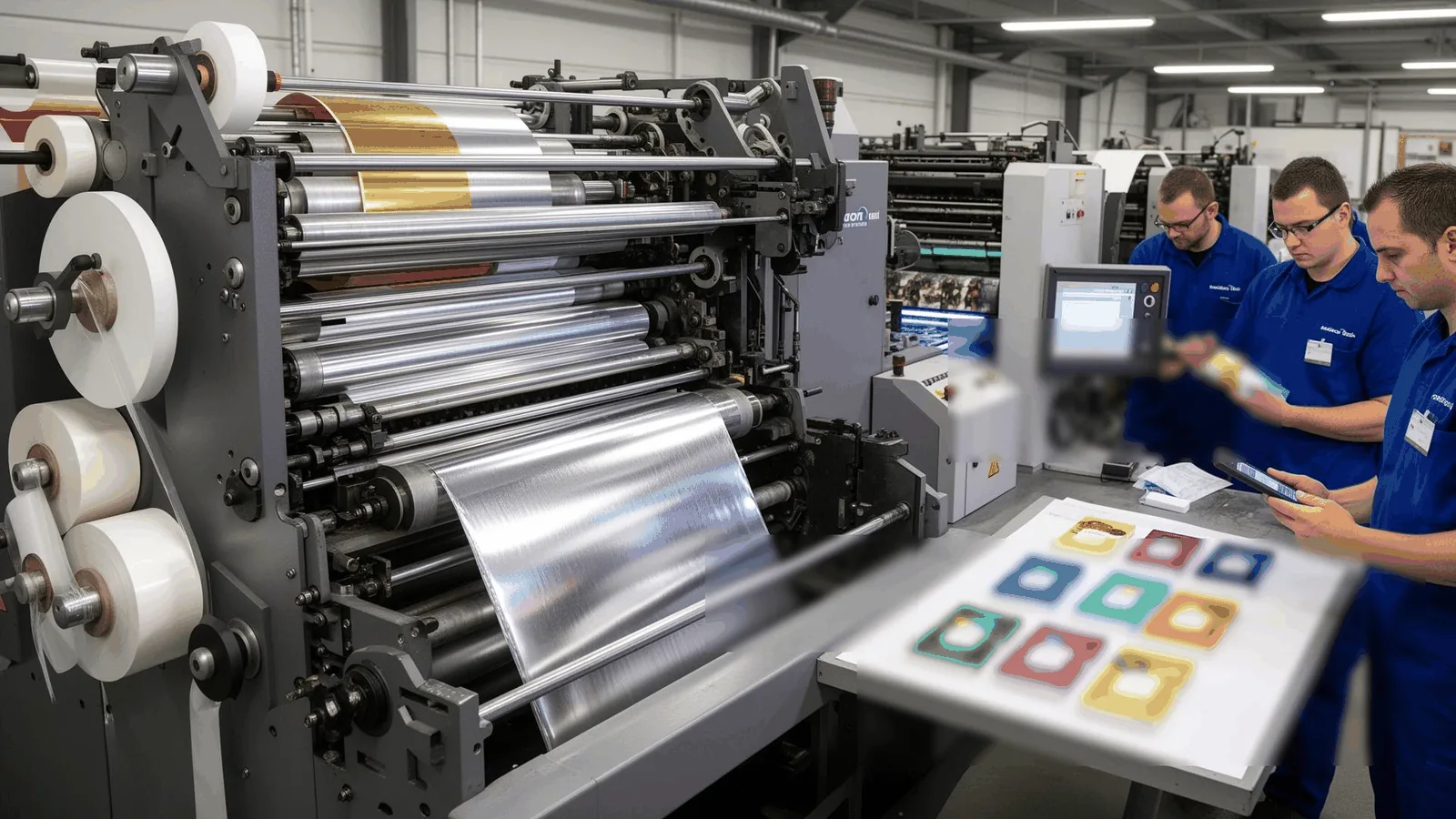
“TL;DR: A retrofit cold foil module installation is not just a bolt-on purchase. The best projects start with a press audit, web-path study, UV adhesive/curing validation, operator workflow plan and acceptance test. If the module fits the press envelope, keeps foil tension stable, cures adhesive consistently and can be cleaned without slowing makeready, retrofitting can add premium metallic packaging capability without buying a new press.
Search intent for “retrofit cold foil module installation” is practical and commercial. Buyers are usually trying to answer four questions: can my existing press accept a cold foil unit, how much downtime should I expect, what utilities and consumables change, and what proof do I need before signing off the project?
This guide turns those questions into a press-side checklist for converters, packaging buyers and print engineers evaluating a cold foil retrofit.
What is a retrofit cold foil module?
A retrofit cold foil module is an add-on foil delivery system installed on an existing printing or converting press. Instead of buying a new press, the converter adds unwind, rewind, nip, tension and control hardware so a printed UV adhesive pattern can pick up metallic foil inline.
Cold foil is attractive for retrofit projects because the process supports fine detail, overprintable metallic color and high-speed packaging work. For teams still clarifying the base process, start with our guide to how cold foil stamping works step by step and the broader cold foil technique guide.
Industry suppliers describe retrofit feasibility in similar terms. Eagle Systems states that almost all types of lithographic printing press can be adapted to cold foil and that modules can be retrofitted without altering the basic press functions or electronics (Eagle Systems). Compact Foilers describes press-mounted cold foil units with tension control, foil-saving options and rapid delivery/installation (Compact Foilers).
Installation decision matrix
| Installation question | What to verify | Why it matters | Pass signal |
|---|---|---|---|
| Press compatibility | Available station, frame clearance, roller access, guard position | The module must fit without compromising press safety or normal print control | OEM or integrator confirms mechanical envelope |
| Web path | Foil unwind/rewind path, nip geometry, substrate travel | Poor web path creates wrinkles, registration drift and foil breaks | Stable foil travel at production speed |
| UV adhesive system | Adhesive unit, anilox/plate or offset unit, curing window | Cold foil transfer depends on adhesive laydown and cure control | Clean transfer with no picking or dull zones |
| Tension control | Closed-loop tension, reel diameter compensation, rewind stability | Metallic foil is sensitive to slack, telescoping and sudden web changes | No chatter, burst lines or tracking drift |
| Operator workflow | Threading, splice, reel change, cleaning, fault recovery | Retrofit value disappears if every job adds excessive makeready | Repeatable changeover time after training |
| Acceptance test | Production substrate, real artwork, target speed, finishing route | Lab samples can hide real production limits | Signed samples match buyer specification |
Step 1: Audit the existing press before requesting quotes
Start with a structured press audit. Measure the available machine footprint, side-frame access, electrical cabinet space, UV lamp location, compressed air availability and operator walkway clearance. Photograph the exact stations where the module could mount.
Then document the jobs you want to run: carton board or label stock, maximum web or sheet size, foil coverage percentage, typical run length, color sequence, varnish, lamination, die-cutting and finishing steps. A retrofit for premium cosmetic cartons has different requirements than a label line running short promotional SKUs.
If the project is carton-focused, compare this article with our luxury cosmetic cold foil cartons guide, because premium cartons often need overprinted metallic tones, varnish protection and strict brand-color approval.
Step 2: Confirm the foil web path and tension strategy
Foil path is the installation detail that buyers often underestimate. The module needs enough space for unwind, foil contact, transfer, waste rewind and safe operator access. If the foil path is too tight or the module sits in a poor station position, wrinkles and tracking issues can appear before the press reaches target speed.
Ask the integrator how tension is measured and corrected as reel diameter changes. Ask whether the module supports foil saving, skip feed or multiple foil lanes. For long-run packaging, foil waste can matter as much as purchase price.
Telstar Engineering describes retrofit cold foil units that can be mounted on nearly any press or converting line and can apply UV-cured cold foil to thin films and heat-sensitive webs (Telstar Engineering). That flexibility is useful, but the real test is still your substrate, your press and your artwork.
Step 3: Validate UV adhesive, curing and overprint sequence
Cold foil transfer depends on a printed adhesive image. Installation planning should include adhesive supplier selection, anilox or plate specification, curing energy and the color sequence after foil transfer.
During trials, check:
- foil release on fine type, hairlines and reverse details
- adhesive squeeze at edges of solid metallic areas
- cure level before overprint or varnish
- ink adhesion on overprinted metallic foil
- odor, rub resistance and downstream die-cutting behavior
The U.S. Environmental Protection Agency notes that UV-curable materials are used in many industrial coating and printing contexts because they cure rapidly under ultraviolet light (EPA). In cold foil, that fast cure is useful only when adhesive film weight, lamp output and press speed are balanced.
Step 4: Plan installation downtime and training
A retrofit module can be physically installed quickly, but production readiness depends on commissioning. Budget time for mechanical mounting, guarding review, control integration, foil threading tests, UV setup, first article approval, operator training and maintenance handover.
Do not measure success by “module installed.” Measure success by “operators can run a sellable cold foil job twice in a row at the agreed speed.”
A practical commissioning plan includes:
- 1dry mechanical run without foil
- 2foil threading and tension run without adhesive
- 3adhesive-only print check
- 4foil transfer at low speed
- 5foil transfer at target speed
- 6overprint/varnish/finishing validation
- 7cleaning and restart test
- 8signed acceptance samples
Step 5: Calculate ROI beyond the module price
The retrofit business case should include module cost, installation labor, utilities, adhesive, foil waste, testing time, training, service access and expected premium revenue. Compare the retrofit against outsourcing foil work or buying a new press.
For financial modeling, the key variables are run length, number of SKUs, foil coverage, makeready time, foil saving capability and the premium your market will pay for metallic packaging. Our cold foil vs hot foil cost guide explains how setup, speed and artwork coverage change the real unit cost.
Buyer checklist before approving a retrofit
Before signing a purchase order, ask for written answers to these points:
- Which exact press models has this module been installed on?
- What press modifications are required, if any?
- Who is responsible for guarding and safety sign-off?
- What utilities are needed: power, air, extraction, UV cooling?
- What are the minimum and maximum foil roll widths?
- Can the module run multiple foil lanes or foil-saving modes?
- What adhesive system and curing setup are recommended?
- What substrates are excluded or need extra testing?
- What production-speed acceptance test will be used?
- What spare parts should be stocked before launch?
For substrate-specific planning, also review which is better for uncoated paper: cold foil or hot foil, because porous or textured papers can change adhesive holdout and transfer quality.
FAQ
—Can any press be retrofitted with a cold foil module?
Many existing presses can be retrofitted, but not every press is automatically suitable. The decision depends on mechanical clearance, station layout, web path, control integration, UV curing capacity, safety guarding and the products you need to run.
—How long does retrofit cold foil module installation take?
Physical installation may be short, but commissioning and operator training usually determine the true timeline. Plan for mechanical mounting, electrical/control checks, foil threading, adhesive trials, curing validation and signed production samples.
—What is the biggest retrofit cold foil risk?
The biggest risk is approving hardware before testing the real production combination: substrate, adhesive, foil grade, artwork coverage, speed, overprint and finishing. A controlled acceptance test reduces that risk.
—Does a retrofit module need special cold foil adhesive?
Yes. Cold foil relies on a UV-curable adhesive pattern that must transfer foil cleanly, cure correctly and support any overprint or varnish. Adhesive choice should be tested on the exact substrate and press setup.
—Is retrofitting better than buying a new cold foil press?
Retrofitting is often better when the existing press is mechanically sound, has suitable stations and can reach the required speed/quality after installation. A new press may be better when the current line lacks space, curing capacity, registration stability or future expansion room.