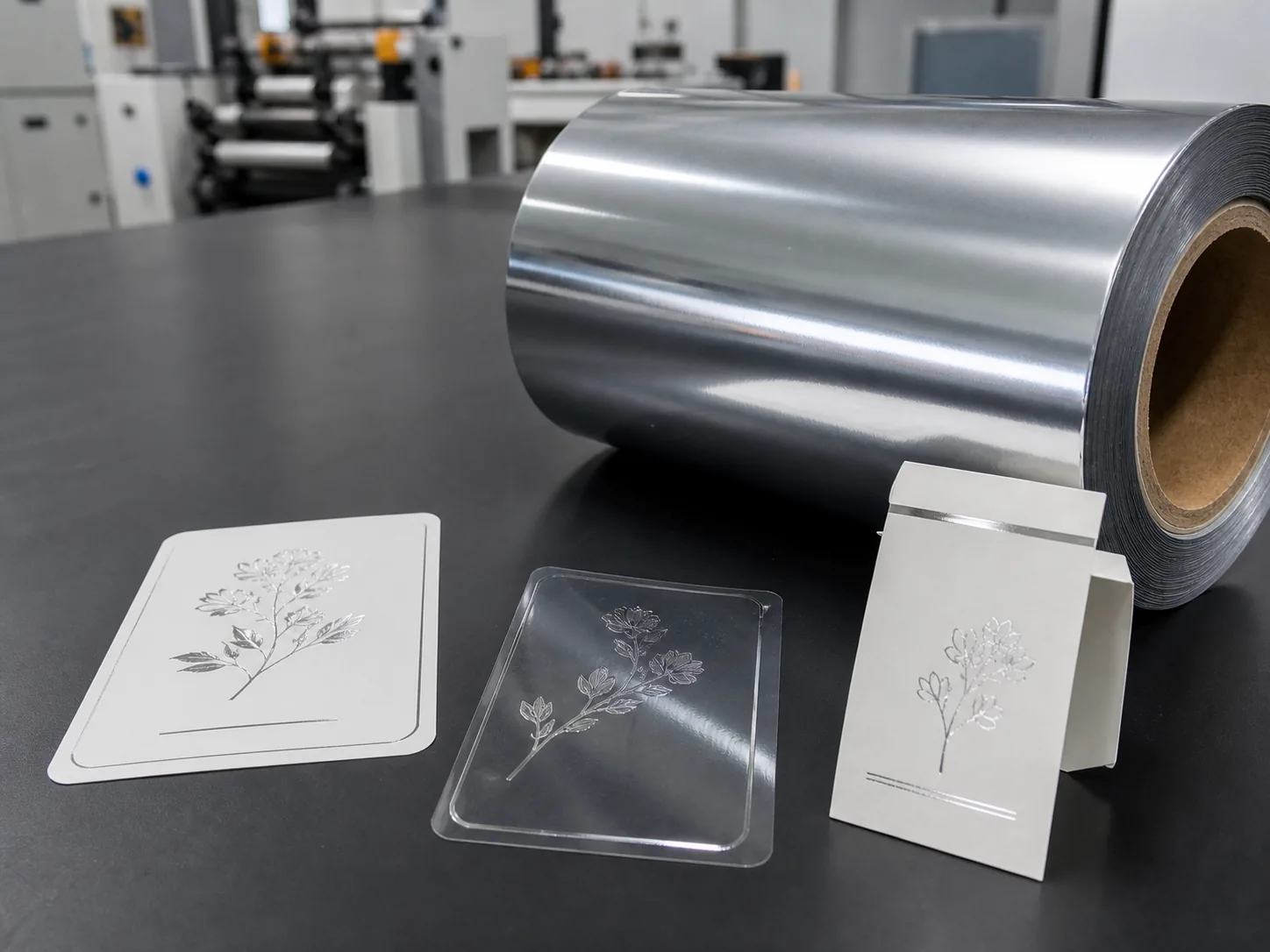
Consider cold foil when the design depends on a reflective metallic surface and the converter has a suitable transfer setup. Consider metallic ink when a specified ink can deliver the approved appearance within the available printing workflow. For labels and packaging, the useful comparison is not which process sounds more premium, but which can reproduce the agreed finish reliably at the quoted job cost.
What is the difference between cold foil and metallic ink?
Cold foil transfers a thin decorative layer from a carrier onto an adhesive image. Metallic ink prints metallic pigment in an ink vehicle directly onto the substrate. Both can create metallic decoration, but they build that decoration differently.
The carrier is removed during cold-foil transfer; it is not the metallic finish left on the package. For a broader introduction, see our cold foil stamping definition.
Metallic ink is also a broad category. ECKART's graphic arts range includes aqueous, UV and solvent-based metallic inks. An ink selected for one printing process should not be treated as representative of every metallic-ink option. Ask for the proposed product grade, not simply a quotation for "silver ink".
Cold foil vs metallic ink at a glance
Start with the required finished appearance, then check the equipment and consumables needed to reproduce it. This table identifies what to compare; it does not assign a universal winner.
Caption: Cold foil and metallic ink: decision factors for a label or packaging job
| Decision factor | Cold foil | Metallic ink |
|---|---|---|
| How the effect is produced | Decorative layer transferred from a carrier onto adhesive | Metallic pigment deposited as part of a printed ink film |
| Appearance to evaluate | Reflective finish, coverage and edge quality | Brilliance, metallic texture and coverage of the specified ink |
| Press requirements | Suitable foil handling, transfer setup and matched adhesive system | Compatible printing unit, ink system and drying or curing setup |
| Artwork preparation | Separate adhesive image and a planned overprint sequence | Ink separation and a printing sequence suited to the selected formulation |
| Material use | Foil feed width, repeat, transfer layout and make-ready waste | Ink consumption, coverage, laydown and preparation losses |
| Subsequent finishing | Check overprint and coating compatibility on the transferred surface | Check overprint and coating compatibility with the ink film |
| Acceptance evidence | Approved finished sample on the production stock | Approved finished sample on the same specified production stock |
Which gives the right metallic appearance?
Cold foil is worth testing when a strongly reflective metallic area is central to the design. Metallic ink deserves a fair comparison when its specified finish meets the brief; do not assume that every metallic ink will look dull.
A silver logo, a large metallic background and a fine reversed-out pattern are different tests. Include the actual difficult parts of the artwork in the proof instead of choosing a swatch that only shows each process at its best.
For a silver cold foil vs silver ink comparison, view both samples under the same lighting and at several angles. Compare coverage, visible texture, edge definition and the appearance after the specified varnish or laminate. A photograph taken at a flattering angle can conceal a difference that is obvious when the customer handles the pack.
Treat "matches the approved sample" as a more useful requirement than "looks premium". If numerical appearance measurements are needed, agree the instrument, geometry and acceptance limits with the converter before testing.
Match the process to your press, stock and artwork

Gold and copper metallic decoration on coated wine-label stock. Illustrative CFS product photography — not a controlled cold foil versus metallic ink comparison.
The available press configuration can decide which option is practical before material price does. A cold-foil proposal needs a suitable transfer system; an ink proposal needs an ink and drying or curing arrangement compatible with the press and stock.
Do not assume that a sheet-fed cold-foil job uses the same materials and sequence as a narrow-web job. KURZ's cold-transfer overview distinguishes these process families. Our flexo cold foil guide and offset cold foil guide provide the corresponding starting points for a CFS enquiry.
Confirm the exact substrate grade and surface treatment. A smooth coated sample cannot demonstrate performance on a textured production stock. Likewise, a successful print on one film does not qualify every film sold under the same general material name.
If the design includes coloured metallic areas, specify which colours print over the metallic base and which areas need an opaque appearance. Agree the separation and coating sequence with the converter rather than adding an overprint requirement after the metallic finish has been approved.
Compare the total job cost, not foil and ink prices
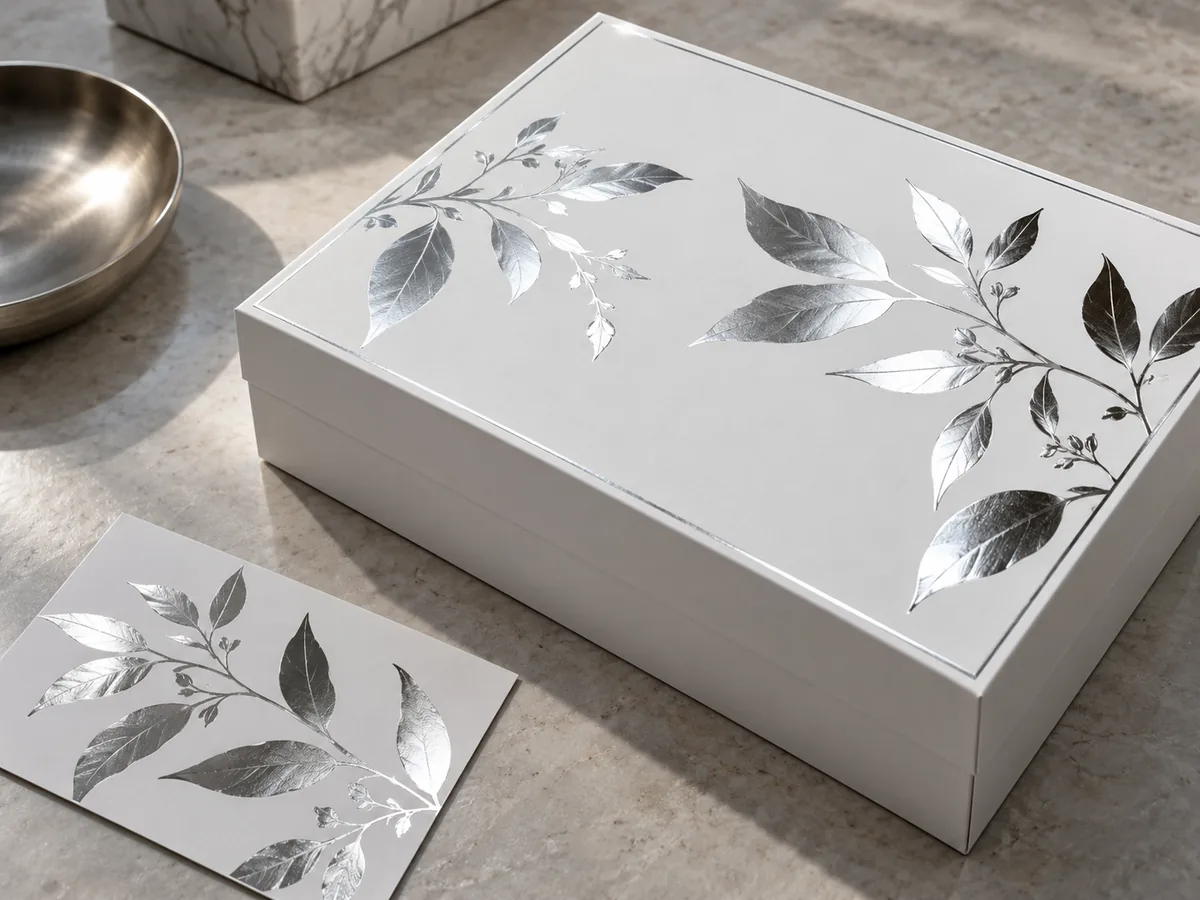
Mirror-silver metallic leaf artwork on a white rigid box and matching card. Fine stems show how much line detail the decoration method has to hold.
Neither process is automatically the cheaper choice. Compare quotations for the same quantity of accepted finished labels or packs, using the same artwork, stock and finishing specification.
For cold foil, ask how the foil width and repeat layout affect consumption, and include adhesive, setup waste and the occupied press units. For metallic ink, include the proposed grade, ink usage, preparation and cleaning, drying or curing needs and any additional passes. Both quotations should account for make-ready, press time and downstream finishing.
Use a consistent calculation: total cost within the agreed job scope divided by the number of accepted finished pieces. A lower consumable price is not a saving if it adds another pass or fails the appearance requirement.
Ask for a revised quotation when the artwork, quantity or finishing changes. There is no reliable universal run-length threshold at which cold foil becomes cheaper than metallic ink.
Approve the finished construction, not the metallic layer alone
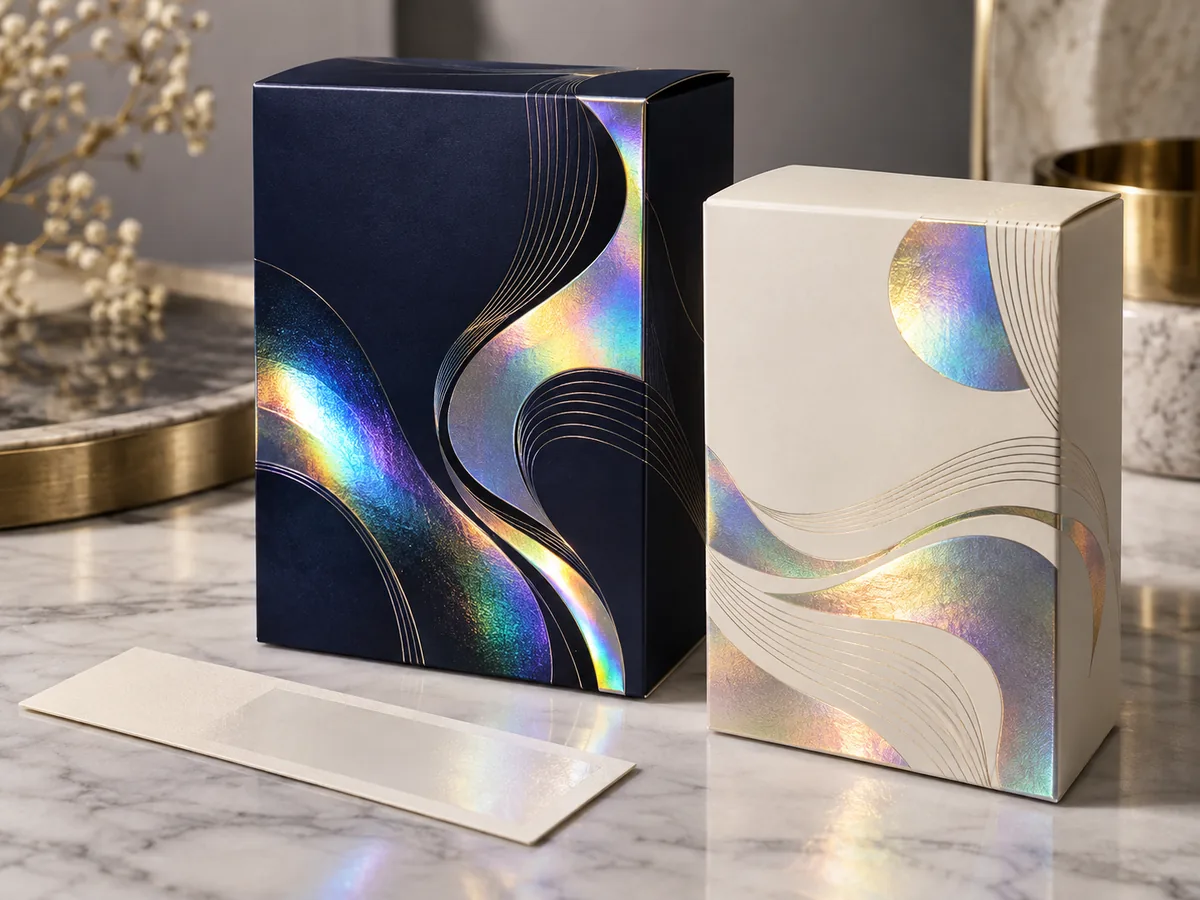
Holographic metallic effects on folding cartons. Diffractive finishes like this are produced with foil, not with metallic ink.
Appearance approval is only part of the decision. Both options need to meet the handling and finishing requirements of the completed label or package.
Evaluate adhesion, rubbing and any relevant folding, scuffing or exposure conditions on the finished construction. Record the conditioning period and agreed test method; do not compare one sample immediately off press with another after full drying or curing. The converter and buyer should define suitable pass criteria for the actual application.
Environmental comparisons also need a defined scope. Identify production waste streams and obtain evidence for the complete packaging construction and its intended recovery route. Neither the word "foil" nor the word "ink" establishes recyclability or a lower environmental impact. This guide does not provide an environmental certification or a comparative life-cycle assessment.
A practical sample test before you choose

Bright gold decoration on dark and light board. Evaluate solid panels and fine line work on your own stock before approving a process.
Request matched trials rather than unrelated sample books. The purpose is to identify an acceptable, repeatable production option, not to stage a photograph in which one process wins.
- 1Define the brief. Record the stock grade, artwork revision, order quantity, required finish and intended handling conditions.
- 2Identify the materials. Record the foil and adhesive grades for one option and the metallic-ink grade for the other. Identify any primers, overprints and protective coatings.
- 3Use representative artwork. Include the smallest important detail, a solid area and any critical overprinted colour from the actual job.
- 4Finish both samples as specified. Assess the version the customer will receive, not just unfinished press sheets.
- 5Review under matched conditions. Use the same lighting and viewing approach. Keep photographs supplementary to the physical samples, and retain unedited originals if results are documented.
- 6Record the decision. Keep the approved sample, relevant press settings, test observations and quotation assumptions together. Record actual results only; leave untested items unapproved.
For the cold-foil part of the trial, the press setup checklist helps organise the information to record. Choose metallic ink if it satisfies the signed brief more effectively on the available equipment. Choose cold foil if its approved finish and production proposal better meet the job requirements.
Technical references and scope
This is a process-selection guide, not a report of a controlled CFS cold-foil versus metallic-ink trial. The evaluation procedure above is proposed guidance. It does not establish a measured performance difference between two named products.
The linked ECKART reference supports the distinction between metallic-ink systems. The linked KURZ reference supports the distinction between cold-transfer process families. Neither supplier's published capabilities should be read as a CFS product specification or endorsement. Final selection requires the technical data for the proposed materials and an approved sample on the specified stock.
Frequently asked questions
Can metallic ink replace cold foil on an existing label? +
It can be considered, but it is a material and process change rather than a direct substitution. Reapprove the appearance, artwork separations, coating compatibility and finished-label performance before switching production.
Is metallic ink suitable when the printer has no cold-foil unit? +
It may be a practical option if the press supports the selected ink system and its drying or curing requirements. The absence of a foil unit does not by itself confirm that a particular metallic ink is suitable.
Is a silver cold-foil sample enough to approve gold decoration? +
No. A silver sample can help assess the base effect, but gold foil and coloured overprints need their own approval. Specify the actual foil or colour-building method and assess the intended final shade and coating.
What should I send when requesting a cold-foil trial sample? +
Send the substrate grade, press and foil-unit details, artwork or coverage information, overprint and finishing requirements, and the target appearance. Include the proposed metallic-ink sample or grade if available so that the comparison has a defined reference.