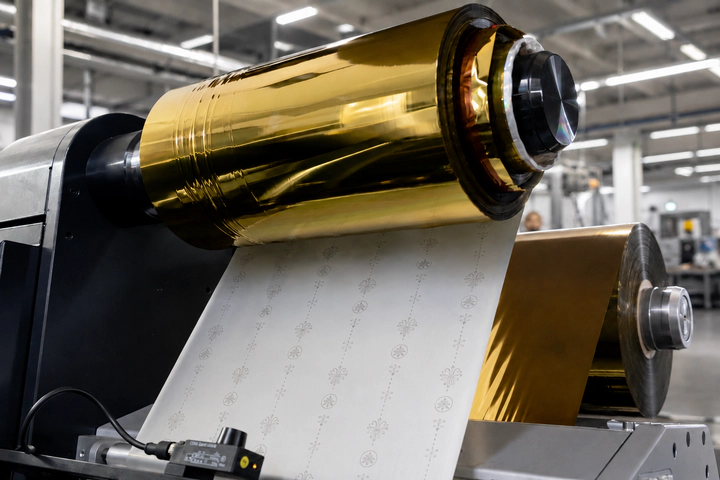
Cold foil stamping is an inline print-finishing process that transfers a thin metallic layer from a carrier film to selected areas of paper, board or film. A printing plate applies UV-curable adhesive, the foil is laminated under pressure, UV energy cures the bond, and the carrier is peeled away. Because no heated die is required, converters can run fine metallic graphics at production speed and overprint the foil with color.
Quick technical answer
Cold foil stamping applies a metallic layer inline on a printing press: a plate lays down UV-curable adhesive in the shape of the artwork, a metallised PET web is nipped onto the wet adhesive, UV lamps cure the bond and the spent carrier peels away. Because there is no heated die, converters can hold fine metallic detail at production speed and overprint the foil with CMYK in the same pass. Results depend on substrate smoothness, adhesive compatibility and cure energy, so every new job should be confirmed with a press trial.
What is cold foil stamping? (definition)
Cold foil stamping — also called cold foil transfer, inline cold foiling, or simply cold foiling — is a decorative printing technique that applies a metallic or holographic finish to paper, board, film, or foil substrates without heat and without a metal die. Instead of the heated brass die used in traditional hot stamping, cold foil relies on two things: a flexo or offset printing plate that lays down a UV-curable adhesive in the exact shape of the artwork, and a cold foil web that is pressed onto the wet adhesive and instantly cured under UV lamps.
Because the process is inline — integrated into a printing press rather than run as a separate finishing step — cold foil delivers metallic decoration at the same speed as normal printing, and the foil area can be overprinted with CMYK inks in later units of the press to create colored metallics (gold, copper, rose, teal, etc.) from a single silver foil.
How cold foil stamping works (step by step)
The process happens in four inline stations on a single press pass:
- 1Adhesive printing. A flexo or offset plate transfers a UV-curable adhesive onto the substrate in the exact shape of the artwork — text, logo, pattern, or full flood.
- 2Foil lamination. A continuous web of metallized PET foil (typically 12–23 microns thick) is unwound and pressed against the adhesive-coated substrate under a nip roller; nip pressure is set during press trials for the substrate and foil grade in use.
- 3UV curing. UV-LED or mercury-arc lamps cure the adhesive inline, permanently bonding the metallic layer to the substrate wherever adhesive was printed.
- 4Foil web rewind. The unused foil — everything outside the printed image area — peels off cleanly and rewinds onto a take-up reel for recycling or disposal.
After the foil station, the substrate continues through the remaining print units, where CMYK inks can overprint the metallic area to shift its color, add texture, or combine with process artwork — all in the same press pass.
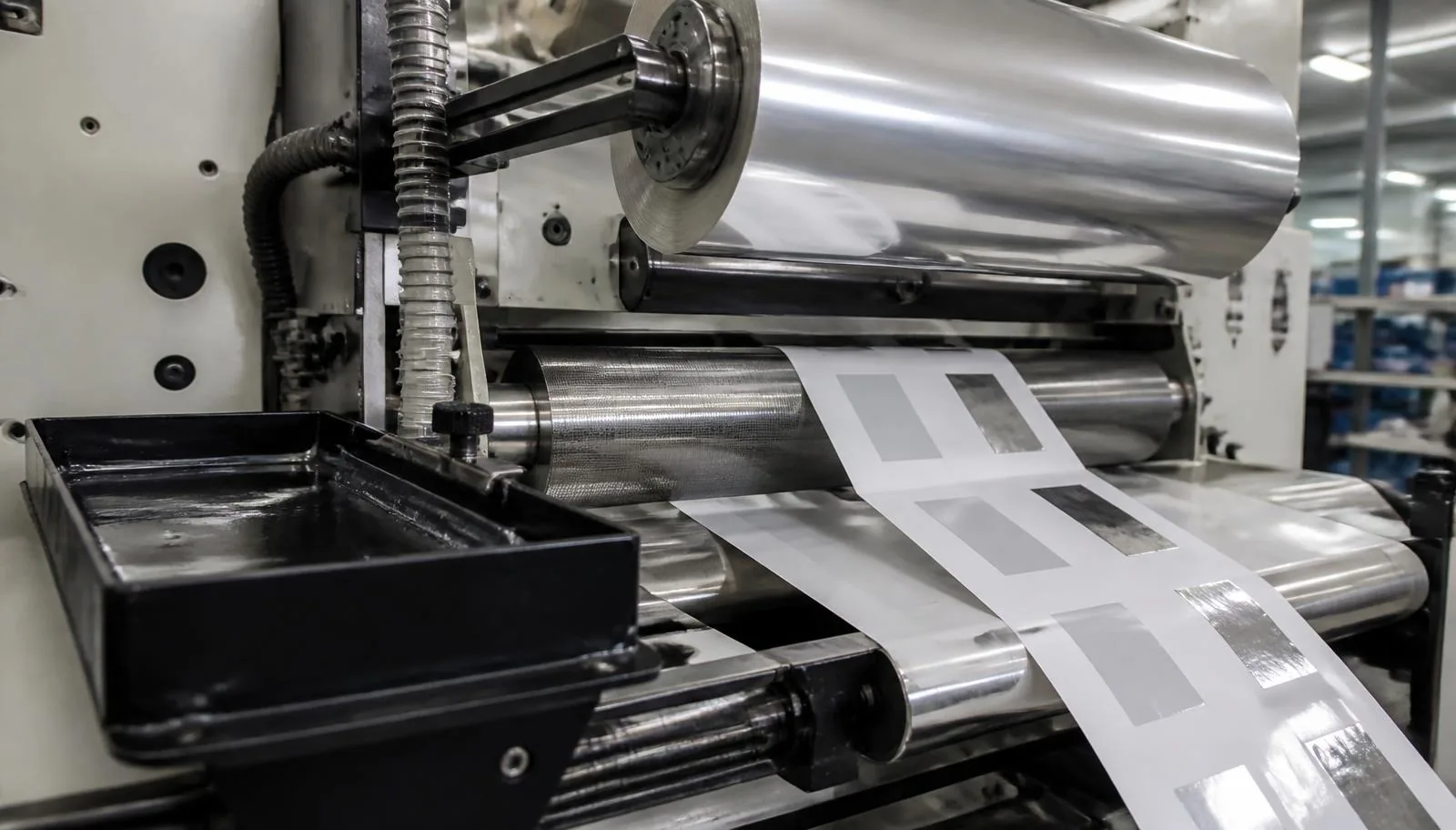
Caption: The adhesive station sets everything downstream — laydown weight here decides edge sharpness, pinholing and how much cure energy the job needs. More detail in our UV cold foil adhesive guide.
Cold foil vs hot foil vs digital foil: at a glance
| Attribute | Cold Foil Stamping | Hot Foil Stamping | Digital Foil (e.g. Scodix) |
|---|---|---|---|
| Where it runs | Inline with the printing press | Usually offline finishing | Offline digital finishing |
| Tooling | Requires a flexo or offset printing plate | Requires an engraved die | No tooling |
| Heat | No heated die | Heat-and-pressure transfer | No heated die |
| Typical run length fit | Suitable for medium and long production | Suitable for short and medium production | Suitable for short production and versioned work |
| CMYK overprint | Supports inline overprinting | Limits overprinting (separate pass) | Supports overprinting |
| Effect | Flat metallic effect | Embossed or tactile effect possible | Raised or flat digital effect |
| Variable data | Not supported | Not supported | Supported |
Bottom line: cold foil suits inline metallic decoration where overprinting and press integration matter. Hot foil suits tactile relief and fine detail. Digital foil suits very short, versioned or personalised work. The right choice depends on your press configuration, substrate, coverage and run length — confirm it with a trial rather than a generic rule.
For a deeper comparison, see our Cold Foil vs Hot Foil Printing guide and the Cold Foil vs Scodix Digital Foil breakdown.
Terminology buyers should know
Most specification misunderstandings between brand owners, converters and foil suppliers come from these seven words being used loosely.
| Term | What it means | Why it matters in a quotation |
|---|---|---|
| UV adhesive | The UV-curable resin printed through a plate to define the foiled image | Grade and laydown decide transfer sharpness, adhesion and cure demand |
| Foil carrier | The PET film that carries the release, metallised and size layers | Carrier gauge (typically 12–23 µm) affects tension behaviour and waste volume |
| Anilox | The engraved roller metering adhesive volume onto the plate | Wrong cell volume produces pinholes or squeeze-out around fine detail |
| Nip pressure | The pressure at the roller that presses foil onto wet adhesive | Uneven nip gives patchy release across the web width |
| UV curing | The lamp dose that fixes the adhesive at running speed | Cure dose falls as speed rises, so adhesion must be re-tested at speed |
| Foil release | How readily the metal separates from the carrier | Release grade must match adhesive and speed, or edges tear or shed dust |
| Overprint | Printing CMYK or varnish on top of the transferred foil | Ink and varnish chemistry decides whether the metal lifts later |
Press-side settings for these variables are covered in the cold foil press setup checklist, and process-specific behaviour in offset cold foil stamping and flexo cold foil stamping.
Where cold foil stamping is used
Cold foil is widely used for metallic decoration on flexible packaging and pressure-sensitive labels, particularly where the metallic area has to be overprinted inline with process colour.
Typical applications include:
- Beverage labels — beer, wine, spirits, energy drinks (metallic sunbursts, foil borders, brand marks)
- Beauty and personal care — shampoo, cosmetics, fragrance cartons
- Confectionery and snack packaging — chocolate wrappers, premium biscuit boxes
- Nutraceutical and pharma cartons — brand differentiation and anti-counterfeit patterns
- Greeting cards, gift wrap, and stationery — full-flood metallic backgrounds
- Security and authentication — holographic cold foil on tickets, tax stamps, IDs

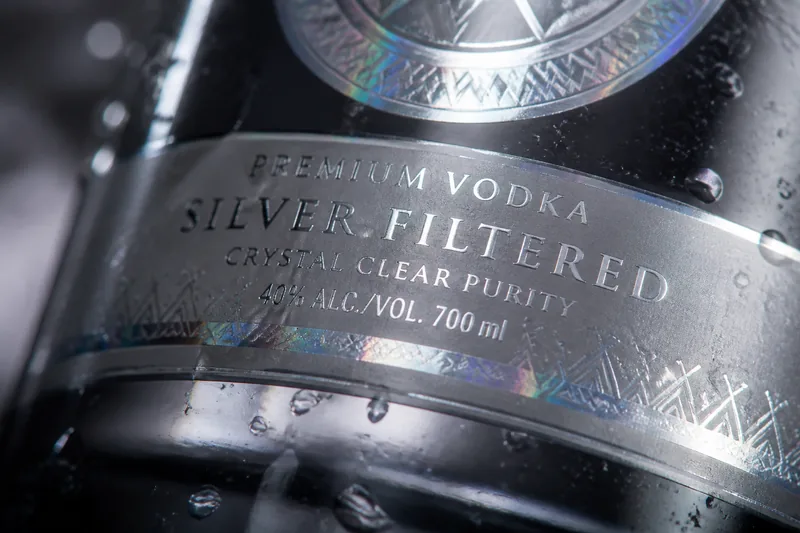
Caption: A finished label with the metallic panel overprinted inline — the standard reason converters choose cold foil over an offline stamping pass.
What substrates and inks work with cold foil?
Cold foil bonds best to smooth, low-porosity surfaces. The guidance below gives initial artwork and press-trial starting points, not universal product specifications:
| Substrate | Suitability | Notes |
|---|---|---|
| BOPP film | Excellent | Standard for pressure-sensitive labels — see our Cold Foil on BOPP Labels guide |
| PET film | Excellent | Widely used for premium labels |
| Coated paper (SBS, C1S, C2S) | Excellent | Requires ≥ 120 gsm and calendered surface |
| Uncoated paper | Poor | Absorbs adhesive — foil coverage suffers |
| Kraft board | Fair | Needs pre-coating or primer |
| Metallic substrates | Not recommended | Adhesion issues; use hot foil instead |
UV inks must be cold-foil compatible — some standard UV formulations inhibit adhesive cure or leave a residue that prevents foil adhesion. Always request a cold-foil compatibility statement from your ink supplier, or use a certified UV cold foil adhesive system.
Cost, run length, and economics
Because cold foil applies the adhesive and metallic transfer inline, it can run with the printing process and avoids an engraved hot-stamping die. Actual speed, cost and break-even volume depend on the press configuration, substrate, adhesive, foil coverage, run length and finishing requirements.
The main cost drivers to model for your own job are:
- Plate and make-ready for the adhesive image, instead of die engraving.
- Foil consumption, which is driven by web width, repeat length and how much of the web is actually transferred.
- Press time, which depends on your running speed and the number of units the job occupies.
- Finishing passes avoided, since the metallic area can be overprinted in the same pass.
Ask your supplier or converter to price these against your real artwork and run length rather than a published average.
For a full quote-ready breakdown, see the Cold Stamping Foil Quote Checklist.
Design rules for cold foil artwork
The values below are initial artwork and press-trial starting points, not universal product specifications. Confirm final limits through a press trial using the actual foil grade, adhesive, substrate, lamp system and production speed.
- Minimum line weight: 0.25 pt (0.09 mm)
- Minimum text size: 5 pt for sans-serif, 6 pt for serif
- Minimum negative space between foil elements: 0.3 mm
- Maximum coverage per plate: 85% (higher risks foil starvation)
- Trap for CMYK-over-foil: 0.15 mm overlap on the foil edge
- Avoid: ultra-fine hairlines under 0.15 pt, isolated dots below 0.3 mm
Cold foil is a spot color in prepress — request a dedicated PANTONE spot channel named "COLDFOIL" in your artwork file, and the printer will map it to the adhesive plate.

Caption: High-chroma reference for CMYK-over-foil artwork — vivid tones stay saturated over a reflective base, which is why trapping and coverage limits matter.
Sustainability and recyclability
Cold foil transfer deposits a very thin metallic layer rather than laminating the whole package with metallised PET film. The 4evergreen Circularity by Design Guideline, Version 4 (February 2026) identifies hot and cold transfer as preferable design approaches to metallised PET laminates for some fibre-based packaging recycling routes.
However, recyclability depends on the complete packaging construction, coatings, adhesives, substrate and local recycling process. Full metallisation may also affect NIR sorting, so production packaging should be assessed using an appropriate recyclability test protocol.
During production the spent carrier film is rewound onto a take-up reel. Recovery or disposal options for that carrier depend on your local waste-management providers.
Evidence & sources
CFS field note. In sample reviews the same three variables explain most rejected cold foil trials: the substrate is not the grade used in the original test, the adhesive laydown was raised to chase coverage instead of fixing anilox condition, and cure was never re-measured after the line speed increased. When converters send us a defect sample together with the approved sample, the difference is usually visible before any material is changed.
Technical references.
- Leonhard Kurz, cold transfer technology overview — foil construction, transfer principle and press integration.
- Packaging Digest, cold foil transfer application tips — practical application guidance from converter practice.
- Foil & Specialty Effects Association, sustainability and green initiatives — industry position on foil decoration and recovery.
- 4evergreen, Circularity by Design Guideline, Version 4, February 2026 — download the PDF. Basis for the design guidance in the sustainability section above.
Practical limitation. Cold foil is not a universal metallic solution. Rough or highly absorbent uncoated stock, heavy textured board, unprimed kraft and low-energy untreated film all reduce transfer quality, and a flat metallic surface cannot reproduce the relief of a hot-stamped or embossed finish. Adhesive compatibility, curing energy at production speed and nip uniformity are job-specific, so published starting values are trial inputs rather than specifications.
Buyer takeaway. Before requesting a sample or quotation, fix the substrate grade and supplier, the press and foil station type, the artwork coverage and smallest detail, the overprint and varnish plan, and the run length. Ask for a transfer and adhesion result on your own stock rather than a generic swatch, and keep the signed sample with the recorded press settings.
Citation-ready summary
Cold foil stamping is an inline print-finishing process in which a UV-curable adhesive is printed in the shape of the artwork, a metallised PET foil is pressed onto the wet adhesive, and UV lamps cure the bond before the carrier film is rewound. No heated die or engraved tooling is required, and the metallic area can be overprinted with process colour in the same press pass. Transfer quality depends on substrate smoothness, adhesive compatibility, cure energy and press setup.
Frequently asked questions
What is cold foil stamping in one sentence? +
Cold foil stamping is an inline printing process that bonds a thin layer of metallized polyester foil to a substrate using a UV-cured adhesive applied through a flexo or offset plate at room temperature — no heated die and no engraved tooling required.
Why is it called "cold" foil? +
It is called cold foil because, unlike traditional hot foil stamping, the process uses no heat to transfer the metallic layer. Bonding is achieved by a UV-curable adhesive activated with ultraviolet light, so the foil, adhesive, and substrate all remain at ambient temperature throughout the transfer.
Is cold foil stamping cheaper than hot foil? +
It can be, because cold foil avoids an engraved die and runs inline with printing instead of as a separate finishing pass. Whether it is cheaper for your job depends on the press configuration, substrate, adhesive, foil coverage, run length and finishing requirements, so compare quotes for your actual artwork and volume.
Can you print CMYK over cold foil? +
Yes. One of cold foil's key advantages is that the metallic area can be overprinted with CMYK inks in the same press pass, allowing a single silver foil to be transformed into gold, copper, rose, teal, or any custom metallic color — without a separate finishing operation.
What is the minimum text size for cold foil? +
As initial artwork and press-trial starting points, not universal product specifications, use around 5 pt for sans-serif and 6 pt for serif typefaces with a line weight of about 0.25 pt (0.09 mm). Below these limits foil coverage becomes inconsistent and fine detail may drop out during the peel step. Confirm final limits through a press trial using the actual foil grade, adhesive, substrate, lamp system and production speed.
What substrates work best with cold foil? +
Cold foil performs best on smooth, low-porosity substrates — coated paper (SBS, C1S, C2S ≥ 120 gsm), BOPP film, and PET film. Uncoated paper, kraft board without primer, and metallic substrates are not recommended because they either absorb the adhesive or prevent proper bonding.
Is cold foil recyclable? +
It depends on the complete packaging construction. The 4evergreen Circularity by Design Guideline, Version 4 (February 2026) identifies hot and cold transfer as preferable design approaches to metallised PET laminates for some fibre-based packaging recycling routes, but coatings, adhesives, substrate and the local recycling process all matter. Assess production packaging with an appropriate recyclability test protocol. The spent carrier film is rewound during production; recovery or disposal depends on local waste-management providers.
Watch the process
Prefer to see it running? Watch the cold foil stamping process video — a 27-second production-line walkthrough with a full transcript covering adhesive printing, foil transfer and UV curing.
Next steps
- Browse our Cold Foil Products range to see available foil colors, gauges, and effects
- Read the pillar page: Cold Foil Printing: Complete 2026 Guide
- Request a free cold foil sample roll to test on your press
- Compare finishes head-to-head: Cold Foil vs Hot Foil Printing
Last updated: August 17, 2026. Reviewed by the ColdFoilStamping technical team.
Continue by task
- Cold foil stamping process — press setup, UV cure and QC, step by step.
- Cold stamping foil material guide — carrier, release, metallised and adhesive layers explained.
- Cold foil technique guide — press-side handling, tension and overprint control.
- Hot foil vs cold foil — tooling, speed and cost comparison.
- Cold foil products — the full CFS foil range and specifications.