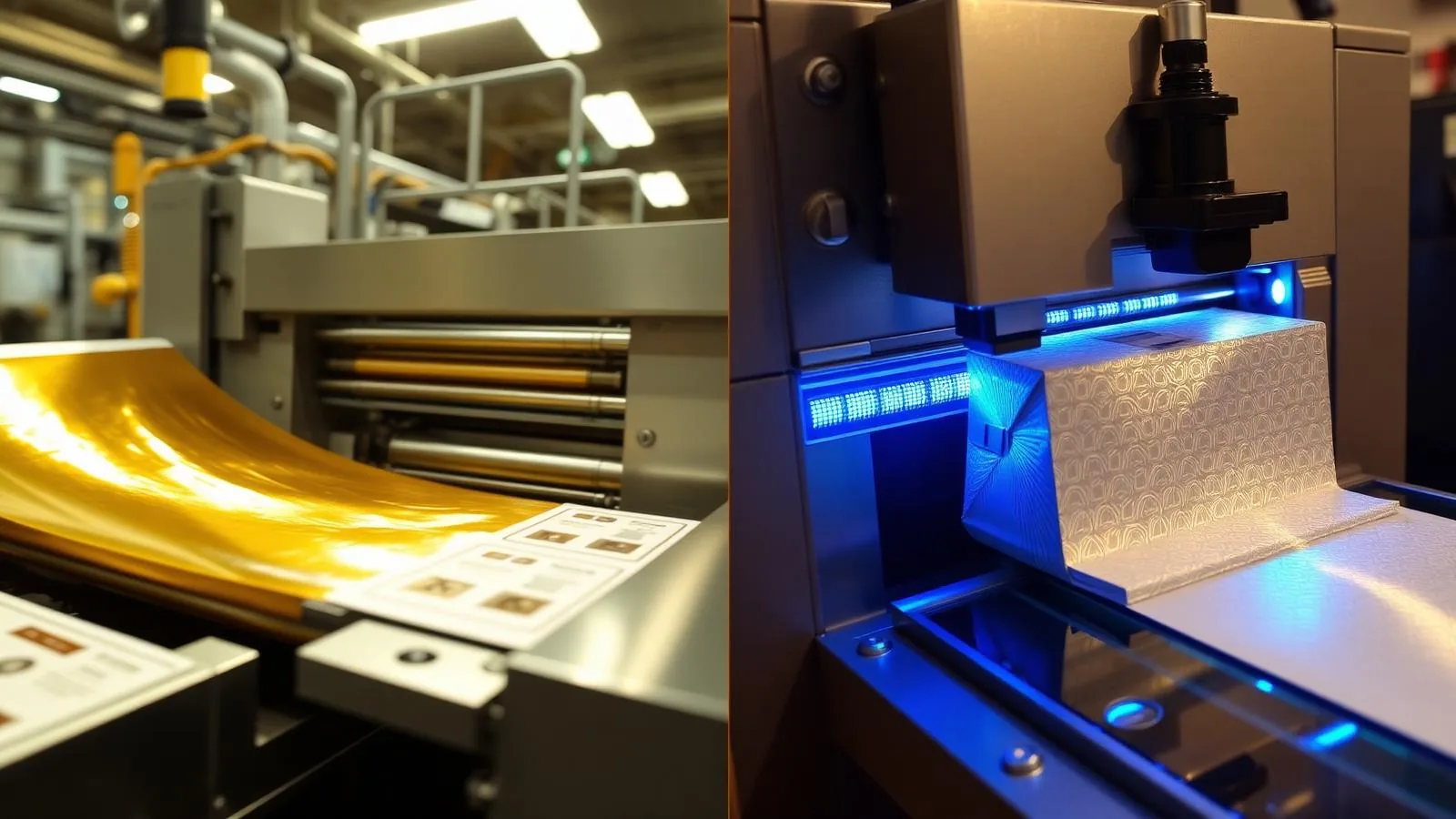
Packaging buyers, converters and print engineers usually reach this comparison with one metallic brief and two very different production routes. This guide sets out how each workflow behaves, what actually drives cost, and which questions to settle with a real job specification before committing artwork or tooling.
Quick technical answer
Cold foil usually suits high-volume inline label and carton production, where a printed adhesive image and roll-fed foil transfer keep metallic decoration inside a single press pass. Scodix-style digital enhancement usually suits short runs, versioned or variable artwork and raised tactile effects, because placement is driven by the job file instead of a plate. The honest decision is made per job, by quoting the same specification through both routes.
Disclaimer: Scodix is a separate company and technology. CFS manufactures and supplies cold foil and is not affiliated with, endorsed by or a supplier to Scodix. All Scodix capability statements here refer to the company's own published documentation.
Scodix vs traditional foil stamping: the short answer
Scodix is digital enhancement: polymer is jetted from the job file and foil is bonded to it, with no plate and no die. Traditional foil stamping uses a heated engraved die to press pigmented foil onto the sheet. Cold foil sits between them as an analog but plate-driven process, transferring foil inline through a printed UV adhesive image.
In practice the three routes answer different questions. Scodix answers "how do I foil 500 versioned sheets tomorrow?". Hot foil stamping answers "how do I get a tactile, embossed metallic crest?". Cold foil answers "how do I put metallic on a long production run without leaving the press?".
| Method | Tooling | Minimum order fit | Speed | Raised effect | Fine detail | Overprinting | Typical buyer |
|---|---|---|---|---|---|---|---|
| Scodix digital foil | None; driven by the job file | Very short runs and versioned work | Sheet-fed digital, slower per sheet | Yes, built from polymer | Good | Limited | Commercial printers, short-run packaging |
| Cold foil | Flexo or offset plate | Medium to long runs | Inline at press speed | No, flat finish | Around 50 µm line detail | Yes, CMYK directly over foil | Label and carton converters |
| Hot foil stamping | Engraved brass or magnesium die | Short runs and luxury accents | Typically 20–60 m/min offline | Yes, from die pressure | Very fine | Unreliable | Luxury print and rigid box makers |
When should a converter choose cold foil instead of Scodix?
Choose cold foil when volume is repeatable and the metallic must come off the same press as the print. Once a job settles into regular production, the per-sheet economics of a plate-driven inline process pull well ahead of a digital enhancement pass, and there is no separate sheet handling stage to schedule.
Cold foil is also the better route when the design relies on overprinted metallics. Because the foil is applied upstream of the process colour units, one silver base can carry several metallic colours across an SKU family without new consumables. If the effect must be flat and continuous over a large area, cold foil handles it more predictably than a polymer build.
When does Scodix make more sense?
Scodix makes more sense when the run is short, the artwork changes often, or the effect must be raised. Because placement comes from the file, versioned artwork, personalised covers and sales samples can be produced without a plate or die, and a raised tactile foil element is available in the same pass.
It is also a practical prototyping route. Producing a handful of decorated sheets to present a concept internally, or to compare finishes before committing to a production process, is much cheaper digitally than by making tooling.
How to test cold foil before replacing digital foil
Run the same artwork both ways on your real substrate and compare the results side by side. Judge metallic brightness, edge sharpness at the smallest positive detail, adhesion after a tape and rub check, and how each result looks under the lighting the finished product will sit in.
Order a swatch book plus a trial roll from the cold foil sample kit page and include your substrate, press and adhesive so the material is slit and matched to your line. Process background is covered in the cold foil printing guide, the analog comparison in hot foil stamping vs cold foil, and supply questions on the cold stamping foil manufacturer page.
Scodix foil vs cold foil: what is the difference?
Cold foil is an analog transfer process that prints UV adhesive and transfers foil inline on flexo or offset presses, making it suitable for repeat and longer production runs. Scodix Foil is a digital sheet-fed embellishment process that places and pins polymer before foil transfer, enabling die-free setup, raised effects and variable data. The better choice depends on run length, format, personalization and finish.
| Factor | Cold foil stamping | Scodix digital foil |
|---|---|---|
| Process | UV adhesive is printed through a plate; foil transfers at the nip and the carrier rewinds | A digital file controls polymer placement and pinning before foil transfer and final curing |
| Conventional tooling | Requires an image plate but no heated metal stamping die | Does not require a conventional image plate or metal stamping die |
| Best-fit work | Repeating designs, repeat orders and medium-to-long production runs | Prototypes, short-to-medium runs, versioned jobs and personalized embellishment |
| Variable data | Not native for each impression because the printed adhesive image is fixed by the plate | Supported through the digital workflow for job-specific or sheet-specific elements |
| Finish profile | Usually a flat mirror-metallic image that can be overprinted when the foil grade and ink system are compatible | Can produce flat or raised tactile foil effects depending on the Scodix application and polymer build |
| Production format | Inline web or sheet-fed cold-foil configurations, depending on the host press | Digital sheet-fed embellishment; format and productivity depend on the Scodix press model |
| Substrates | Depends on foil, UV adhesive, press and surface; validate paper, board and label films by trial | Depends on the press model and Scodix Recommended Substrate List; current systems support multiple paper, plastic and laminated media types |
| Cost logic | Plate and makeready costs are spread across the run, so economics often improve as repeat volume rises | No conventional image tooling; useful when setup avoidance, short runs or versioning outweigh per-sheet processing cost |
| Qualification | Trial the actual foil, adhesive, substrate, coverage, UV cure and finishing sequence | Confirm the press model, recommended substrate and foil, application settings, build height and number of cycles |
Sources and scope. Scodix capabilities vary by press model, application and configuration, so always confirm details against the official documentation for the specific machine: Scodix technology overview, how the Scodix Foil process works and the Scodix Ultra 2500 SHD specifications. This guide combines official Scodix product information with CFS cold-foil application knowledge; it is not a controlled third-party side-by-side laboratory test.
How does Scodix Foil work?
Scodix Foil is a digital embellishment process: the artwork file — not a plate or die — defines where the effect lands. According to the official Scodix Foil breakdown, the sequence runs broadly as follows.
- 1The printed sheet is loaded and registered on the digital enhancement press.
- 2A digital file drives placement of the clear polymer onto the areas that will carry foil.
- 3The polymer is pinned so it holds its position and profile before foil is introduced.
- 4Metallic foil is brought into contact and transfers to the polymer areas.
- 5The finished effect is cured and the sheet is delivered for further finishing.
Because the placement is digital, each sheet can differ. That is the structural difference from an analog plate-based workflow, and it is why Scodix is frequently specified for versioned or personalized packaging and print.
How does cold foil stamping work?
Cold foil transfers a metallic layer using a printed UV adhesive rather than heat and a metal die. The press prints the adhesive image, brings the foil web against the wet adhesive at the nip, cures it, then rewinds the carrier so only the adhesive-covered image keeps its metallic layer. On many lines the foiled area can then be overprinted with process or spot colours to build coloured metallic effects, provided the foil grade, ink and cure system are compatible.
Because the adhesive image comes from a plate, the same artwork repeats impression after impression — which is exactly why the process suits repeating designs and longer production runs. For the full press-side walkthrough, see our step-by-step cold foil stamping process. For carrier construction, release behaviour and specification language, see what cold stamping foil is made of.
Which method fits your run length and cost structure?
There is no universal break-even quantity, and any supplier who quotes one without seeing your job is guessing. Production speed, unit cost and the crossover point all depend on press model, sheet or web format, foil coverage, number of cycles or layers, tooling, makeready, foil width, substrate, adhesive or polymer consumption and downstream finishing.
The workable approach is to compare job-specific quotes and trials against the same specification. Use this checklist when you request them:
- Run quantity per order, and whether the order repeats.
- Number of versions, languages or SKUs in the same artwork family.
- Repeat frequency across the year, which changes how tooling amortizes.
- Sheet or web format and the host press the job will actually run on.
- Foil coverage and how much of the sheet carries metallic image.
- Tooling and makeready expectations, including plate cost and setup waste.
- Whether variable data or personalization is genuinely required.
- Finishing sequence: varnish, lamination, embossing, die-cutting, gluing.
- Trial and qualification cost, including test material and press time.
Ask both routes to quote against that same brief. The comparison becomes reliable only when the specification is identical on both sides.
Decision matrix: which route fits the job?
| Use case | Better fit | Why | Buyer question to ask |
|---|---|---|---|
| Repeat roll-fed label programme | Cold foil | Foil transfers inline at press speed and the plate cost spreads over the run | What is the cost per thousand at our actual coverage and run length? |
| Folding cartons with large metallic areas | Cold foil | Coverage is priced from foil consumption, not per sheet processing | How much foil width and coverage does the artwork really need? |
| Personalised or serialised packs | Digital enhancement | Placement is driven by the file, so each sheet can differ | Can the effect carry variable data at the required speed? |
| Short-run premium prototype or pitch pack | Digital enhancement | No plate or die means a faster, cheaper first sheet | What is the minimum viable quantity and turnaround? |
| Raised, tactile metallic effect | Digital enhancement | Polymer build creates relief that flat foil transfer cannot | How high is the build, and does it survive our converting steps? |
| Metallic that must be overprinted with CMYK | Cold foil | The metallic image can be overprinted inline to create custom shades | Which foil grade and ink system are qualified for overprint? |
| Film or pressure-sensitive labelstock | Cold foil | Roll-fed cold foil is standard on filmic label lines | What surface treatment and dyne level does the film hold? |
| Mixed versioning inside one long programme | Both, planned together | Base metallic inline, versioned accents digitally | Who owns the qualification of the combined sequence? |
Flat metallic transfer or raised tactile foil?
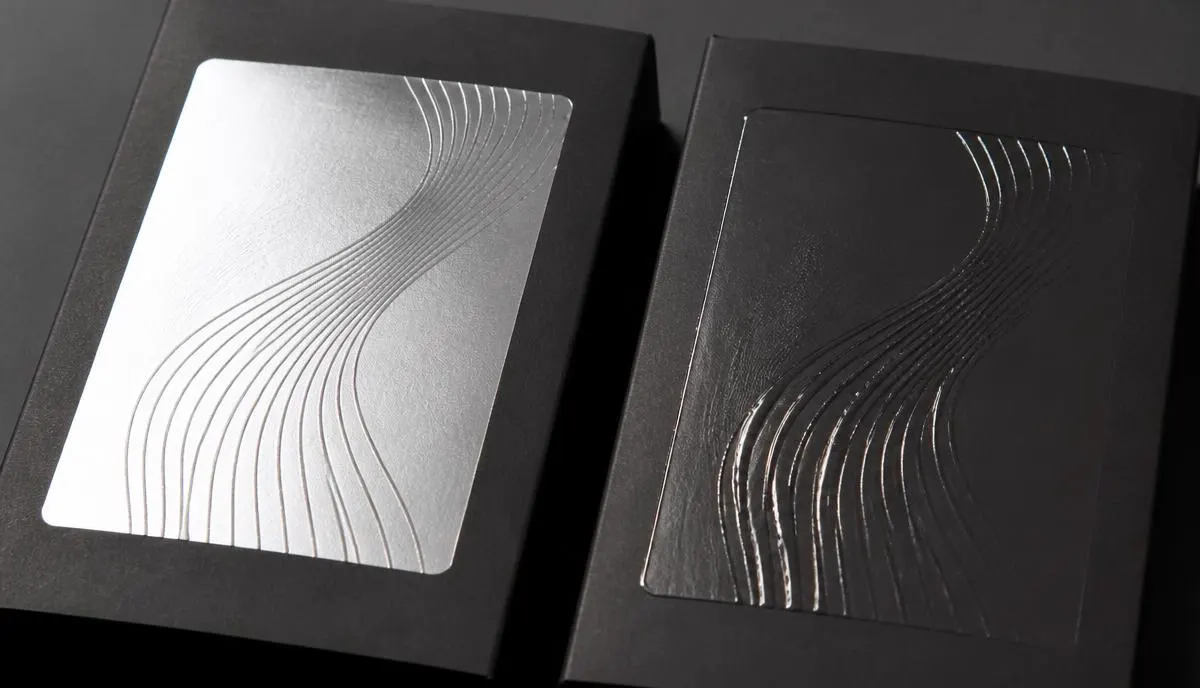
Cold foil is generally selected where the design calls for a flat metallic graphic that sits in the print, often with the intention of overprinting it to create coloured metallics inline. Scodix can build tactile digital embellishment, so the foil area can be raised depending on the application and polymer build.
Neither finish is objectively better. They are different design outcomes: a flat inline metallic reads as an integrated printed effect, while a raised effect adds a sensory dimension a buyer can feel. Decide from the shelf brief, the artwork and the brand's finishing language — then confirm that the chosen route can hold the detail your artwork needs by proofing it, not by comparing datasheets.
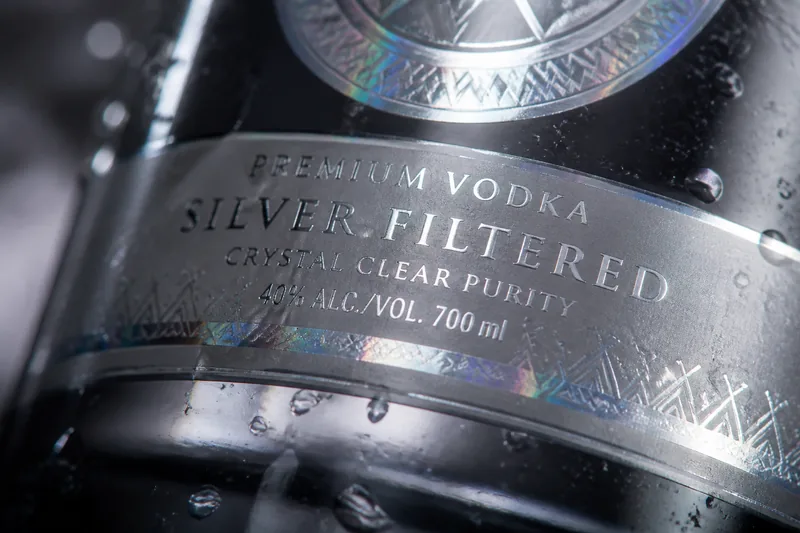
Caption: Flat cold foil transfer — mirror metallic that sits in the printed surface and can be overprinted, but carries no relief.
Which substrates can each process use?
Scodix substrate support is model- and RML-dependent. Current systems support a range of media, and the authoritative answer for any specific job is the Recommended Substrate List for that press model rather than a general statement about the technology. It is not accurate to say Scodix works only on coated paper and board.
Cold-foil compatibility likewise depends on the combination in front of you: the foil grade, the UV adhesive, the surface energy and smoothness of the substrate, the press configuration and the cure. Coated board, uncoated stocks and label films all behave differently, and the same foil can perform well on one substrate and poorly on another.
In both cases the correct step is the same: run a production trial on the actual substrate with the actual inks, coatings and finishing sequence before committing to a specification. For flexo and offset qualification detail, see our flexo cold foil stamping and offset cold foil stamping pages.
When should a buyer choose Scodix digital foil?
- Prototypes, mock-ups and concept work that must exist before tooling is committed.
- Short-to-medium runs where avoiding conventional image tooling has real value.
- Versioned jobs with multiple SKUs, languages or regional variants.
- Personalized or serialized embellishment driven from a data file.
- Designs that need a raised tactile foil effect rather than a flat metallic graphic.
- Workflows that are already digital end to end and want embellishment to match.
When should a buyer choose cold foil stamping?
- Repeating artwork that stays stable across orders.
- Inline label and folding-carton workflows where foil is applied during printing.
- Designs that rely on overprinting the metallic layer to build coloured metallic systems.
- Production runs long enough or frequent enough to spread plate and makeready costs.
- Jobs already running on a flexo or offset press with a cold-foil configuration.
- Programmes where the same specification must be reproduced reliably over time.
Can cold foil and Scodix be combined?
In principle a printed sheet can carry an inline cold-foil element and later receive a digital embellishment pass, but this is not something to assume. The polymer, the foil already on the sheet, any varnish or lamination, and the surface condition of the cold-foiled area all interact.
Treat it as a qualification exercise: agree the sequence in advance, test with the actual substrate, inks, coatings and finishing steps, and confirm adhesion and appearance on both the foiled and non-foiled areas before committing production artwork. Your embellishment supplier and your printer should both sign off on the same tested sequence.
How should sustainability be compared?
There is no universal winner here, and percentage claims about waste, energy or carbon rarely survive scrutiny once the full job is considered. Compare the whole finished pack instead of the decorating step alone.
Look at substrate recyclability in the destination market, total foil coverage across the design, carrier or transfer-film waste, makeready waste, energy use per job, spoilage rates, run length and the complete finished-pack structure including varnish and lamination. A low-coverage design on a recyclable board can outperform a heavily embellished pack regardless of which decorating route produced it.
Do not treat a supplier statement as certification. If recyclability matters to your brief, ask for the test method, the assessment scheme and the published report, and see our cold foil recyclability proof checklist.
Evidence & sources
CFS field note. The comparison usually resolves itself once a buyer puts a real specification on the table. In our sample work the jobs that come back to cold foil are roll-fed label programmes with repeat artwork and meaningful metallic coverage; the jobs that stay digital are short, versioned or need a raised effect that a flat transfer simply cannot produce. Buyers who ask for one universal answer typically end up requoting later.
Technical references.
- Scodix official website and the Scodix Foil process breakdown — the authoritative source for digital embellishment capability, substrates and press models.
- Leonhard Kurz, cold transfer technology overview — cold foil construction and inline transfer principle.
- CFS cold foil references: offset cold foil stamping, flexo cold foil stamping and the cold foil press setup checklist.
Practical limitation. This is not a controlled laboratory comparison. Digital embellishment capability is model- and configuration-specific, and cold foil results depend on press type, foil grade, adhesive, substrate treatment and coverage. Cold foil cannot deliver per-impression variable artwork or a raised tactile build; digital enhancement is normally an additional sheet-fed pass rather than an inline one.
Buyer takeaway. Before requesting a sample or quotation, decide the run length, the number of versions, whether relief is a requirement or a preference, the substrate, and the finishing sequence after decoration. Then quote the identical specification through both routes and compare total cost including makeready, waste and the extra handling pass.
Citation-ready summary
Cold foil stamping and Scodix-style digital foil enhancement solve different production problems. Cold foil prints a UV adhesive image and transfers metallised foil inline on flexo or offset presses, which suits repeat, roll-fed and higher-volume label or carton work with overprintable flat metallic areas. Digital foil enhancement places polymer from a job file, enabling die-free setup, versioned or variable artwork and raised tactile effects on shorter runs. Cost and suitability are job-specific and should be quoted from one shared specification.
Frequently asked questions
What is the main difference between cold foil and Scodix digital foil? +
Cold foil is an analog inline process: UV adhesive is printed through a plate and foil transfers to the adhesive image on a flexo or offset press. Scodix Foil is a digital sheet-fed embellishment process where a file places and pins polymer before foil transfer. One repeats a fixed image efficiently; the other changes the image without conventional tooling.
How does Scodix compare with traditional foil stamping? +
"Traditional foil stamping" can mean hot foil stamping, which uses a heated metal die, or cold foil, which uses printed UV adhesive. Scodix differs from both by removing the conventional plate or die and driving placement from a digital file. If your real question is hot versus cold, see our separate hot vs cold foil stamping comparison.
Which process is better for variable data and personalization? +
Scodix digital foil is the natural fit. Because placement is driven by the job file, individual sheets can carry different foiled elements — serial numbers, names, regional variants. Cold foil is not native for per-impression variation, since the adhesive image is fixed by the plate. Changing the cold-foil image means new artwork and a new plate.
Is cold foil always cheaper for long runs? +
No, and no honest break-even quantity applies to every job. Cold foil economics improve as plate and makeready costs are spread over more impressions, but the crossover depends on press, format, coverage, foil width, substrate, waste and finishing. The reliable method is to quote the same specification through both routes and compare the job-specific numbers.
Can Scodix digital foil run on plastic and uncoated substrates? +
Substrate support is model-dependent and governed by the Scodix Recommended Substrate List for the specific press. Current systems support multiple paper, plastic and laminated media types, so the older claim that Scodix handles only coated paper and board is not accurate. Confirm your exact stock against the RML for that machine and run a trial.
Can cold foil create the same raised tactile effect as Scodix? +
Cold foil normally produces a flat metallic image that sits in the printed surface, so it does not itself build the raised profile a polymer-based digital embellishment can create. A tactile result on a cold-foiled pack usually comes from a separate process such as embossing, which must be planned into the artwork and finishing sequence from the start.
Choose the process from a real job specification
The comparison only resolves when it is anchored to a live job. Send the press type, UV adhesive, substrate, artwork coverage, finish target and estimated run length. CFS can recommend a cold-foil trial specification; obtain a separate Scodix production quote when comparing the two workflows.
Compare cold foil on your own substrate
Scodix and its product names are trademarks of their respective owner. CFS is not affiliated with or endorsed by Scodix.