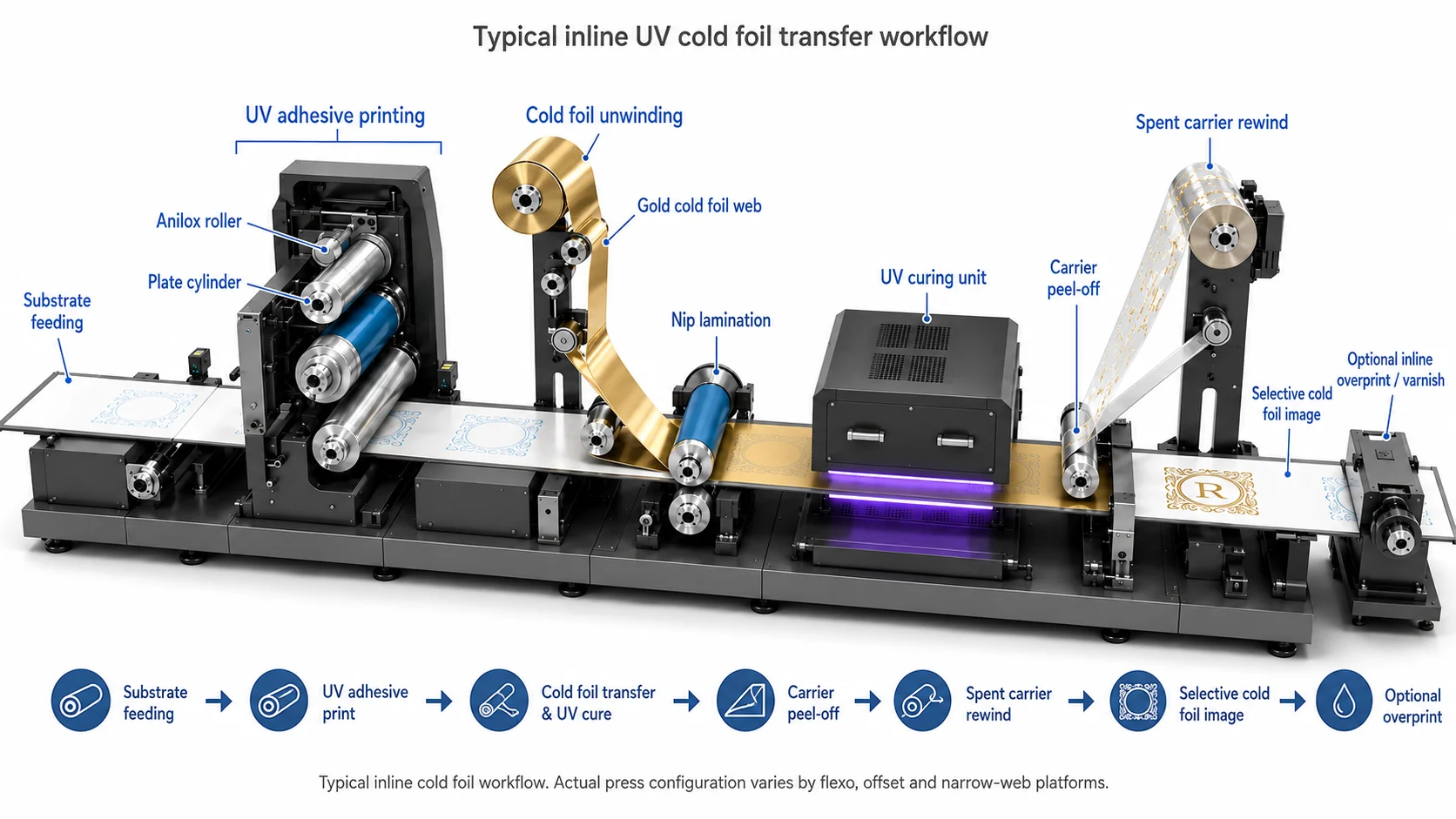
Cold foil stamping works by printing a UV-curable adhesive in the exact shape of the metallic artwork, pressing a cold foil web onto that adhesive, curing it instantly with UV energy, and peeling away the carrier film so only the bonded metal layer remains. Unlike hot foil stamping, the process uses no heated die, which makes it fast to change, highly detailed, and compatible with many packaging substrates.
If you are new to the material itself, start with What is cold stamping foil?, or read the full cold foil stamping definition for the underlying terminology. If you want the broader process comparison, read Cold foil stamping vs hot foil after this guide.
TL;DR
- Cold foil stamping is an inline process that transfers metallic foil with printed UV adhesive, pressure, and curing.
- The image shape is controlled by the adhesive plate, not by a heated metal die.
- The key variables are adhesive laydown, nip pressure, UV dose, foil release, substrate surface energy, and registration.
- Cold foil can be overprinted with CMYK to create gold, champagne, copper, holographic, and custom metallic colors from one silver base foil.
- For packaging converters, the main benefits are speed, fine detail, short setup time, and strong compatibility with label and folding-carton workflows.
The short answer: what happens on press?
A cold foil unit adds a metallic transfer stage to a conventional print line. The press first prints adhesive only where foil should appear. A foil web then meets the wet adhesive under pressure. UV lamps cure the adhesive through or around the foil construction, and the carrier film separates from the decorative metal layer. The metal stays bonded to the printed sheet.
The process is usually described in four stations:
- 1Adhesive printing — flexo, offset, or screen units apply UV adhesive in the artwork shape.
- 2Foil nip — the cold foil web contacts the adhesive under controlled pressure.
- 3UV curing — UV energy polymerizes the adhesive and locks the metal layer in place.
- 4Foil release — the polyester carrier rewinds, leaving the metallic image on the substrate.
For a deeper process overview, see our related guide: What is the cold foil technique?.
Step 1: artwork becomes an adhesive plate
In hot stamping, the die defines the image. In cold foil stamping, the printed adhesive defines the image. That means the quality of the metallic result starts in prepress.
Fine type, hairlines, reverse text, screens, and halftones can all be built into the adhesive separation. Converters often treat the foil layer like a spot color: it receives its own plate, its own trapping decisions, and its own registration tolerances.
A practical rule is simple: if the adhesive edge is clean, the foil edge can be clean. If the adhesive floods, skips, dries unevenly, or is under-cured, the foil will show it immediately.
Step 2: UV adhesive is applied only where foil is needed
Cold foil adhesive is not ordinary varnish. It must wet the substrate, accept the foil layer, cure quickly, and remain compatible with later printing or coating. On press, the adhesive film must be even enough to produce full metallic density without squeezing beyond the image edge.
Common control points include:
- Coat weight — too little adhesive causes pinholes and weak transfer; too much causes spread or edge build-up.
- Viscosity — adhesive must print consistently through the chosen plate or blanket system.
- Substrate wetting — low surface energy films may need corona treatment or primer.
- Plate condition — worn plates can create weak solids and fuzzy detail.
UV curing chemistry is widely used across printing and converting because it can harden coatings in fractions of a second. Industry education from RadTech explains how UV and electron-beam curing enable high-speed production with instant cure behavior.
Step 3: foil contacts the adhesive under pressure
The foil web is made from multiple layers: a carrier film, release layer, metallic layer, and sometimes color or protective coatings. During the nip stage, the foil passes against the wet adhesive with controlled contact pressure.
Only the adhesive areas grab the metal layer. Non-image areas remain on the carrier and rewind as waste matrix. This is why cold foil can create delicate highlights without requiring a custom engraved die for every design.
Good transfer depends on three things working together:
- Clean web tension so the foil does not wrinkle or wander.
- Stable nip pressure so solids fill without crushing fine detail.
- Correct foil release for the adhesive, substrate, speed, and UV system.
Step 4: UV curing locks the foil to the substrate
Once the foil is in contact with the adhesive, UV lamps cure the adhesive almost instantly. The energy dose must be strong enough to bond the foil but not so aggressive that it overheats sensitive films or causes unwanted distortion.
Packaging teams often validate cure by checking tape pull, rub resistance, overprint adhesion, and finishing performance. A foil that looks bright at the delivery pile still needs to survive die-cutting, folding, filling, shipping, and shelf handling.
The U.S. Department of Energy tracks industrial energy efficiency as a major manufacturing priority. Cold foil supports that direction because it eliminates heated stamping dies and enables inline production, reducing separate offline decoration steps in many packaging workflows.
Step 5: overprinting turns silver into a color system
One of cold foil stamping's biggest advantages is that silver foil can be overprinted. Transparent CMYK or spot inks can turn the same metallic base into gold, rose gold, copper, bronze, emerald, blue, or custom brand colors.
This is especially useful for folding cartons and labels where brands need multiple metallic SKUs. Instead of stocking separate foil shades for every design, printers can use a bright silver base and control hue with ink.
That does not mean every color is automatic. The final shade depends on foil brightness, ink transparency, ink density, substrate tone, coating choice, and viewing angle. For color-critical projects, drawdowns and press proofs are still essential.
What can go wrong?
Cold foil is reliable when the press is controlled, but most defects come from a short list of variables.
| Symptom | Likely cause | What to check |
|---|---|---|
| Pinholes in solids | Low adhesive laydown, rough substrate, poor wetting | Coat weight, anilox/plate, primer, substrate surface |
| Fuzzy edges | Excess adhesive or too much nip pressure | Adhesive volume, viscosity, plate swelling, impression |
| Weak transfer | Under-cure or mismatched foil release | UV dose, lamp age, foil grade, line speed |
| Foil scuffing | Poor top protection or finishing mismatch | Coating, varnish, rub tests, handling path |
| Registration drift | Web tension or thermal instability | Tension control, unwind, sheet transport, press speed |
“"Cold foil success is not one magic setting. It is a controlled chain: adhesive, pressure, cure, release, and overprint must all agree before the sheet looks effortless."
Cold foil vs hot foil: why the workflow feels different
Hot foil uses heat, pressure, dwell time, and a metal die. It can create deep embossing and premium tactile effects, but it usually requires more tooling and offline setup. Cold foil is more like printing: faster artwork changes, inline decoration, and easier integration with CMYK.
Choose cold foil when the job needs:
- fine metallic detail;
- fast setup;
- frequent artwork changes;
- inline production;
- overprinted metallic color;
- label or carton efficiency.
Choose hot foil when the job needs:
- deep debossing or embossing;
- heavy tactile impression;
- very small offline runs where tooling is already justified;
- a traditional luxury craft finish.
For a full buyer-focused breakdown, continue with Cold foil stamping vs hot foil.
FAQ
—Does cold foil need heat?
No. The transfer depends on UV adhesive, pressure, and curing rather than a heated die. Some UV systems generate process heat, but heat is not the transfer mechanism.
—Can cold foil be used on plastic film?
Yes, but the film surface must be suitable for adhesive wetting. Corona treatment, primer, and foil grade selection are common variables for film applications.
—Is cold foil only silver?
No. Silver is common because it can be overprinted into many metallic colors. Colored and holographic cold foils are also available.
—Is cold foil durable enough for packaging?
Yes, when the foil, adhesive, coating, substrate, and finishing sequence are matched correctly. Converters should validate rub, tape, fold, and product-handling performance before production approval.
—Can cold foil replace hot foil stamping?
Sometimes. It is usually better for speed, fine detail, inline production, and overprinted color. Hot foil remains useful for deep tactile impression and traditional stamped effects.
Bottom line
Cold foil stamping works because it turns metallic decoration into a print-controlled process. The adhesive carries the image, the foil supplies reflectivity, UV curing creates the bond, and overprinting expands one metallic base into a flexible color system.
That combination is why cold foil is widely used in modern labels, cartons, cosmetics, wine and spirits packaging, and FMCG launches where brands need premium shelf impact without slowing the pressroom down.