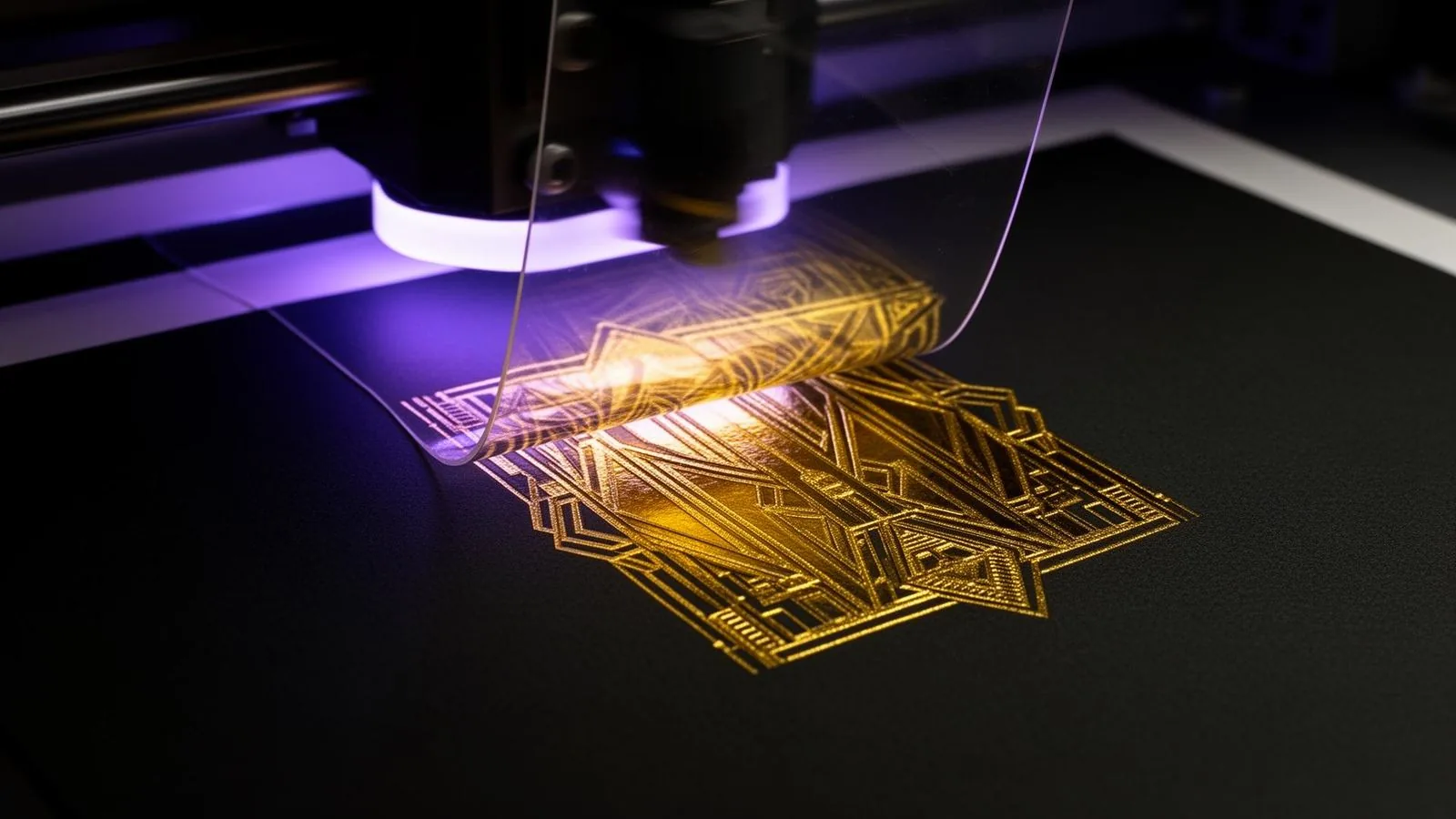
This guide focuses on the foil material itself rather than the press process. It explains how cold stamping foil is constructed, which specifications converters should compare between suppliers, how material choice changes across flexo, offset and label work, and what information a foil manufacturer needs before a meaningful sample can be produced. Use it as a material and specification reference when you are qualifying a new grade or replacing an existing one.
What is cold stamping foil?
Cold stamping foil is a multilayer transfer film made from a PET carrier, release coating, decorative metallic or holographic layer, and a surface engineered to bond with UV-curable adhesive. During printing, the decorative layer transfers to the adhesive while the PET carrier is rewound. Buyers evaluate release, appearance, overprintability and press compatibility.
It helps to keep two terms apart. "Cold stamping foil" is the consumable roll you buy and load onto the press. "Cold foil stamping" is the application process that puts it on the substrate. If you need the short conceptual explanation of the process before comparing materials, read the cold foil stamping definition first, then come back to the specifications below.
What is cold stamping foil made of?
Cold stamping foil is not a sheet of metal. It is a coated polyester web in which each layer performs one job, and the balance between those layers is what separates a grade that runs cleanly from one that fights you on press. The carrier provides dimensional stability and must stay intact under web tension while allowing UV energy to reach the adhesive beneath it. The release coating decides how cleanly the decorative layer separates. The lacquer and metallised layers create the visual effect, and the top coat determines whether inks, varnishes and adhesives will hold onto the surface afterwards.
| Layer | Main function | Why it matters to converters |
|---|---|---|
| PET carrier | Carries the coated layers through the press and is rewound after transfer | Governs web handling and tension stability; must transmit enough UV energy for the adhesive to cure |
| Release coating | Controls separation of the decorative layer from the carrier | Too tight and coverage breaks up; too loose and foil transfers outside the printed image |
| Decorative lacquer or holographic layer | Provides colour, gloss and any embossed diffraction pattern | Defines shade, brightness and pattern registration; determines shade-matching consistency between batches |
| Vacuum-metallized aluminium layer | Delivers the reflective metallic appearance | Drives opacity and coverage over the printed adhesive, and how the finish reads under overprinted inks |
| Adhesive-receptive or protective top coat | Bonds to the UV adhesive and protects the transferred image | Controls adhesion, overprintability and resistance to rub, scuff and downstream chemicals |
Layer thicknesses, coating chemistries and metallising parameters differ by grade and by supplier. Ask for the technical data sheet of the specific grade instead of relying on generic construction figures.
Which cold foil specifications matter when buying?
Most foil comparisons go wrong because two suppliers quote different properties. The list below is the set of criteria worth putting side by side before you agree on a grade. Where a value depends on your adhesive, substrate or press, treat the supplier data sheet as a starting window and confirm the result in a trial rather than assuming a number transfers between plants.
| Specification | What to confirm | Why it affects production |
|---|---|---|
| Carrier film thickness | Thickness class of the PET carrier for the grade | Influences web tension behaviour, splice handling and rewind stability |
| Release behaviour | Release class and the adhesive family it is tuned for | Determines edge definition, coverage and unwanted transfer outside the image |
| Metallic shade and consistency | Shade reference, batch tolerance and how shade is checked | Shade drift between rolls shows up immediately on repeat packaging work |
| Optical density or coverage | Measurement method used by the supplier | Affects perceived brightness and whether fine artwork looks solid |
| Holographic pattern | Pattern name, pitch direction and registration behaviour | Pattern orientation and repeat affect artwork layout and visual continuity |
| Overprintability | Which ink and varnish systems the top coat accepts | Determines whether you can build custom shades by printing over the metallic |
| Scratch and chemical resistance | Test methods used and the finishing steps applied afterwards | Predicts survival through die-cutting, folding, gluing and filling lines |
| UV adhesive compatibility | The adhesive brands and grades already validated with the foil | Adhesive and release chemistry must be matched, not mixed by assumption |
| Substrate compatibility | Board, paper or film types the grade is intended for | Surface energy, smoothness and coating strongly change transfer quality |
| Roll width, length and core | Slit widths available, running length and core diameter | Must match the cold foil module, unwind shafts and waste rewind capacity |
| Batch consistency and traceability | Batch coding, retention samples and change notification policy | Makes repeat orders and any complaint investigation possible |
| Storage and shelf life | Recommended temperature, humidity and stock rotation | Poor storage changes release behaviour before the roll ever reaches the press |
Avoid vendor claims expressed as universal maximum press speeds or guaranteed adhesion values. Final compatibility should be confirmed through a press trial using the intended foil, UV adhesive and substrate.
Cold stamping foil vs hot stamping foil
The two consumables look similar on the roll but are engineered for different transfer mechanisms, so they are not interchangeable.
| Aspect | Cold stamping foil | Hot stamping foil |
|---|---|---|
| Transfer trigger | UV-curable adhesive printed in the artwork shape | Heat and pressure from a heated die |
| Foil release system | Release tuned to break against cured adhesive at ambient temperature | Release and size layers activated thermally |
| Tooling requirement | Printing plate or image carrier for the adhesive | Engraved or etched metal die per image |
| Suitable substrates | Smooth coated boards, papers and many films | Includes textured and uncoated stocks that cold foil handles poorly |
| Overprinting capability | Designed to be overprinted inline to create custom shades | Usually decorated as a final effect |
| Typical qualification method | Press trial with the intended adhesive and substrate | Die trial at working temperature, pressure and dwell |
For a full commercial and production comparison, see our hot foil vs cold foil comparison.
How cold stamping foil transfers on press
The transfer sequence matters here only because it explains why the material specifications above exist.
- 1Print the UV-curable adhesive in the exact shape of the artwork.
- 2Bring the foil web into contact with the wet adhesive at the nip.
- 3Cure the adhesive with UV energy through the carrier film.
- 4Rewind the carrier once the decorative layer has transferred to the substrate.
Each step loads a different property of the foil: adhesive receptivity, web handling, UV transmission and release. If any of the four is mismatched, the defect usually appears as poor coverage or ragged edges rather than as an obvious material fault.
For press configuration, curing and troubleshooting detail, follow the step-by-step cold foil stamping process.
How to select foil for flexo, offset and label presses
There is no single grade that suits every press. Selection depends on the press configuration and cold foil module, the UV adhesive in use, the substrate and its surface treatment, the running speed, the artwork coverage and detail, and what happens to the printed product afterwards.
—Flexographic cold foil
Narrow-web UV flexo lines apply adhesive through an anilox and plate, so anilox volume, plate screening and adhesive laydown drive the result. Grades intended for flexo are usually specified for narrower slit widths and for inline overprinting directly after transfer. See our flexo cold foil stamping materials page for the configurations we supply.
—Offset cold foil
Sheetfed offset applies adhesive from a plate and blanket, with the foil laid down in a dedicated module before the following printing units. Sheet size, gripper handling and the number of downstream units all influence which grade and roll format is appropriate. Details are on our offset cold foil stamping page.
—Labels and film substrates
Self-adhesive papers, BOPP, PE and PET face stocks vary widely in surface energy and topcoat. Films often need corona or topcoat verification before transfer quality is predictable, and the finished label may face moisture, abrasion or squeeze deformation. Compare available grades and finishes on our cold foil products page.
How to qualify a cold foil sample before production
Treat sample qualification as a short, documented procedure rather than a visual glance at a swatch.
- 1Identify the press and the cold foil module, including its position in the unit sequence.
- 2Record the UV adhesive brand and grade you intend to run.
- 3Confirm the substrate, its supplier and any surface treatment or topcoat.
- 4Provide artwork coverage and the smallest detail or line weight required.
- 5Define the target metallic shade or holographic pattern.
- 6Test release and edge definition across the full image, including fine type.
- 7Test adhesion and rub resistance using a repeatable method, such as the one described in our guide to cold foil adhesion testing for labels.
- 8Test overprinting and downstream finishing: inks, varnish, lamination, die-cutting and gluing.
- 9Record the approved roll and batch information so repeat orders can be matched.
What information should you send when requesting samples?
The more of the following you supply, the closer the first sample will be to a production-ready match:
- press manufacturer and model
- flexo or offset configuration and where the cold foil module sits
- UV adhesive brand and grade
- substrate, including supplier and surface treatment
- target colour or holographic pattern
- finished application and end-use conditions
- required roll width, length and core size
- estimated order volume and repeat frequency
- any known production problem you are trying to solve
Ready to qualify a cold foil grade?
Frequently asked questions
What is cold stamping foil made of? +
Cold stamping foil is a coated polyester film. A PET carrier supports a release coating, a decorative lacquer or embossed holographic layer, a vacuum-metallized aluminium layer and an adhesive-receptive top coat. The carrier is rewound after transfer, while the decorative and metallised layers stay on the substrate where UV adhesive was printed and cured.
Is cold stamping foil the same as hot stamping foil? +
No. Both transfer a decorative layer from a PET carrier, but the release systems are engineered for different triggers. Cold stamping foil releases against UV-curable adhesive at ambient temperature, while hot stamping foil is activated by heat and pressure from an engraved die. Using one in place of the other normally produces incomplete or uncontrolled transfer.
Can cold stamping foil be overprinted? +
Many cold foil grades are designed to be overprinted inline, which is how converters build custom shades such as coloured metallics from a single silver foil. Whether a specific ink or varnish system holds depends on the top coat. Confirm ink adhesion and rub resistance on the intended foil, adhesive and substrate before committing artwork to it.
How do I select cold foil for a flexo or offset press? +
Start with the press configuration and cold foil module, then the UV adhesive, substrate, line speed, artwork coverage and post-print finishing. Flexo and offset lay adhesive down differently, so grades are specified accordingly. Ask for grades already validated with your adhesive family, then run a press trial before approving the material for production.
What information is needed to request a cold foil sample? +
Provide the press make and model, the cold foil configuration, the UV adhesive, the substrate and its surface treatment, the target shade or holographic pattern, the finished application, required roll width, length and core, plus estimated volumes. If you are replacing a foil that is failing, describe the defect so the sample can address it directly.
Can the same cold foil run on every adhesive and substrate? +
No. Release behaviour is tuned to particular adhesive chemistries, and transfer quality changes with substrate smoothness, coating and surface energy. Treat data sheet windows as a starting point only. Final compatibility should be confirmed through a press trial using the intended foil, UV adhesive and substrate before scaling to production volumes.