“TL;DR: Most cold foil stamping machines are modules fitted to an existing flexo or sheetfed offset press. Buying decisions therefore centre on press compatibility, adhesive and curing capability, foil-web handling and the substrates you actually run. CFS supplies the foil and application support; press suitability and performance must be confirmed with the press OEM or a qualified integrator.
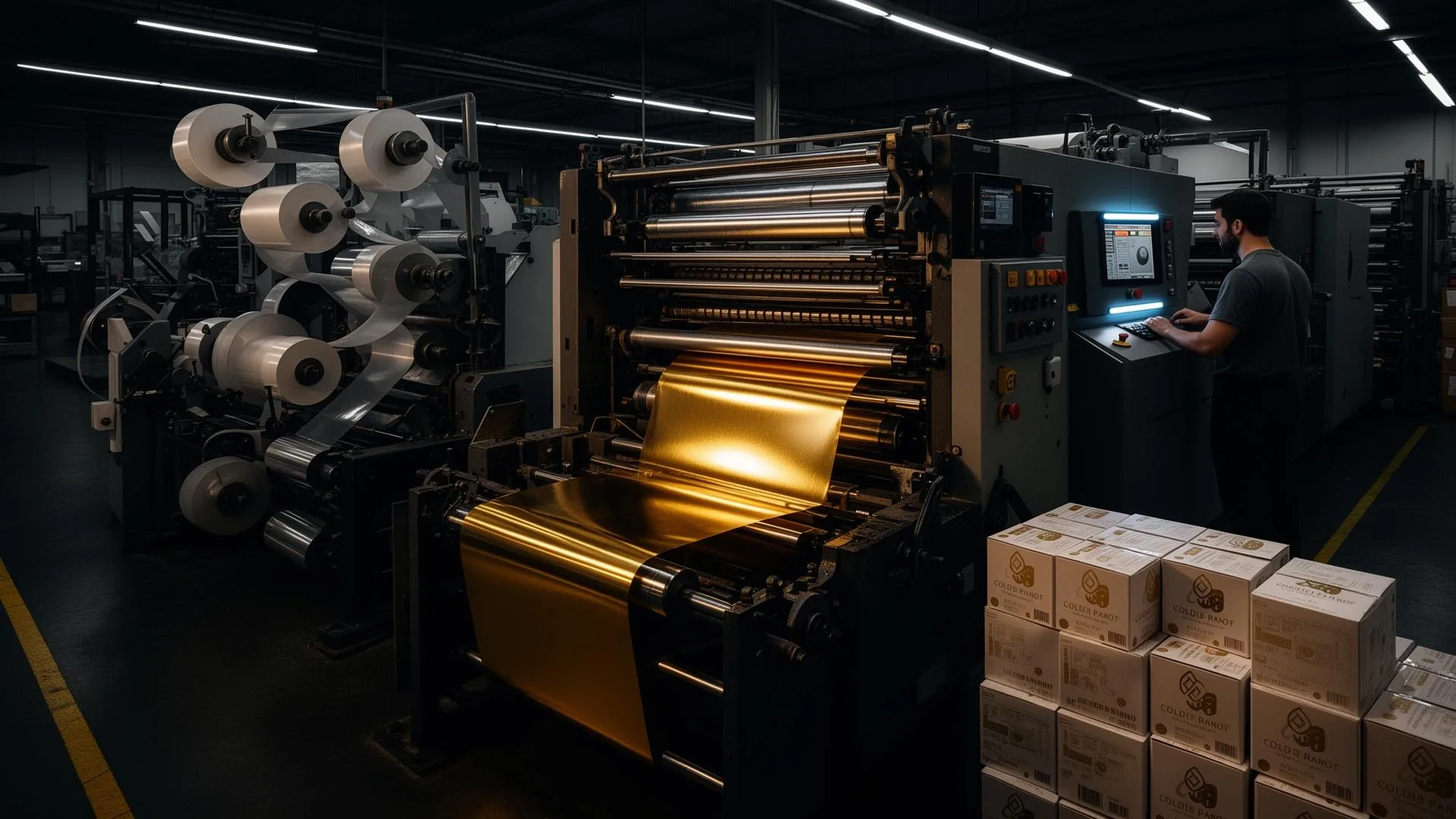
Most cold foil stamping machines are modules integrated into a flexographic or sheetfed offset press rather than standalone stamping machines. The system combines adhesive application, controlled foil-web contact, UV or LED UV curing and carrier rewind; the correct configuration depends on the existing press, substrate and production workflow.
That distinction matters commercially, because the question is rarely "which machine should I buy" and more often "what does my press need in order to run cold foil reliably". This guide describes the modules, the retrofit routes offered by press manufacturers, the factors that govern realistic output, and the specifications worth putting in an RFQ before you commit capital.
What is a cold foil stamping machine?
A cold foil stamping machine is the combination of press units that prints a UV-curable adhesive, brings a metallised transfer film into contact with that adhesive, cures the bond and removes the spent carrier. Nothing in the process is heated by a die, so image detail is defined by the printing plate rather than by tooling.
Because the decorated area is produced photomechanically, artwork changes are plate changes rather than engraving changes. This is the main reason converters look at cold foil when foil designs change often, or when the foil has to be overprinted in the same pass to create secondary shades.
Standalone cold foil laminating machines do exist for specific film and digital-print workflows, but in commercial packaging and label plants the inline module is the normal configuration.
Which components make up a cold foil system?
A cold foil system is usually described in five functional groups, each of which can be a separate purchase decision:
- 1Adhesive unit — an offset or flexo unit that lays UV adhesive only in the image area, with its own anilox or plate, metering and cleaning requirements.
- 2Foil unwind and web guiding — tension-controlled unwind for the transfer film, with edge guiding and splice handling.
- 3Nip or laminating station — the controlled contact point where the foil meets the wet adhesive; nip pressure and roller condition strongly influence transfer.
- 4Curing system — mercury UV or LED UV, sized for the adhesive chemistry, substrate and line speed.
- 5Carrier rewind — takes up the spent PET carrier at stable tension, with scrap handling and, on many installations, foil-saving or web-width management options.
Downstream units then print or varnish over the transferred layer. Whether that is possible in one pass depends on unit count and drying capacity, which is often the real constraint on an older press rather than the cold foil module itself.
Sheetfed offset, narrow-web flexo and retrofit configurations
Sheetfed offset installations place the cold foil module early in the press so later units can overprint the metallic layer. Foil-web width management matters here because carrier film is consumed across the sheet, and folding-carton work usually pairs the module with interdeck curing.
Narrow-web flexo and label presses handle cold foil as a web process, where tension control and web path length dominate the setup. Self-adhesive laminates, films and coated papers behave very differently, so the module's tension range and drive control are worth checking against your actual job mix.
Retrofit configurations add the module to a press already on the floor. Press manufacturers publish these as defined upgrade programmes — for example Heidelberg's FoilStar cold foil system for sheetfed offset, and Koenig & Bauer's retrofits and upgrades programme for sheetfed presses. Both are OEM examples rather than a statement of what any given press on your floor will accept.
What determines production speed?
Achievable speed is set by the slowest constraint in the chain, not by the module rating. In practice the limiting factors are adhesive cure capacity at the required coat weight, foil-web tension stability, substrate behaviour and the coverage of the foil image.
Large solid areas, coarse substrates and heavier adhesive films all raise the energy the curing system must deliver, and every one of those variables can force a lower running speed. Foil consumption also scales with speed and coverage, so the economically optimal speed is not always the mechanically possible one.
OEMs publish speed figures for specific press platforms and configurations; treat those as attributed examples for that machine, not as a general performance figure for cold foil or for CFS material. Your own qualified speed should come from a trial on your press with your substrate and foil grade.
New press or retrofit module?
A retrofit is attractive when the existing press has the unit count, web or sheet path, curing capacity and control system to accept the module without compromising the rest of the job mix. It is usually the shorter route to production, but only the OEM or integrator can confirm mechanical fit, interlocks and safety compliance.
A new press becomes the better option when the current machine is already constrained — for instance when there are no free units for overprinting, when curing capacity is at its limit, or when the press is near the end of its service life. Both routes should be evaluated against your real annual foil volume and the mix of jobs you expect, not against a single showcase job.
Whichever route you take, request written confirmation of guaranteed performance conditions, spare-part availability and service response from the supplier of the module.
Which substrates can the system process?
Smooth coated papers, coated folding-carton board and many pressure-sensitive label facestocks are the most predictable substrates because adhesive holdout and surface uniformity are good. Films such as BOPP and PET can also run well, provided surface treatment and adhesive compatibility are verified.
Uncoated papers, textured boards and heavily recycled grades are the harder cases: absorbency and roughness can reduce adhesive holdout and edge definition, and may need a primer or a different foil grade. Our guide to cold foil on uncoated paper covers the testing sequence for those substrates.
Substrate suitability is a system property — paper, adhesive, foil grade, curing and press settings together — so it should always be confirmed on the machine that will run the job.
What should buyers include in an RFQ?
A cold foil RFQ is easier for a supplier to answer accurately when it describes production reality rather than an idealised job. Useful content includes:
- Press make, model, year, unit count and current curing configuration.
- Web width or maximum sheet size, and typical running speeds for the jobs concerned.
- Substrate list with grammage, coating and supplier, plus any recycled content.
- Foil types under consideration, expected coverage and whether overprinting is required.
- Annual foil volume by job family, and typical run lengths.
- Downstream processes: varnish, lamination, embossing, die-cutting, converting.
- Quality requirements, inspection methods and acceptance criteria.
- Site constraints — available floor space, extraction, power and installation window.
Ask each supplier to state clearly what is included, what is optional and which performance figures are guaranteed under which conditions.
Commissioning and maintenance questions
Commissioning is where the specification is tested against reality, so agree the acceptance criteria before installation: which substrate, which foil, which image, which speed and which defect tolerances define a successful sign-off. Written acceptance conditions prevent later disagreements about whether the module performs as sold.
Maintenance planning should cover roller condition and cleaning routines, adhesive unit cleaning, UV lamp or LED module service life, tension-system calibration and foil scrap handling. Recurring transfer problems usually have several possible causes, so diagnose them from evidence on the sheet rather than assuming a single fault; the cold foil defects photo guide is a practical starting point.
Before each production run, a structured check of substrate, adhesive, anilox, tension and cure — as in our press setup checklist — removes most avoidable variation.
Frequently asked questions
Is a cold foil stamping machine a standalone machine? +
Usually not. In commercial packaging and label production it is a module integrated into an existing flexo or sheetfed offset press, combining adhesive application, foil-web contact, curing and carrier rewind.
Can a cold foil module be retrofitted to an existing press? +
Often, yes. Press manufacturers publish retrofit programmes for sheetfed presses, and Heidelberg and Koenig & Bauer both document such upgrades. Whether your specific press qualifies must be confirmed by the OEM or a qualified integrator.
Does CFS sell cold foil stamping machines? +
No. CFS supplies cold foil material and application support. We can help qualify foil grades and troubleshoot transfer on your press, but machine supply, retrofit engineering and safety compliance are the responsibility of the press OEM or integrator.
How fast can cold foil run? +
That depends on the press, adhesive, curing capacity, substrate and foil coverage. OEM figures apply to specific machines and configurations, so a realistic speed for your work should be established in a trial rather than taken from a datasheet.
Which substrates are easiest to run? +
Smooth coated papers, coated carton board and many label facestocks are the most predictable. Uncoated, textured and heavily recycled grades usually need additional testing and sometimes a primer.
Discuss foil compatibility for your press
If you are specifying or retrofitting a cold foil system, the fastest way to reduce risk is to qualify the foil on the press that will run it. Request a cold foil sample kit with your substrate and press details, and we will suggest grades to include in the trial.