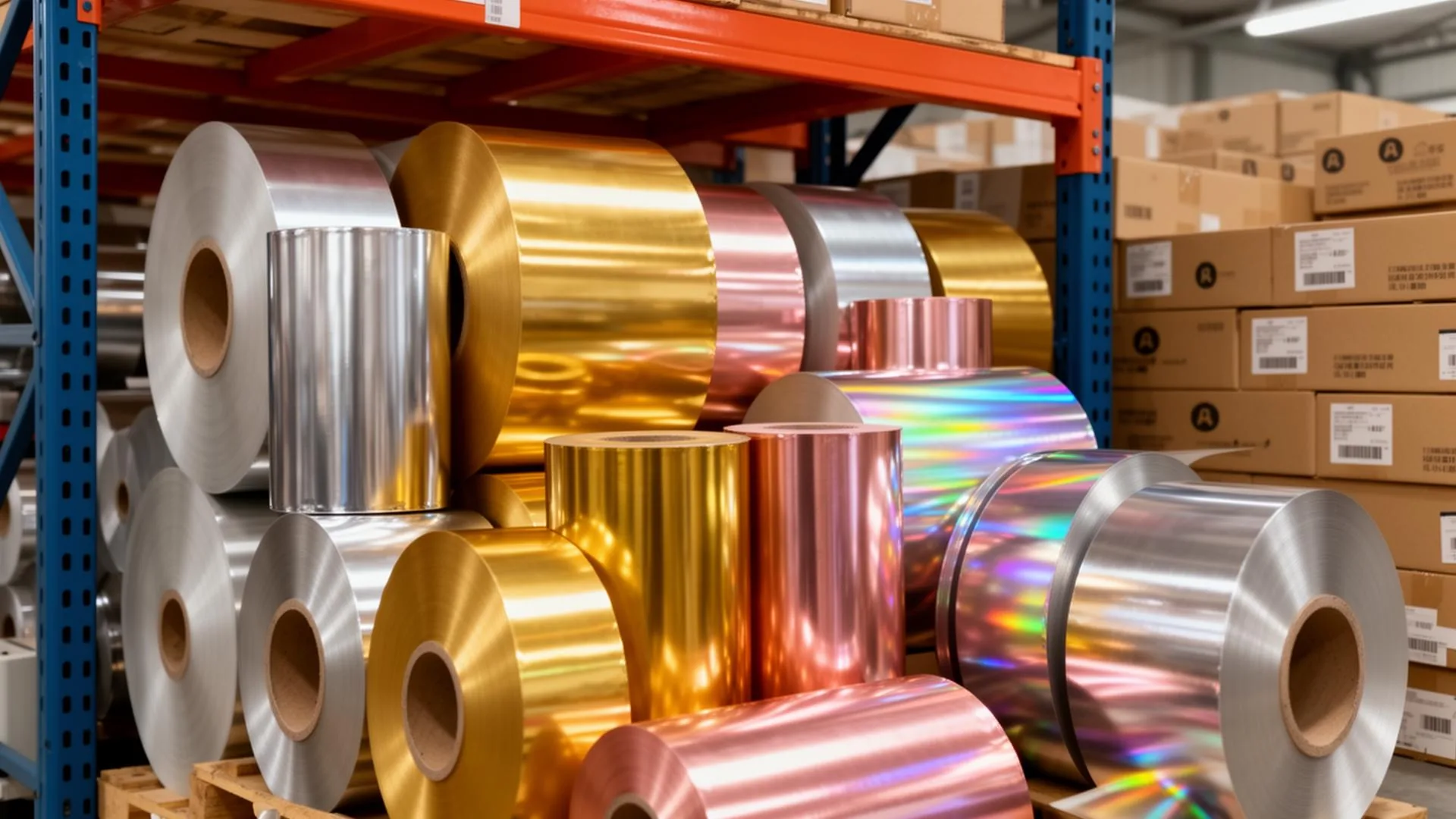
“TL;DR: Buying wholesale metallic cold stamping foil rolls is a specification exercise, not a commodity transaction. The right roll combines the correct release value, metallization shade, carrier thickness, core size and slit width for your press and your substrate. This guide walks packaging buyers through MOQs, roll formats, quality checks, total landed cost and the specification sheet to send suppliers — so the foil that arrives runs cleanly the first time.
Search demand around cold foil keeps shifting from generic education ("what is cold foil") toward procurement-grade phrases like "wholesale metallic cold stamping foil rolls," "cold foil supplier MOQ" and "metallic foil roll price per square meter." That shift reflects what we see on the production floor: brands and printers are no longer asking whether to use cold foil — they are asking how to source it at the right price, in the right format, in volumes that match their press schedule.
According to one industry summary, the global cold stamping foil market was valued at USD 432 million in 2024 and is projected to reach USD 616 million by 2032 at a 5.2% CAGR. Wholesale buyers driving that growth are mostly folding-carton converters, label printers and luxury-packaging brand owners — and they all need the same thing: predictable rolls, predictable transfer, predictable lead time.
This article is written from the foil manufacturer side. It explains how wholesale metallic cold foil rolls are actually made, slit and shipped — and what to put in your purchase order so the rolls behave correctly on a high-speed offset, flexo or label press.
What "wholesale metallic cold stamping foil rolls" actually means
In the trade, wholesale does not just mean "buy a lot." It means buying foil in mill-master form or bulk slit rolls directly from a manufacturer or master distributor, rather than retail-cut sheets. A typical wholesale order has four properties:
- Master rolls or bulk slit rolls, usually 640 mm – 1280 mm wide before slitting.
- MOQs measured in square meters or kilograms, not single rolls.
- Custom slit widths and core IDs to match the buyer's press.
- Lot consistency across multiple shipments — same shade, same release, same carrier.
A "metallic cold stamping foil" itself is a multi-layer film. As described in Wikipedia's overview of cold foil printing, cold foil printing applies a thin metallic film to a substrate using a UV-cured adhesive instead of heat and pressure. The roll you buy is engineered specifically for that adhesive transfer step.
A wholesale metallic cold foil roll typically contains five functional layers:
- 1PET carrier film (commonly 12 µm) — the dimensionally stable backbone.
- 2Release coating — tuned so the metal layer leaves the carrier only where adhesive is printed.
- 3Color/lacquer layer — defines the shade (gold, champagne, rose gold, copper, etc.).
- 4Vacuum-metallized aluminum layer — the reflective surface, deposited under vacuum (see Wikipedia: Vacuum metallizing).
- 5Size / tie coat — promotes adhesion to the UV adhesive on press.
If any one of those five layers is mis-tuned for your press, the roll will look correct on the shelf and fail at the nip. That is why wholesale specification matters more than wholesale price.
Roll formats wholesale buyers should know
Most cold foil rolls ship in one of three formats. Mixing them up is one of the most common reasons a "good price" turns into expensive scrap.
| Format | Typical width | Typical length | Core ID | Best for |
|---|---|---|---|---|
| Master roll | 640 – 1280 mm | 4,000 – 12,000 m | 6 inch (152 mm) | In-house slitting, large converters |
| Press-ready slit roll | 50 – 1040 mm | 1,000 – 4,000 m | 3 inch (76 mm) | Offset, flexo and rotogravure cold foil units |
| Label-press roll | 100 – 520 mm | 500 – 2,000 m | 3 inch (76 mm) | Narrow-web label & carton presses |
A few practical notes from the slitting line:
- **Always order width based on the foiled image area plus a 5–10 mm safety margin** on each side — not the maximum web width. Buying wider rolls than you need is the #1 hidden cost in cold foil.
- Core ID must match your press unwind. A 3-inch roll on a 6-inch shaft will wobble; a 6-inch roll cannot mount on a 3-inch shaft at all.
- Length affects splice frequency, which directly affects OEE on long runs. For high-volume jobs, longer rolls are usually worth the higher per-roll price.
Metallic shades available at wholesale
Wholesale metallic cold foil is not just "gold and silver." Reputable manufacturers maintain a spectrum of shades, and a serious purchase order specifies the shade by internal code or a referenced standard — not by adjective.
Common wholesale categories include:
- Bright silver — pure aluminum, untinted lacquer; the highest reflectivity baseline.
- Bright gold / champagne / pale gold — yellow-tinted lacquer over aluminum; varies by L\a\b\* target.
- Rose gold and copper — pink/orange-tinted lacquer; strong demand in cosmetics and spirits.
- Holographic — embossed pattern in the release/lacquer interface; covered in our deeper guide on what cold stamping foil is.
- Matte and brushed metallics — diffusion finishes for premium minimalist packaging, especially luxury cosmetic cartons.
- Pigmented and pearlescent variants — used as accents alongside straight metallics.
“"Modern cold foil specification is more like sourcing a coated film than buying a craft material — buyers should expect a TDS, a lot number and a reproducible shade target." — production engineering note, internal QC team
For shade-critical work, ask the supplier for L\a\b\* values measured on a standard substrate, not just a printed swatch. Two "champagne golds" from different mills can read very differently under D65 lighting.
How wholesale cold foil is priced
Wholesale cold foil is normally priced per square meter (m²) of foil, sometimes converted to a per-kilogram or per-linear-meter figure for invoicing. The headline price is only one of six factors that determine landed cost:
- 1Foil grade — bright silver and standard golds are the cheapest baseline; holographics, pigmented metallics and high-release "premium offset" grades carry a premium.
- 2Slit width and roll length — narrow widths cost more per m² because of slitting yield loss.
- 3Core, packaging and labeling — premium cores, foam end-caps and barcoded labels add cost but reduce edge damage in transit.
- 4MOQ and lot size — most mills have step pricing at 1,000 m², 5,000 m² and 20,000 m² levels.
- 5Lead time — stock shades ship faster; custom shades typically need 3–6 weeks.
- 6Logistics and duties — air vs. sea, palletized vs. carton, Incoterms (EXW, FOB, DAP) and import tariffs.
A useful sanity check: when you compare two quotes, normalize them to landed cost per 1,000 m² of foiled image area on your actual job, not per roll. That is the only number that matches what the press operator actually consumes. The same logic applies when you compare cold foil to other decoration routes — see our breakdown of the cost difference between cold foil and hot foil stamping.
Specification sheet to send wholesale suppliers
A clean RFQ saves weeks. Send the supplier a single-page spec that includes all of the following:
- Application — offset cold foil unit, flexo cold foil, label press, etc.
- Press make and model, web speed range, max foil unit speed.
- Substrate(s) — coated paperboard (e.g. SBS, FBB), uncoated stock, BOPP label film, PE label film, etc. For uncoated work, also reference our note on cold foil vs hot foil for uncoated paper.
- UV adhesive system in use (manufacturer, viscosity, lamp type — mercury vs. LED).
- Foil shade target with L\a\b\* values or a reference standard.
- Required release behavior — tight (fine type, small dots) or loose (large solids).
- Slit width(s) and tolerance, core ID, roll length, max OD.
- Packaging — individual poly bag, carton, pallet configuration, marking.
- Lot size and call-off schedule — single shipment vs. blanket order with releases.
- Quality acceptance criteria — splices per roll, edge damage, shade ΔE tolerance.
A supplier that cannot answer this sheet point-by-point is not a wholesale supplier; they are a reseller. The difference shows up at the press the first time you run a long job.
Quality checks on incoming wholesale rolls
Before any wholesale lot reaches the press, run a five-minute receiving inspection. It catches roughly 80% of the issues we have seen at customer sites over the years.
- 1Visual — check for telescoping, dished ends, edge nicks and core crush.
- 2Lot label — confirm shade code, lot number, manufacture date and length match the PO.
- 3Carrier check — peel a small section by hand; the metal should not come off without adhesive present.
- 4Adhesion test — print a small UV-adhesive patch on your standard substrate and run a transfer test at typical press speed.
- 5Shade comparison — compare against the master swatch under D65 light, not under shop fluorescents.
For a deeper press-side workflow, our step-by-step guide on how cold foil stamping works shows where each of these checks fits in the production sequence.
Wholesale lead time and inventory strategy
Most printers operating cold foil at scale run a two-tier inventory:
- A-tier shades (bright silver, standard gold) — held in 4–8 weeks of safety stock, replenished automatically.
- B-tier shades (rose gold, holographics, pigmented metallics) — ordered against confirmed jobs, with a written lead-time agreement (commonly 3–6 weeks for custom shades).
Air freight is rarely worth it for cold foil — the m²/kg ratio is poor and rolls are easily damaged in mixed air cargo. Sea freight on palletized, shrink-wrapped loads with desiccant is the norm for international wholesale, and it shapes your safety stock math more than the unit price does.
Frequently asked questions
What is the typical MOQ for wholesale metallic cold stamping foil rolls? Mill MOQs commonly start at 1,000 – 5,000 m² per shade per slit width. Below that volume, you are usually buying from a distributor's stock at a higher per-m² price but with no MOQ.
Can I order custom shades and widths at wholesale? Yes. Custom shades typically require an MOQ of 5,000 – 20,000 m² and a 3–6 week lead time, plus a signed shade approval (printed swatch or L\a\b\* target).
What core size should I order? Match your press unwind exactly. 3-inch (76 mm) cores are standard on most cold foil units and label presses; 6-inch (152 mm) cores are used for master rolls and some wide-web converters.
How should wholesale foil rolls be stored? Store rolls upright on their cores (or hung on shafts), at 18–25 °C and 45–60% RH, in original packaging, away from direct sunlight and solvents. Most manufacturers quote a 12-month shelf life under those conditions.
Is metallic cold foil recyclable? The metallized layer is extremely thin (a fraction of a micron), so cold-foiled paperboard is generally accepted in standard paper recycling streams in most regions. Always confirm with the local waste authority and the brand's recyclability claims policy.
How do I compare wholesale quotes fairly? Normalize every quote to landed cost per 1,000 m² of foiled image area on your actual job, including duties, freight and expected waste. Headline per-m² prices are not comparable across slit widths and shades.
Where to go from here
If you are scoping a wholesale program for the first time, start narrow: pick one A-tier shade, one substrate, one press, and run a qualified pilot lot. Use the spec sheet above, run the five-minute receiving check, and measure landed cost on the foiled image area. Once that loop is stable, expanding to additional shades and widths becomes a procurement task rather than a technical risk.
For deeper background, our companion articles cover the cold stamping foil search-trend buyer's guide, the step-by-step cold foil process and cold foil vs hot foil economics. Together they give procurement, prepress and production a shared vocabulary — which is, in practice, the cheapest quality tool a wholesale buyer has.