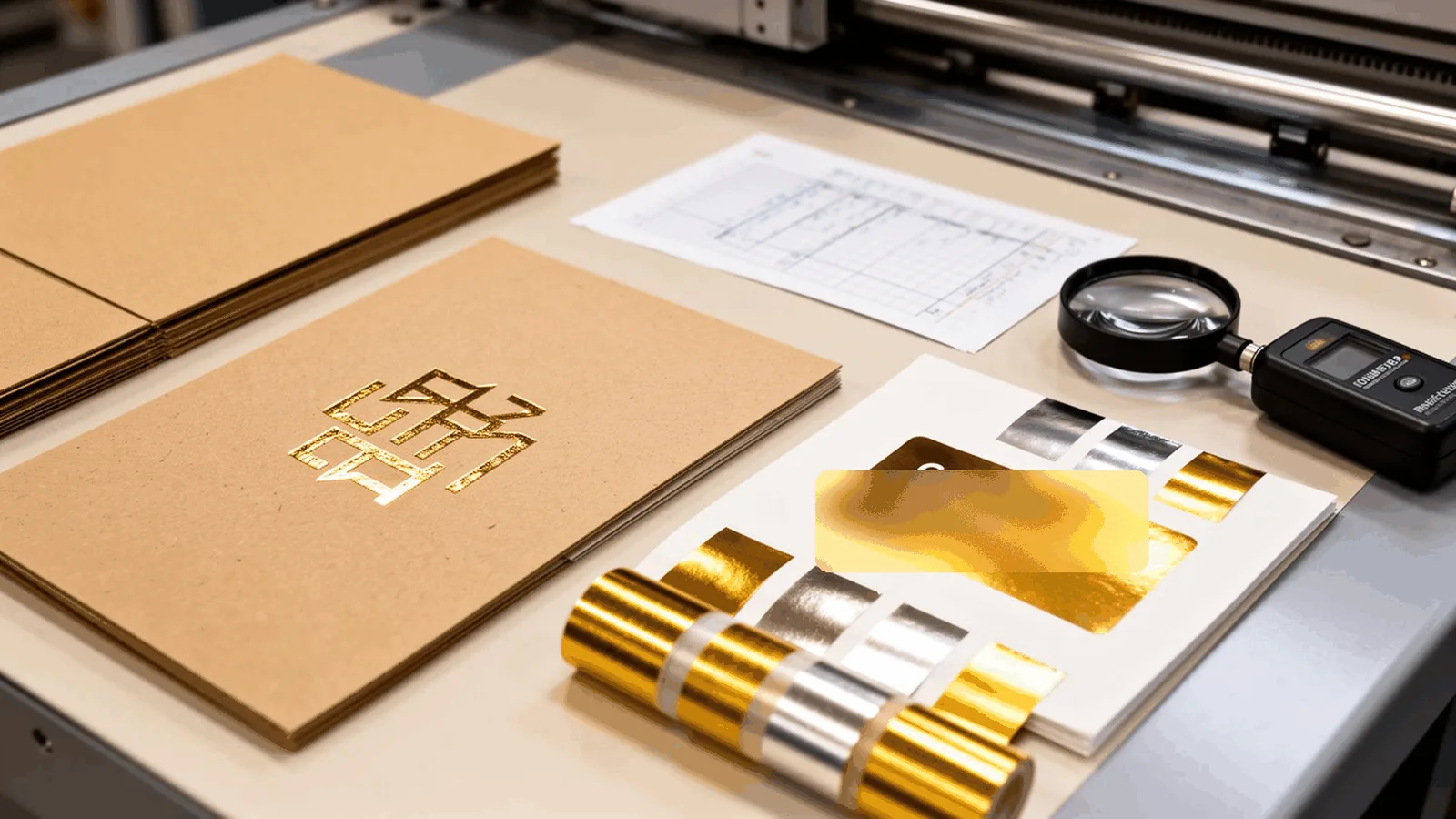
“TL;DR: On highly absorbent or textured uncoated paper, hot foil is usually the safer first choice for dense metallic coverage, tactile impression and rough kraft-style stocks. Cold foil can still be better when the project needs inline speed, fine detail, overprintable metallic color, label production efficiency or a controlled primer/varnish strategy. The right answer depends less on the foil name and more on paper porosity, surface sizing, adhesive holdout, artwork coverage and the press route.
Searches around “which is better cold foil or hot foil for uncoated paper” show practical buyer intent: teams are not asking for a textbook definition; they are trying to avoid failed transfer, dull metallic areas, adhesive absorption and launch delays. Uncoated paper makes that decision harder because its open surface can absorb fluids and expose texture in ways that coated substrates do not.
A useful specification starts with the paper, not the foil. TAPPI’s paper science references describe surface sizing and coating as key variables in paper performance, while Wikipedia’s cold foil printing overview defines cold foil as a metallic foil process applied through printing rather than a heated stamping die. Those basics explain why uncoated paper behaves differently: cold foil depends on a printable adhesive layer sitting cleanly on the surface; hot foil depends on heat, pressure and dwell transferring foil into or onto the sheet.
For a broader process comparison, keep Hot vs Cold Foil Stamping: 2026 Buyer’s Guide open while reading this article. For cost trade-offs after the substrate decision, see Cost Difference Between Cold Foil and Hot Foil Stamping.
Why uncoated paper changes the foil choice
Uncoated paper has no smooth pigment coating to create a sealed, even print surface. Depending on the grade, it can be porous, fibrous, soft, rough, dusty or heavily textured. That matters because metallic foil needs a consistent bonding layer and a consistent contact surface.
With cold foil, UV-curable adhesive is printed first, foil is nipped against the adhesive, then cured and stripped. If the adhesive sinks into the sheet or spreads through fibers, the foil may look grainy, weak or incomplete. With hot foil, the heated die and pressure can help the foil conform to the paper texture, but very rough surfaces still require the right foil grade, die setup and make-ready.
The main uncoated-paper variables are:
- Absorbency: high absorption can steal adhesive or coating before it can form a foil-ready surface.
- Roughness: valleys in the sheet reduce full contact for foil transfer.
- Surface sizing: stronger sizing improves holdout and can make cold foil more realistic.
- Dust and fiber lift: loose fibers can weaken adhesion and produce specks.
- Caliper and compressibility: soft stocks may accept hot foil impression better, but they can also distort fine detail.
Quick decision: which process is better?
For most uncoated packaging papers, use this rule of thumb:
| Uncoated paper condition | Better starting point | Why it usually wins |
|---|---|---|
| Rough kraft, recycled board, cotton paper, linen texture | Hot foil | Heat and pressure can bridge surface texture better than a printed adhesive film. |
| Smooth, well-sized uncoated sheet | Cold foil test is realistic | Better holdout gives UV adhesive a chance to stay on the surface. |
| Large solid metallic panels | Hot foil | Dense coverage is less dependent on adhesive print uniformity. |
| Fine detail, thin rules, inline label work | Cold foil | Printed adhesive can register fine artwork efficiently when the surface is controlled. |
| Metallic color overprinting | Cold foil | Silver cold foil can be overprinted to create multiple metallic colors in one workflow. |
| Short-run luxury invitation, book cover, premium stationery | Hot foil | Tactile impression and deep shine are often part of the value proposition. |
This is not a rule against cold foil on uncoated paper. It is a rule against assuming uncoated paper behaves like coated paper. If the sheet is smooth and sized, cold foil can be viable; if the sheet is rough, open and absorbent, hot foil usually starts with a wider production window.
When cold foil is the better option
Cold foil becomes attractive on uncoated paper when the converter can control the surface before foil transfer. That may mean choosing a smoother uncoated grade, adding a primer, using a suitable UV adhesive, applying a local varnish under the foil area, or limiting the artwork to details that transfer well.
Choose cold foil first when the project needs:
- 1Inline production speed on a UV-capable label or packaging press.
- 2Fine registered foil details that align with printed graphics.
- 3Overprinted metallic colors from a silver foil base.
- 4Multiple SKUs where plate-based adhesive changes are easier than separate stamping dies.
- 5Moderate coverage instead of large, dense metallic blocks.
Cold foil is also useful when brand teams want a metallic effect integrated into the print design rather than a separate post-press embellishment. If you are still learning the workflow, read How Cold Foil Stamping Works: Step-by-Step and What Is the Cold Foil Technique? before approving a paper stock.
When hot foil is the safer choice
Hot foil is often safer on uncoated paper because it is less dependent on a wet adhesive layer remaining perfectly on the surface. A heated die, pressure and dwell can create stronger contact on rougher stocks. That is why hot foil often appears in premium stationery, book covers, wine labels, invitations and textured packaging.
Choose hot foil first when the project has:
- rough kraft, recycled, cotton or heavily textured paper;
- large solid foil areas or dense logos;
- a desired debossed or tactile impression;
- very short runs where die cost is acceptable;
- a premium finish where depth matters more than inline speed.
The trade-off is cost and flexibility. Hot foil usually requires a die, offline setup, more make-ready and slower throughput. For a detailed cost framework, use Cost Difference Between Cold Foil and Hot Foil Stamping.
Test matrix before choosing the process
A practical test should compare the exact paper, artwork and finishing stack. Do not approve the process from a foil swatch alone.
| Test item | Cold foil acceptance check | Hot foil acceptance check |
|---|---|---|
| Foil coverage | No pinholes, grainy edges or adhesive starvation. | No voids in texture valleys; consistent shine across solids. |
| Fine detail | Thin rules transfer cleanly without fill-in or broken edges. | Fine lines do not plug, crush or lose definition. |
| Rub and scuff | Foil survives handling after cure and varnish. | Foil resists abrasion without flaking from fiber peaks. |
| Crease and fold | Foil stays intact on cartons after scoring and folding. | Impression does not crack the paper or foil film. |
| Overprint or varnish | Ink/varnish bonds to the foil and surrounding paper. | Protection layer does not dull the foil beyond approval limits. |
| Production speed | Transfer remains stable at target press speed. | Stamping speed holds quality without overheating or distortion. |
The U.S. Environmental Protection Agency’s sustainable materials management hierarchy is useful context here: the better choice is the one that meets brand requirements with fewer failed trials, rejects and avoidable waste. A decoration method that looks cheaper on paper can become expensive if it creates repeated rejects on a difficult substrate.
Artwork guidance for uncoated paper
Artwork can decide the process as much as the paper does. Cold foil usually performs best on controlled, printable shapes with adequate adhesive laydown. Hot foil usually performs better when the design needs dense, simple metallic areas with tactile depth.
For cold foil on uncoated paper:
- avoid very large unbroken metallic blocks unless the surface has been qualified;
- use slightly bolder minimum line weights during early trials;
- keep reverse type large enough to resist adhesive gain;
- specify whether the silver foil will be overprinted into gold, copper or brand colors;
- test varnish because uncoated paper and foil may need different protection behavior.
For hot foil on uncoated paper:
- avoid ultra-fine detail on very soft or fibrous sheets;
- confirm die depth and make-ready with the real paper caliper;
- test both flat foil and slight impression if the brand wants tactile depth;
- check whether heavy pressure changes sheet flatness or folding behavior.
Buyer recommendation
If the paper is rough, open, recycled or heavily textured, start with hot foil unless there is a strong production reason to force cold foil. If the paper is smooth, well-sized and part of an inline packaging or label program, start with a cold foil qualification trial and compare it against hot foil before locking the specification.
For most packaging teams, the best workflow is:
- 1Shortlist the uncoated paper grades first.
- 2Decide whether the foil effect is fine detail, dense coverage or overprinted metallic color.
- 3Run cold foil and hot foil samples on the hardest artwork area.
- 4Test rub, fold, scuff, tape pull and varnish compatibility.
- 5Choose the process that gives repeatable production quality, not only the best single lab sample.
If your team needs the terminology before requesting samples, start with What Is Cold Stamping Foil?. If you are preparing a supplier brief, the trend-focused checklist in Cold Stamping Foil Search Trend: What Buyers Should Know This Week can help structure the request.
Frequently asked questions
Is cold foil good on uncoated paper? +
Cold foil can work on smooth, well-sized uncoated paper, especially for fine detail and inline production. It is riskier on rough, porous or highly absorbent sheets because the adhesive may sink into the paper before foil transfer.
Is hot foil better than cold foil for kraft paper? +
Hot foil is usually the better starting point for kraft paper, recycled board and rough natural stocks because heat and pressure can handle texture more effectively than a printed cold-foil adhesive layer.
Can cold foil be used on textured paper? +
It can be tested, but textured paper narrows the process window. Use a qualified primer or varnish strategy, avoid dense solids during early trials, and test rub, scuff and fold performance before approval.
Which process costs less on uncoated paper? +
Cold foil can cost less in inline production and multi-SKU work, but only if transfer is stable. Hot foil can cost more because of dies and setup, but it may be cheaper overall when rough paper would cause cold-foil rejects.
What should buyers test before approving foil on uncoated paper? +
Test the real paper, real artwork, target speed, varnish or laminate, rub resistance, fold performance, scuff resistance, tape pull and visual consistency under multiple light angles.