Hot foil printing,
heat-set & tactile.
The original metallic decoration process — a heated brass die presses pigmented foil into the substrate, producing the sharpest edge and the only true tactile relief in the foil category. Slower and tooling-heavy than cold foil printing, but on short runs, textured stocks and pigment colours, still the right call.
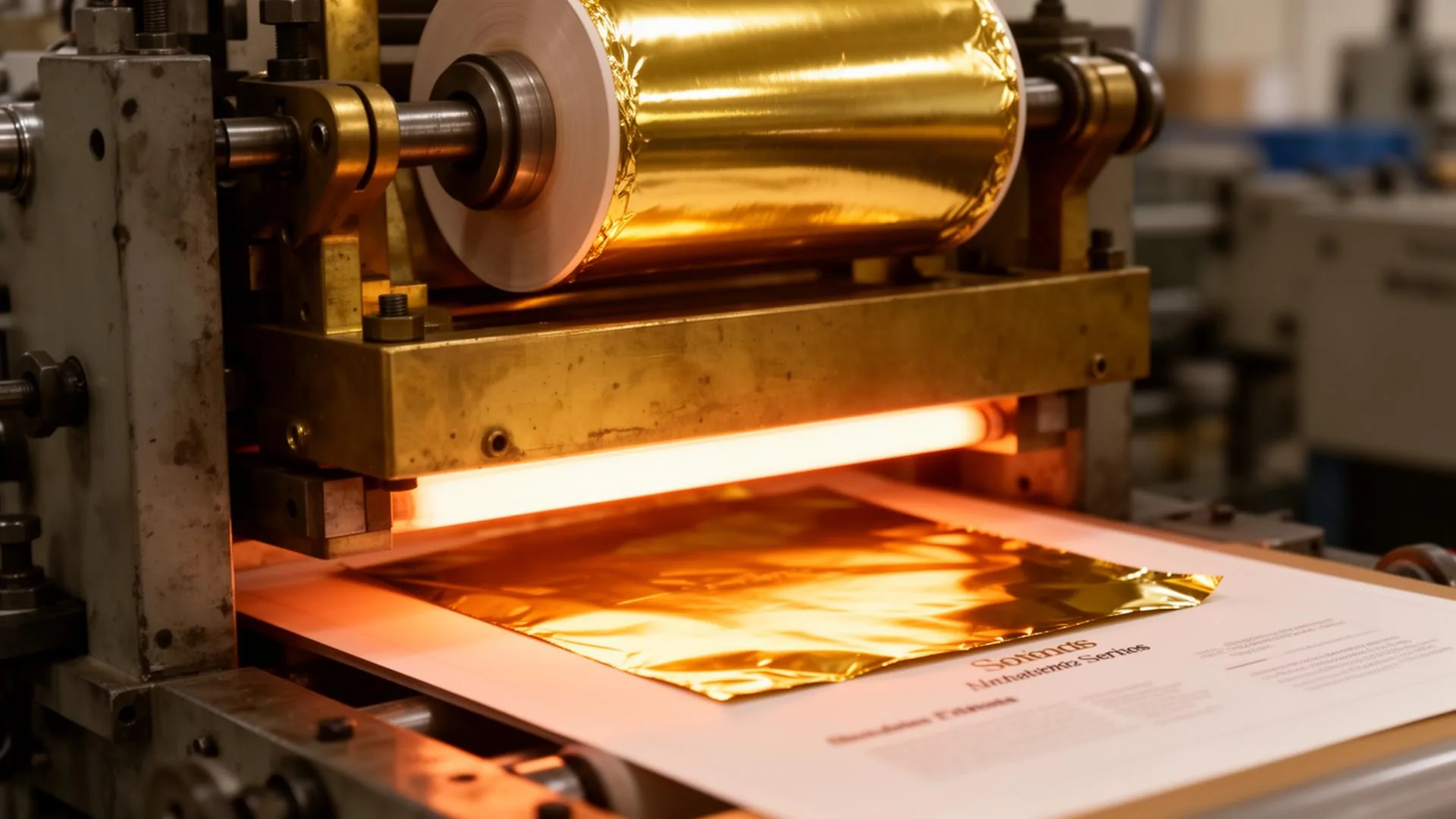
- 120–150°C
- Die temperature
- 20–60m/min
- Typical press speed
- 4k–8ksph
- Sheet-fed throughput
- $300+
- Brass die tooling
01 · Definition
What is hot foil printing?
Hot foil printing — also called hot foil stamping or hot stamping — uses a heated engraved metal die to press pigmented foil into a paper, board or specialty substrate. Heat melts the foil's release layer; pressure bonds the pigment-and-sizing layer to the sheet. The carrier film rewinds with a clean negative of the image.
It is the oldest production foiling method and still the benchmark for edge sharpness, pigment colour range and tactile relief. Where cold foil printing wins on speed and inline integration, hot foil wins on craft and substrate range — which is why both processes coexist in modern packaging plants. For a wider view, see the cold foil pillar guide and the hot vs cold foil stamping buyer's guide.
02 · Why printers still choose hot foil
Sharper edge, tactile relief, wider substrate range
Heat + pressure = sharpest edge
A heated brass or magnesium die presses pigmented foil into the substrate at 120–150 °C. Edge definition is the cleanest available — fine serif type and 0.15 mm rules render without halation.
Tactile relief and combo emboss
Die pressure leaves a slight deboss on the foiled image, and a sculpted combo die foils and embosses in the same hit. Cold foil printing is flat by comparison.
Works on stocks cold foil struggles with
Heavily textured uncoated, soft-touch laminates, leather, vinyl, book cloth and PU. Hot foil printing forms a mechanical anchor that UV adhesive cannot match on these surfaces.
Pigment foils and specialty effects
True chromatic pigments (deep reds, navy, matte black), leafing-style golds and brushed-pattern foils are made for hot stamping. Cold foil is mostly limited to mirror metallics plus CMYK overprint.
03 · How hot foil printing works
Four steps, one heated die
Hot foil printing is an offline operation on a dedicated platen or rotary press. Make-ready is longer than cold foil but the toolset and craft are well-understood in every packaging plant.
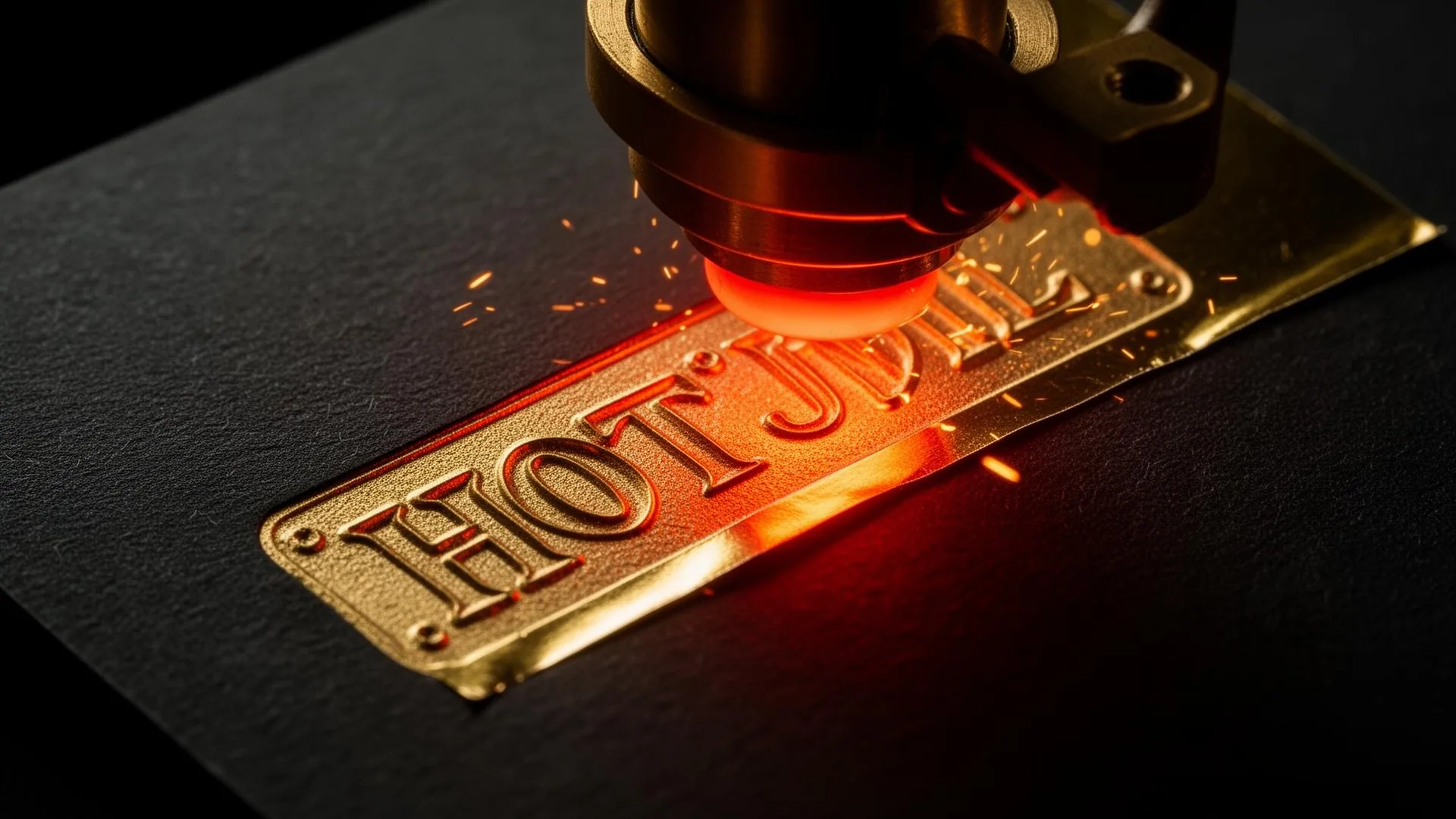
The strike — brass die at 140 °C, dwell measured in milliseconds, pigment bonded into the fibre.
- 1
Mount the heated die
A custom brass (best) or magnesium (cheaper) die is engraved with the image and clamped to the heated chase. Magnesium tools heat in ~5 min, brass in ~10 min and holds temperature better for long runs.
- 2
Bring up temperature and dwell
The die is held at 120–150 °C. Dwell time (10–80 ms) and pressure (1–3 t/cm²) are tuned to the foil and stock. Operators trial a strike, read coverage, adjust.
- 3
Strike the foil web
Pigmented foil indexes between the die and substrate. Heat melts the release layer, pressure transfers the pigment + sizing onto the sheet. The die lifts; the carrier rewinds with a perfect negative.
- 4
Strip and inspect
The foiled sheet exits, cools, and is inspected for full coverage, edge crispness and tail crazing. Reject rates of 1–3% are normal at make-ready.
04 · Hot vs cold foil printing
Head to head — the honest split
Hot foil wins on tactile and craft; cold foil wins on speed and cost at volume. The same table that appears on the cold foil printing pillar, presented from the hot-foil side first.
| Attribute | Hot foil printing | Cold foil printing |
|---|---|---|
| Process | Heated die + pressure | Printed UV adhesive + UV cure |
| Temperature | 120–150 °C | Room temperature |
| Tooling | Brass / magnesium die — $300–$1,500+ | Flexo plate — $50–$200 |
| Make-ready | 30–60 min | 5–15 min |
| Press speed | 20–60 m/min · 4k–8k sph | 300–450 m/min · 12k–18k sph |
| Inline with CMYK? | No — offline second pass | Yes — single inline pass |
| Overprint on foil? | Limited — ink often crawls | Yes — direct CMYK overprint |
| Edge definition | Sharpest available | Excellent on coated stock |
| Tactile / emboss | Slight deboss; combo emboss possible | Flat finish |
| Short runs (<2k) | Often cheaper — die amortises fast | Less economical |
| Long runs (>5k) | Tooling and speed penalty grows | 30–60% cheaper per impression |
| Best substrates | Coated, uncoated, textured, leather, vinyl, cloth | Coated SBS/FBB, films, primed uncoated |
| Foil range | Pigment + metallic + holographic + specialty | Mirror metallic + holographic (tinted via CMYK) |
Pick hot foil printing when…
- Short runs below ~2,000 sheets where die cost amortises fast
- Premium book covers, certificates, business cards and stationery
- Designs that need a tactile deboss or combo emboss-foil
- Pigment colours (deep red, navy, matte black) not available as cold foil
- Heavily textured uncoated, soft-touch lam, leather, vinyl or cloth
- Spot decoration on already-finished or non-press substrates
Switch to cold foil printing when…
- Volumes above ~5,000 sheets, especially reel-fed converting
- Inline UV-flexo or sheet-fed offset lines with a cold foil module
- CMYK overprint, rainbow metallic, tinted golds in one pass
- Sustainability briefs (PPWR mono-material, zero VOC)
- Tight multi-SKU schedules with frequent changeovers
Deeper reads: cold foil printing pillar · cold foil pillar guide · hot vs cold foil stamping 2026 guide · cost difference between cold and hot foil · which is better on uncoated paper?
05 · Where hot foil printing shines
Categories where hot foil is still first choice
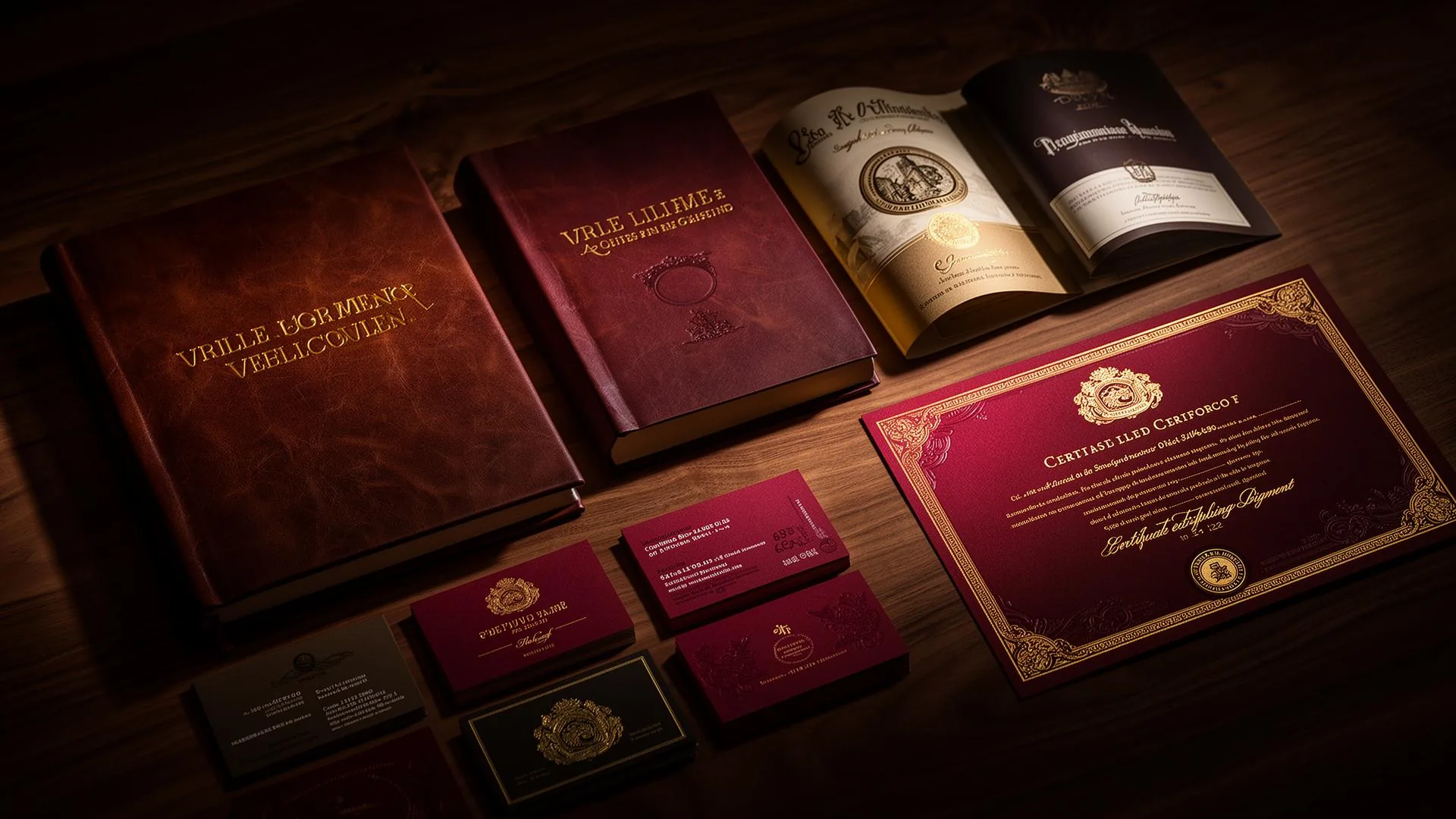
Book covers & jackets
Sharp serif type, deboss, leather and cloth substrates.
Business cards & stationery
Short runs, tactile finish, premium card stock.
Wine & spirits labels
Combo emboss-foil seals, pigment golds on textured stock.
Certificates & diplomas
Crisp edges, pigment foils, low volumes.
Luxury cosmetics (short runs)
Pigment-matched brand colours not available as cold foil.
Leather, vinyl & cloth goods
Substrates where cold foil adhesive will not anchor.
06 · Related guides
Keep reading
Cold foil printing — pillar
Inline UV-flexo process, press speeds, costs and the reverse-direction comparison.
Read the cold foil pillarCold foil pillar guide
The full cold foil reference — definitions, applications, FAQs, related blog hub.
Open pillar guideHot vs cold foil stamping
2026 buyer's guide with cost tables and decision matrix.
Read the comparisonFoil stamping services
Production capability — both processes available with prepress, plates and QC.
See services07 · FAQ
Common questions
What is hot foil printing?
+
Hot foil printing — also called hot foil stamping or hot stamping — transfers pigmented or metallic foil from a polyester carrier onto a substrate using a heated metal die and mechanical pressure. The die is engraved with the image, heated to 120–150 °C, and pressed into the foil and stock for 10–80 ms. Heat melts the foil's release layer; pressure bonds the pigment to the sheet.
Hot foil printing vs cold foil printing — which should I choose?
+
For runs below ~2,000 sheets, tactile relief, pigment foils or hard-to-stick substrates, hot foil printing is the better tool. For runs above ~5,000 sheets, CMYK overprint, rainbow metallics, fast changeovers or mono-material recyclable packaging, cold foil printing wins. The split is real, not marketing — see the comparison table above for the full breakdown.
How much does a hot foil printing die cost?
+
Magnesium dies run $150–$400 and suit short runs. Brass dies cost $400–$1,500+ depending on size and detail and hold temperature for hundreds of thousands of impressions. Combo emboss-foil dies are typically $800–$3,000. Add $80–$250 for a counter die when you need a sculpted emboss.
What press speed does hot foil printing run at?
+
Production speed depends on die size, dwell time and substrate. Sheet-fed platen presses (Bobst, Gietz, Heidelberg) run 4,000–8,000 sheets per hour. Roll-fed rotary hot foil units run 20–60 m/min. Cold foil printing, by comparison, runs 300–450 m/min inline.
Can you over-print CMYK on hot foil?
+
Technically yes, in practice rarely well. The release layer left on hot-stamped foil tends to make CMYK and conventional inks crawl or fish-eye. Hybrid approaches usually print first, then hot stamp on top. Cold foil printing is the inverse — designed to be over-printed.
Is hot foil printing recyclable?
+
Yes for paper and board. Pigment hot foil deposits typically sit below 5 g/m² (well under EU PPWR 2027 mono-material thresholds), and standard repulping mills disperse the metallic layer. Avoid metallised laminates as the carrier; use plain PET-carrier foils for the cleanest recycling story.
Hot foil, cold foil — or both?
Send your artwork, run length and substrate. We'll quote both processes side-by-side so you can pick on facts, not folklore.