TL;DR. Luxury brands don't choose cold foil because it is cheaper than hot foil — they choose it because it lets them combine a mirror-bright metallic with fine 4 pt type, photographic image areas, and CMYK-over-metallic gradients in a single press pass at 120–150 m/min, on the same SBS or FBB carton stock they already use for hot-foil work. For a 50,000-unit cosmetic carton run, cold foil typically lands 35–55 % below the all-in cost of brass-die hot foil while delivering 78–90 GU at 60° on coated board. The trade-off is honest: cold foil is not the right answer for heavy embossed crests, dark substrates without a white underprint, or sub-3,000-unit prestige runs where tooling amortisation favours hot foil. This guide is how luxury packaging buyers, brand designers, and packaging engineers actually specify it.
“"Cold foil transfer has moved from a mass-market decoration to a credible prestige finish. On UV offset and UV flexo lines running at 120 m/min and above, surface gloss now reaches 85–92 GU at 60°, within 5 % of conventional hot-stamped foil, while enabling four-colour process overprinting in the same pass." — Smithers, The Future of Metallic Effects to 2029, industry outlook 2024.
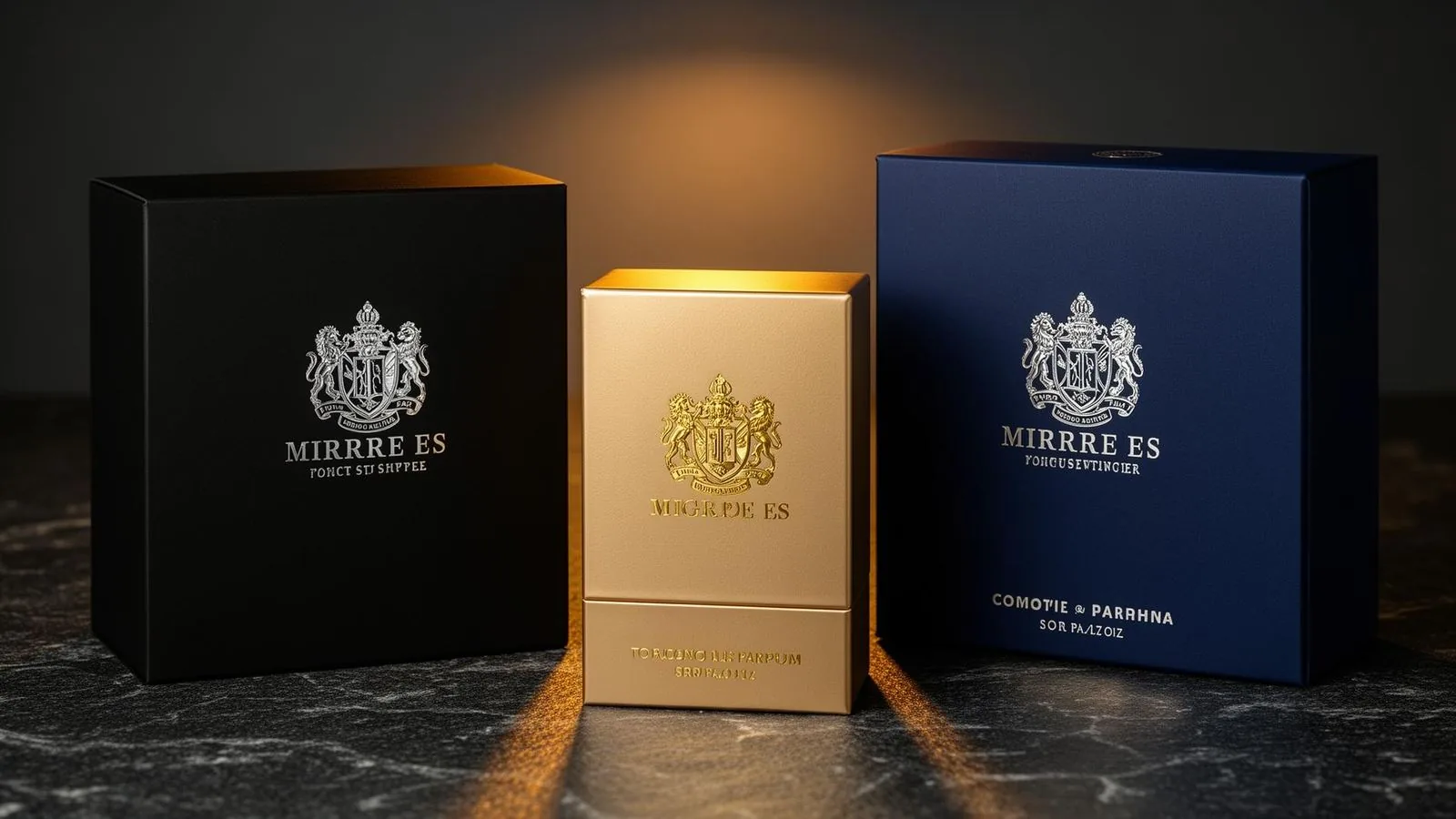
---
1. What "luxury" actually means to a foil specification
When a beauty or spirits brand briefs a converter, the word "luxury" usually translates to four measurable things on the printed carton:
- 1Reflective brilliance. A specular gloss reading of 80 GU or higher at 60° on metallic areas. Below 70 GU the foil reads as "metallic ink" to a trained eye.
- 2Edge sharpness. Type and rule down to 0.2 mm (about 4 pt) with no feathering or pinholing visible at arm's length.
- 3Tonal control over the metal. The ability to lay CMYK, varnish, or a tinted lacquer over the foil to create rose gold, champagne, gunmetal, or a brand-specific colour without switching foil reels.
- 4Surface hierarchy. A clear contrast between matte board, soft-touch lamination, spot UV, and the foil itself — so the metal reads as the most precious element, not the loudest.
Cold foil delivers points 1–3 better than any other inline process available today, and point 4 is a finishing decision (soft-touch laminate, matte OPV, blind emboss) that sits on top of the cold foil layer. For the broader process logic, see our cold foil printing pillar and the hot foil vs cold foil printing comparison.
2. Where luxury brands are actually using cold foil
The category mix has shifted noticeably between 2022 and 2026. Five segments now dominate cold-foil prestige work:
| Segment | Typical format | Why cold foil wins |
|---|---|---|
| Prestige skincare & fragrance cartons | 300–350 g/m² SBS, 70×70×120 mm | Photographic skin tones print over foil for "lit from within" backgrounds |
| Premium spirits secondary packs | 350–400 g/m² FBB, sleeves & gift boxes | Tinted varnish over silver foil = bespoke gold/copper without new tooling |
| Confectionery limited editions | 280–320 g/m² coated white, short-run seasonal | Plate changes vs. brass dies = 2-week not 6-week lead time |
| Personal care reformulations | Recyclable mono-material cartons | Cold foil is mono-material compatible (see §6) |
| Tobacco & vape (regulated markets) | 270–300 g/m² SBS with health-warning area | Foil holds register with mandatory warning text in one pass |
Direct-to-consumer beauty in particular has driven volume: Smithers attributes roughly 18 % of the global cold-foil packaging market to prestige skincare and fragrance alone in its 2024 outlook, up from about 11 % five years earlier.
For a deep dive on one of these segments, the luxury cosmetic cold foil cartons article walks through a real 50,000-unit specification from artwork to delivery.
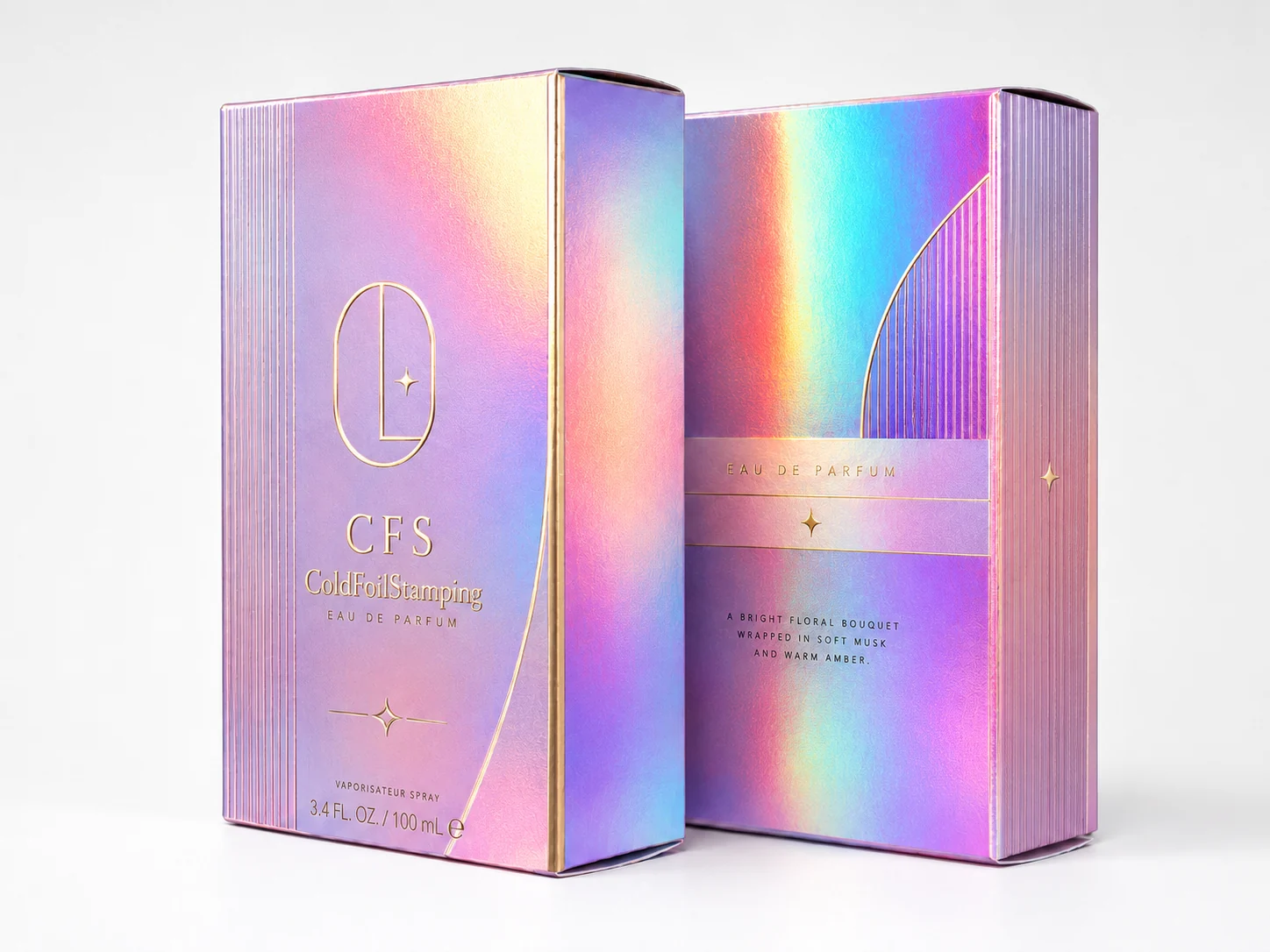
3. The specification a luxury brand should actually hand to the converter
A weak brief reads: "silver cold foil on the logo, please make it look premium." A specification a converter can quote and reproduce reads like this:
- Substrate: SBS C1S, 320 g/m², GD2 grade or better, brightness ≥ 88, PPS ≤ 1.5 µm. Named mill preferred (Stora Enso Performa Brilliance, Iggesund Invercote, MetsäBoard Pro).
- Foil: UV cold-transfer foil, bright silver, release coat hardness Shore D 55–60, aluminium layer ≥ 30 nm. Brand-specific colours achieved by CMYK overprint on silver base, not by switching to a coloured foil reel.
- Adhesive: UV-curable cationic cold-foil adhesive, 1.0–1.4 g/m² wet film on coated board. Anilox 3.5–4.5 cm³/m² for line work, 5.0–6.0 cm³/m² for solids.
- Press: UV offset (Heidelberg Speedmaster XL 106 with FoilStar, KBA Rapida 106 with HR-UV, or equivalent) or 8-colour UV flexo for label work.
- Target gloss: ≥ 82 GU at 60° measured on a 25×25 mm solid; ≥ 75 GU on type areas.
- Register: ±0.10 mm foil-to-print, ±0.15 mm foil-to-cut.
- Finishing: soft-touch matte laminate over full carton, with a knockout plate so foil reads against matte (do not laminate over foil unless the brand specifically wants a "buried metal" effect).
- Sampling: 25 live press sheets retained, of which 5 are colour-balanced for brand approval (CIE L\a\b\* + 60° gloss reading documented per sheet).
A converter that pushes back on the anilox cell volume or the PPS roughness spec is doing their job. A converter that quotes without asking is not — see our anilox roller selection guide for cold foil for the engineering behind those numbers.
4. Cost honesty: where cold foil saves money and where it doesn't
The most common reason a luxury brand switches from hot to cold foil is not the unit cost of the foil itself (it is roughly comparable per square metre). It is inline integration: cold foil prints in the same pass as CMYK, while hot foil is a separate, off-line operation on a Bobst Masterfoil or Gietz FSA with brass dies, makeready, and a second handling cycle.
Real-world numbers from European cosmetic carton runs (2025 quotes, normalised):
- 5,000-unit run, single foil area, simple shape: hot foil typically wins by 8–15 % because brass-die makeready is a fixed cost that amortises quickly at small scale.
- 25,000-unit run, two foil areas, CMYK overprint on one: cold foil wins by 22–30 % and offers a 2-week shorter lead time.
- 100,000-unit run, full-bleed foil background: cold foil wins by 40–55 %; the difference grows with foil area because hot foil burns through brass life and adhesive-side foil yield is lower.
The honest break-even for a typical cosmetic carton with one foil area and no overprint sits around 8,000–12,000 units. Below that, hot foil. Above that, cold foil. The full breakdown lives in the cost difference article.
What you do not save on:
- Soft-touch lamination (€0.04–0.08 / carton): the same regardless of foil method.
- Cutting and creasing (€0.012–0.020 / carton): the same.
- Boxing and palletising: the same.
- Brand-side colour management: if anything, cold foil requires more upfront Pantone-to-CMYK-over-silver work for the first SKU.
5. The five mistakes that ruin a luxury cold-foil job
Most "the foil looks cheap" complaints trace back to the same handful of decisions. They are all avoidable.
- 1No white underprint on dark or natural board. Cold foil is a thin aluminium layer; if the substrate is kraft or black, the foil reads grey-gold. A 0.6–1.0 g/m² UV opaque white under the foil zone fixes it.
- 2Specifying "Pantone 871 gold" as a foil colour. 871/872/877 are metallic inks, not foil targets. Specify the foil as bright silver and the overprint colour as a tinted varnish or a CMYK build (typically 0/25/85/10 for a warm gold over silver).
- 3Laminating over the foil without a knockout. Gloss laminate buries the metal and drops gloss by 15–25 GU. If matte/soft-touch is the brand standard, use a knockout plate so the laminate ends 0.3 mm inside the foil edge.
- 4Foil over a heavy emboss. Cold foil cracks above about 0.4 mm emboss depth in a 320 g/m² SBS. If you need a deep embossed seal, the answer is hot foil + emboss combo die — not cold foil.
- 5Skipping a press-side cold foil prepress check. Most artwork issues (foil on type < 4 pt, foil under a barcode, foil in the bleed area) are catchable in five minutes if someone actually looks at the cold-foil separation as its own layer.
6. Sustainability — what luxury brands can credibly claim
This is the section that has changed most in the last 24 months, because regulation and brand-owner reporting have caught up with what converters already knew.
A cold-foil carton on standard SBS:
- Is recyclable in the EN 643 "PPB" paper-for-recycling stream (board with surface decoration) according to CEPI guidelines, because the metallised layer is below the 5 % non-paper material threshold by mass on a typical foiled area. See CEPI's Cepi Recyclability Laboratory test method.
- Counts as a mono-material paperboard package under the EU PPWR (Packaging and Packaging Waste Regulation, in force 2026) provided no plastic laminate is added on top. This is a real differentiator vs. metallised polyester laminates.
- Has roughly 30–45 % lower cradle-to-gate CO₂e than a hot-stamped equivalent, primarily because there is no brass-die tooling, no off-line process, and foil-side yield is higher (less foil web waste per impression).
For the technical detail behind those claims, the is cold foil recyclable article cites the underlying CEPI Test Method I (2022) protocol with measured pulp-yield numbers. The mono-material recyclable packaging piece extends it to flexible structures.
What you cannot credibly claim:
- "100 % recyclable" without naming the stream. Use "recyclable in the paper-for-recycling stream (EN 643 PPB)".
- "Plastic-free" if the carton has a polyester soft-touch laminate.
- "Carbon-neutral foil" without a verified Scope 3 calculation from the foil supplier.
7. Lead times, MOQs, and how to actually run the project
For a brand owner planning a launch, the realistic timeline from approved artwork to palletised cartons in Europe is:
- Week 1: prepress, foil-layer separation, white-underprint build, soft-proof.
- Week 2: wet proof or draw-down on actual substrate, brand approval, signed colour standard.
- Week 3: press makeready (4–6 hours for first SKU, 1.5–2 hours for repeats), production run, inline QC.
- Week 4: lamination, cut & crease, gluing, QA on 1 % AQL, palletise, ship.
MOQs in 2026 are lower than most brand teams assume: most European cold-foil converters now quote down to 3,000–5,000 cartons for a first run, because the lack of brass tooling collapses the setup cost floor. Below 3,000 units, digital foil (Scodix, MGI JETvarnish + foil) is usually a better answer than either cold or hot.
8. FAQ
Is cold foil considered "luxury" by major beauty brands?
Yes — and it has been since roughly 2020. L'Oréal, Estée Lauder, LVMH beauty, and Coty all run cold foil on prestige cartons today, typically combined with soft-touch lamination and a blind emboss. The decision is rarely "cold vs. luxury"; it is "cold vs. hot for this specific job".
Can cold foil match a Pantone metallic exactly?
Not exactly, but close. Pantone metallics are inks measured on coated stock; cold foil is a true metal layer. The workflow that works is to specify the foil as bright silver and the overprint as a CMYK build calibrated against the target Pantone metallic under a D50 light at 45°/0° geometry. Most brand owners accept a ΔE ≤ 2.5 against the Pantone target.
What is the minimum type size for cold foil on luxury cartons?
4 pt for a sans-serif with stroke weight ≥ 0.15 mm, 6 pt for a serif. Below that you start seeing pinholing on the inside of bowls (e.g. the counter of an "e" or "a"). For ingredient lists and legal text, do not use foil — print in black or a tinted overprint and keep foil for the brand mark.
Does cold foil work on textured or uncoated luxury stock?
Yes, with a primer and accepting that the result is a satin metallic, not a mirror. The full engineering is in Cold foil on uncoated paper. Designers who plan for a satin finish (Munken, Cyclus, Gmund Cotton) get beautiful results; designers expecting chrome end up reprinting on C1S.
How long does the press setup take for a luxury cold-foil carton?
4–6 hours for a first run on an 8-colour UV offset press, including foil-web threading, anilox load check, and white-underprint plate alignment. Repeats drop to 1.5–2 hours because the foil unit stays threaded and the plates store cleanly.
Should the foil sit under or over the soft-touch laminate?
Under, with a knockout in the laminate plate over the foil area. Laminating over cold foil cuts gloss by 15–25 GU and reads as muted metal, which is the opposite of why you specified foil.
9. Where to go next
- For the engineering of the process itself: Cold Foil Printing — pillar and Hot Foil vs Cold Foil — pillar.
- For a real cosmetic specification end-to-end: Luxury cosmetic cold foil cartons.
- For brand-side designers: Cold foil prepress designer guide.
- For sustainability claims you can defend: Is cold foil recyclable?.
- To estimate a job before quoting: Cold foil stamping cost calculator.
If you are scoping a specific luxury carton project, request a sample with the substrate, foil area, and run length and we will return a press-side draw-down on the actual stock within 10 working days.