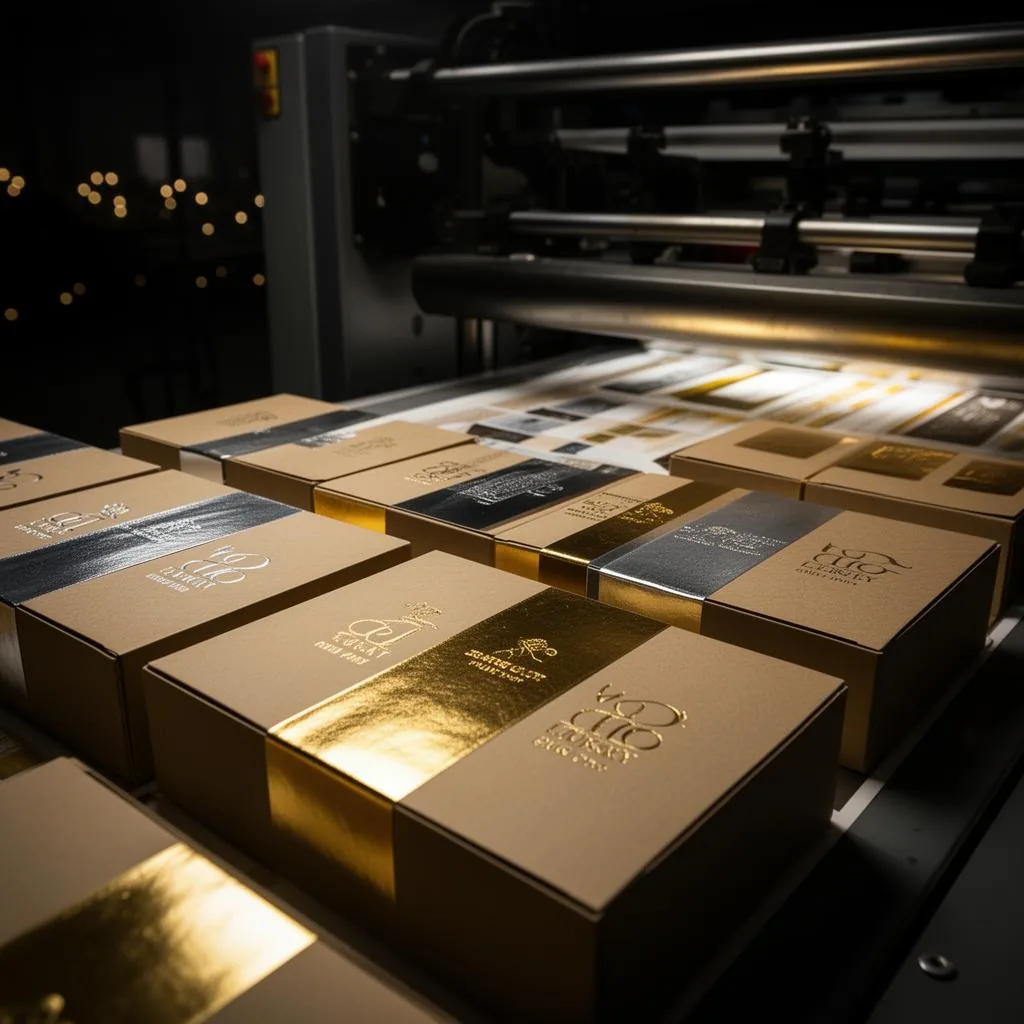
“TL;DR: Foil printing is the process of bonding a thin metallic foil layer onto paper, board, film or label stock to produce a reflective, jewellery-grade finish. Modern metallic foil printing is dominated by inline cold foil, which prints a UV-curable adhesive on a flexo or offset press, nips a real aluminium-vapour-deposited foil against it, and cures the bond at ambient temperature at up to 300 m/min with ~50 µm detail and full CMYK overprint for coloured metallics from a single silver base. This guide explains how foil printing works, what it costs, where it wins, and how to brief a converter in 2026.
If you are sourcing packaging, labels, business cards, greeting cards or premium book covers, foil printing is what gives the surface its mirror shine — and the technology choice behind it decides your unit cost, lead time and design freedom.
What is foil printing?
Foil printing — also called foil stamping or metallic foil printing — is a decoration process that transfers a thin metal layer from a carrier film onto a substrate to create a brilliant, reflective image. The metal is real, vapour-deposited aluminium typically 30–80 nm thick, coated with a release layer and (optionally) a coloured lacquer that tints the silver into gold, copper, rose, holographic or pastel tones.
Unlike printed metallic ink — which uses aluminium flakes suspended in varnish and only ever looks "silvery" — foil printing deposits a continuous mirror layer. That is why a foiled logo looks like polished metal, not glitter.
How does metallic foil printing work?
In 2026, the production-grade way to print foil at volume is inline cold foil, the technology this site is built around. The five-step transfer is what makes it so fast:
- 1Print adhesive. A flexo or offset unit lays a UV-curable adhesive in the exact shape of the foil graphic onto the substrate.
- 2Nip foil web. A continuous foil web is fed into a transfer roller and pressed against the wet adhesive.
- 3UV cure. A UV lamp instantly cures the adhesive — locking the metal layer onto the print at full press speed.
- 4Strip carrier. The PET carrier film is peeled away; foil only stays where adhesive was printed.
- 5Overprint. Downstream CMYK units print directly on top of the cured foil to create coloured metallics — pearl gold, rose copper, holographic blues — from a single silver foil base.
For a deeper press-side walk-through, see our step-by-step cold foil process guide and the cold foil stamping machine guide.
Foil printing vs other metallic finishes
| Finish | Look | Speed / cost at volume | Best for |
|---|---|---|---|
| Cold foil printing | True mirror metallic + CMYK overprint | Up to 300 m/min inline · lowest cost-per-unit at scale | Labels, folding cartons, flexible film, premium FMCG |
| Hot foil stamping | Mirror metallic, optional emboss | 30–80 m/min sheetfed · die cost US$80–400+ | Tactile luxury accents, short runs, embossed monograms |
| Metallic ink | Silvery / pearlescent — not true mirror | Press-speed, very low cost | Large coverage, soft sheen, budget jobs |
| Metallised board | Full-sheet mirror substrate | Substrate-level cost, no spot detail | 100% metallic backgrounds (beer, cosmetics) |
The headline numbers come from inline cold foil benchmarks reported by Packaging Europe and converter case studies tracked by Smithers, whose 2025 packaging market report values the global decorative foil segment at over US$3 billion and notes cold foil as its fastest-growing decoration technology.
What does foil printing cost?
Foil printing cost is driven by four variables, not one:
- Foil coverage area (the actual square-metres of metallic graphic, not the sheet size)
- Substrate (coated paper and board cure cleaner than uncoated or absorbent stocks)
- Run length (cold foil collapses unit cost above ~50,000 impressions; short runs amortise tooling poorly)
- Foil grade (bright gold, pale gold, silver, holographic, rose — see our foil products range)
For a working model, plug your job into our cold foil stamping cost calculator — it estimates per-carton foil cost from coverage, run length and substrate.
When should you specify foil printing?
Foil printing is the right call when your brief includes any of the following — and most premium packaging briefs hit several at once:
- Premium brand cue. A true mirror finish reads as "high value" in a way no printed ink can match.
- Coloured metallics. Rose gold, pearl gold, holographic, brushed bronze — all achievable from a single silver foil base via CMYK overprint.
- Fine detail. Micro-text, hairlines, security patterns down to ~50 µm.
- High volume. Above 50,000 impressions, inline cold foil printing is the lowest-cost route to a metallic finish.
- Heat-sensitive substrates. Cold foil runs at ambient temperature — safe on thin films, metallised papers and certain coated stocks.
- Sustainability targets. Inline cold foil uses ~45% less energy per impression than continuous-heat decoration and avoids die scrap.
For real-world examples, our luxury cosmetic cold foil cartons guide walks through how cosmetics brands brief foil printing on secondary packaging.
Foil printing for labels, cartons and flexible film
Three substrate families dominate commercial foil printing:
- Pressure-sensitive labels — wine, spirits, craft beer, cosmetics. Cold foil printing pairs with downstream UV inkjet or flexo CMYK for full coloured metallics.
- Folding cartons — secondary packaging for cosmetics, spirits, confectionery, pharma. Sheet-fed and web-fed cold foil both apply.
- Flexible film — pouches, sachets, wraps on BOPP, PET and PE. Cold foil's ambient-temperature process is the key enabler here; see our cold foil on flexible films guide.
How do you brief a foil printing job?
A converter brief that gets accurate quotes back the same day usually includes:
- 1Substrate (grade, weight, coating)
- 2Foil graphic area in cm² per impression, plus a PDF showing coverage
- 3Foil grade (bright gold, pale gold, silver, holographic, rose — see products/compare)
- 4Run length and reprint expectation
- 5Overprint requirements (CMYK on top of foil? spot colours? varnish?)
- 6Finishing (die-cut, emboss, varnish, lamination)
- 7Sustainability constraints (recyclability targets, FSC, mono-material)
For the prepress side, our cold foil prepress designer's guide covers artwork setup, trapping and adhesive plate generation.
“"Foil printing has moved from a finishing afterthought to a primary design decision. Brands are briefing cold foil into the artwork from day one because that is where the unit economics work." — paraphrased from converter feedback at recent LabelExpo events.
Is foil printing sustainable?
More than its reputation suggests. The metal layer in foil printing is only 30–80 nm of aluminium — a fraction of a gram per square metre — and inline cold foil printing avoids the continuous heat load of older die-based processes. The carrier film and de-inking behaviour are the questions most circular-packaging programmes ask; we cover both in our is cold foil recyclable? guide and the mono-material recyclable packaging guide aligned with the EU PPWR 2027 framework.
Ready to spec a foil printing job?
Request a free cold foil sample pack calibrated to your substrate and press, browse the full foil products range, or read the technical documentation for adhesive, anilox and curing recommendations.
Frequently asked questions
What is foil printing? +
Foil printing is a decoration process that transfers a thin layer of real, vapour-deposited aluminium foil from a carrier film onto a substrate using either a UV-curable adhesive (cold foil printing) or a heated die. The result is a true mirror metallic finish — far brighter than any printed metallic ink — used on packaging, labels, greeting cards, book covers and business cards.
What is metallic foil printing? +
Metallic foil printing is the same process as foil printing, with the emphasis on the coloured metallic finishes it can produce. Modern cold foil printing creates pearl gold, rose, copper, holographic and pastel metallics by overprinting CMYK inks on top of a single silver foil base — eliminating the need to stock dozens of pre-coloured foil rolls.
How fast is metallic foil printing? +
Inline cold foil printing runs at up to 300 m/min on modern web-fed presses, roughly 3–4× faster than traditional sheet-fed foil decoration. That speed is the reason cold foil is now the default for high-volume metallic packaging in 2026.
What does foil printing cost per unit? +
Unit cost depends on foil coverage, substrate, run length and foil grade. As a rough guide, premium folding-carton jobs at 100,000+ impressions land at single-digit cents per carton for spot foil graphics. Use our cold foil stamping cost calculator for a job-specific estimate.
Can you print CMYK on top of foil? +
Yes — and it is the single biggest advantage of cold foil printing. Downstream CMYK units on the same press print directly on top of the cured silver foil, producing pearl gold, rose, copper, holographic and pastel metallics from one foil grade. We cover the technique in detail in our CMYK over cold foil guide.
Is foil printing recyclable? +
The aluminium layer in foil printing is only 30–80 nm thick — well below the threshold most recycling streams care about — and modern de-inking processes handle it cleanly. The carrier film is rewound, not landfilled. Full detail is in our is cold foil recyclable? guide.
What is the difference between foil printing and metallic ink? +
Metallic ink uses aluminium flakes suspended in a varnish — it looks silvery but never mirror-bright. Foil printing deposits a continuous, vapour-deposited metal layer that reflects light like polished jewellery. For premium packaging, the visual gap between the two is substantial.