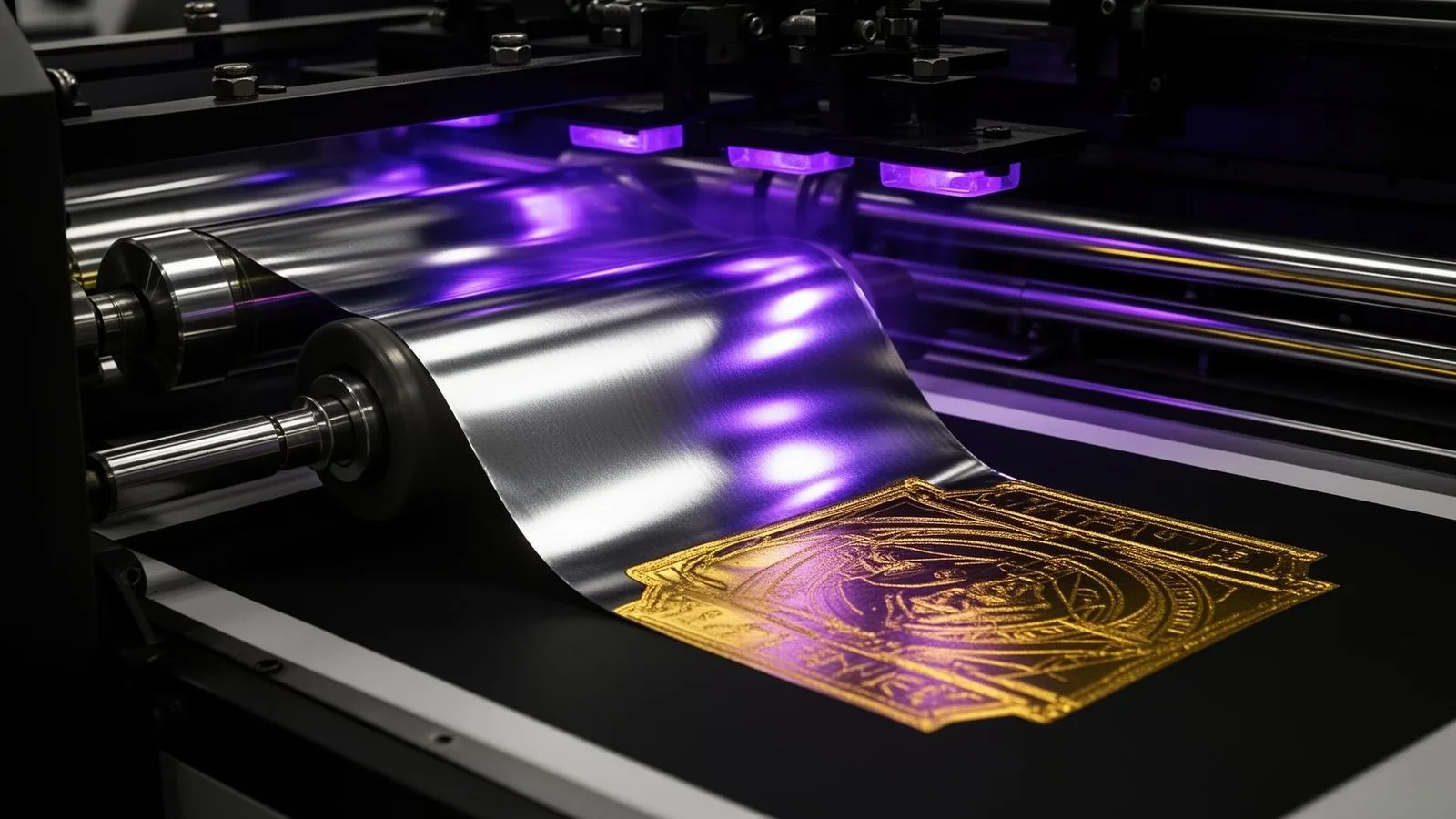
Cold foiling is an inline print-finishing process that transfers a metallic or holographic layer from a carrier film onto a printed adhesive image. Instead of using a heated metal die, the press prints adhesive only where the metallic effect is needed, brings a foil web into contact with that adhesive, cures or sets the bond, and rewinds the spent carrier film.
For packaging buyers, the important point is simple: cold foiling behaves more like a printing station than a separate stamping operation. That makes it strong for labels, cartons, films, overprinted metallic colors, and medium-to-long production runs, but it also means the result depends on substrate surface, adhesive laydown, foil release, nip contact, curing, and downstream ink or coating compatibility. If you are new to the process, start with the cold foil stamping definition, then follow the step-by-step press guide for the operator view.
What is cold foiling?
Cold foiling is the process of applying a metallic foil effect to selected printed areas using adhesive rather than a heated stamping die. It is also called cold foil stamping, cold foil printing, or cold foil transfer, depending on whether the speaker is focused on finishing, printing, or the material-transfer mechanism.
In a typical packaging workflow, the adhesive image is printed by a flexo or offset unit. A cold foil web is pressed against the adhesive, the bond is cured or set according to the adhesive system, and the PET carrier film is peeled away. The decorative metallic layer remains only where adhesive was printed.
Three points are worth clarifying before specifying a job:
- The PET carrier is removed and rewound; it is not laminated permanently onto the package.
- Cold foiling is normally flat. Embossed relief requires hot stamping or a separate embossing process.
- Not every cold foil system is identical. Sheet-fed offset and narrow-web flexo systems can use different adhesives, press layouts, substrates, and foil grades.
How does cold foiling work on press?
Cold foiling works by printing an adhesive image first, then transferring the foil layer onto that adhesive before the carrier is peeled away. The quality of the result depends less on the foil color alone and more on whether the adhesive, substrate, curing system, nip contact, and web tension work together.
| Press stage | What happens | What to check |
|---|---|---|
| Artwork and plate/blanket setup | The foil area is converted into an adhesive image. | Fine lines, reverses, large solids, registration tolerance. |
| Adhesive application | Adhesive is printed only where foil should transfer. | Adhesive uniformity, edge definition, contamination, drying/cure behavior. |
| Foil contact | The foil web meets the wet or tacky adhesive under controlled pressure. | Nip evenness, roller condition, web tracking, wrinkles. |
| Curing or setting | The adhesive bond is locked while the foil is held against the substrate. | Lamp output or curing condition, press speed, heat sensitivity, overprint compatibility. |
| Carrier release | The PET carrier separates and rewinds. | Clean release, foil dust, pinholes, missing transfer, edge ragging. |
| Overprint or coating | Ink, varnish, lamination, or coating may be applied after foiling. | Ink adhesion, scuff resistance, color shift, rub and tape testing. |
This is why cold foiling should be qualified with the actual substrate, adhesive, foil grade, ink system, and press conditions. A foil that transfers cleanly on coated label stock may behave differently on absorbent paper, recycled board, or treated film.
Cold foiling, cold foil stamping and cold foil printing: are they the same?
In packaging conversations, these terms often describe the same family of processes, but each term emphasizes a different viewpoint. "Cold foiling" is the broad practical term, "cold foil stamping" compares it with hot foil stamping, and "cold foil printing" highlights that the foil image is created through a printing unit rather than a heated die.
| Term | Usually means | Where to read more |
|---|---|---|
| Cold foiling | General process of applying foil without a heated die. | This article |
| Cold foil stamping | Cold foil as an alternative to hot foil stamping. | Cold foil stamping definition |
| Cold foil printing | Printing-focused description, often used by converters. | Technology |
| Cold foil transfer | Material-transfer description used by foil and equipment suppliers. | Cold foil products |
What equipment and materials are required?
A cold foiling job needs a press or module that can apply adhesive, control foil contact, cure or set the adhesive, and rewind the carrier film. The common production routes are sheet-fed offset for cartons and commercial print, narrow-web flexo for labels, and wider web configurations for selected film or flexible-packaging applications.
The core material set includes:
- Cold foil transfer film
- Adhesive matched to the foil release and substrate, such as a UV cold foil adhesive
- Substrate with suitable surface energy, coating, or treatment
- Ink, varnish, or lamination system compatible with the transferred foil
- Press controls for tension, nip contact, registration, and curing
Foil selection usually starts from the target finish: review the full range of cold foil products, then compare silver cold foil for overprintable metallic color work against holographic cold foil for diffractive and security-oriented designs.
Which variables control cold foil transfer quality?
Cold foil transfer quality is controlled by the full press system, not by one setting. If a job shows pinholes, missing foil, dull metallic effect, or ragged edges, the first checks should include substrate surface, adhesive film, nip pressure, curing, web tension, and foil grade compatibility.
| Symptom | Likely area to check first | What to record before changing foil grade |
|---|---|---|
| Pinholes or missing dots | Adhesive laydown, substrate absorbency, dust, cure condition | Substrate, adhesive batch, anilox/coating unit, press speed, lamp output. |
| Ragged foil edges | Plate/blanket condition, adhesive spread, nip pressure | Artwork detail, adhesive viscosity, roller condition, foil release behavior. |
| Dull metallic effect | Substrate surface, adhesive sink-in, overprint or varnish effect | Substrate coating, primer, overprint sequence, coating type. |
| Foil wrinkles | Web tension, roll alignment, nip roller condition | Foil width, unwind/rewind tension, splice behavior, roll storage. |
| Poor overprint adhesion | Ink or varnish compatibility with foil surface | Ink series, drying/curing condition, tape test result, rub test result. |
None of these values are universal specifications. Treat them as trial variables to record on your own press so the next run can be compared against a documented baseline. For visual diagnosis, use the cold foil defects photo guide and the pinholing and ghosting diagnosis guide; before a production run, work through the cold foil press setup checklist.
Where does cold foiling perform best?
Cold foiling performs best when the decoration is graphic, flat, metallic, and integrated into a press workflow. It is especially useful for pressure-sensitive labels, wine and spirits labels, cosmetics cartons, pharmaceutical cartons, promotional packaging, and designs that need metallic color overprinting.
It is a strong fit when:
- The design uses fine metallic graphics, halftones, gradients, or large flat metallic areas.
- The substrate is heat-sensitive or better handled without a heated die.
- The buyer wants metallic colors created by overprinting silver foil.
- The converter wants to avoid engraved die lead time.
- The job benefits from inline production and faster artwork changes.
When should you choose hot foil instead?
Hot foil can still be the better choice when the design depends on tactile relief, heavy debossed effects, very small luxury runs, or rough uncoated materials that need heat and pressure to achieve the desired finish. Cold foil is usually flatter and more printing-like; hot foil is more tooling-based and can feel more sculpted. For a fuller comparison of cost, speed and tooling, see hot foil stamping vs cold foil.
| Requirement | Better starting point |
|---|---|
| Flat metallic graphics with overprint colors | Cold foiling |
| Embossed or debossed metallic relief | Hot foil stamping or foil + embossing |
| Heat-sensitive film or thin material | Cold foiling |
| Very rough uncoated board | Hot foil or a tested primer route |
| Fast artwork changes across many SKUs | Cold foiling |
| Very short luxury run with one simple mark | Test both; economics depend on equipment and setup |
How should a buyer qualify cold foil before production?
A buyer should qualify cold foil with a real sample or press trial, not only by looking at a digital rendering. Metallic effect, adhesion, overprint behavior, and defect risk depend on the actual substrate, ink, adhesive, foil grade, and curing system.
| Buyer input | Why it matters |
|---|---|
| Substrate name, coating, weight, and supplier | Controls adhesive holdout and metallic brightness. |
| Press type and cold foil module | Determines process route and foil grade selection. |
| Adhesive system | Must match foil release, substrate, and curing method. |
| Artwork sample | Shows solids, fine lines, reverses, coverage, and registration risk. |
| Overprint or varnish plan | Affects final color, rub resistance, and adhesion. |
| End-use environment | Helps evaluate scuff, moisture, migration, or compliance needs. |
| Target finish | Gold, silver, holographic, champagne, rose gold, or custom overprint. |
If you are qualifying cold foil for a real job, send CFS the substrate, artwork, press type, and target finish. The fastest next step is to request a cold foil sample kit or a sample roll, or to contact the technical team before full production.
Frequently asked questions
Is cold foiling the same as cold foil stamping? +
Yes, in many packaging conversations the terms overlap. Cold foiling is the general process name, while cold foil stamping is often used when comparing it with hot foil stamping.
Does cold foiling use heat? +
Cold foiling does not use a heated stamping die. The process may still involve UV curing, lamps, press friction, or other production heat, so it should not be described as completely heat-free in every practical sense.
Can cold foil be overprinted? +
Yes, many cold foil workflows are designed for overprinting. A common route is to transfer silver foil first, then print transparent or process colors over it to create gold, champagne, rose gold, green, blue, or gradient metallic effects.
Does cold foiling work on plastic film? +
It can work well on PE, PP, BOPP, PET, and other treated films when the adhesive and surface treatment are compatible. Corona treatment, primer condition, and ink or coating sequence should be checked during qualification.
Why does cold foil sometimes fail to transfer cleanly? +
Common causes include absorbent substrate, uneven adhesive, poor nip contact, incorrect foil tension, contaminated surface, under-cure, over-cure, or a foil grade that does not match the adhesive system. Check the process variables before assuming the foil color itself is defective.
Bottom line
Cold foiling is best understood as a controlled printing process for metallic effects, not as a simple replacement for hot stamping. It can be fast, flexible, overprintable, and well suited to labels and cartons, but only when the foil, adhesive, substrate, curing, and press conditions are qualified together.