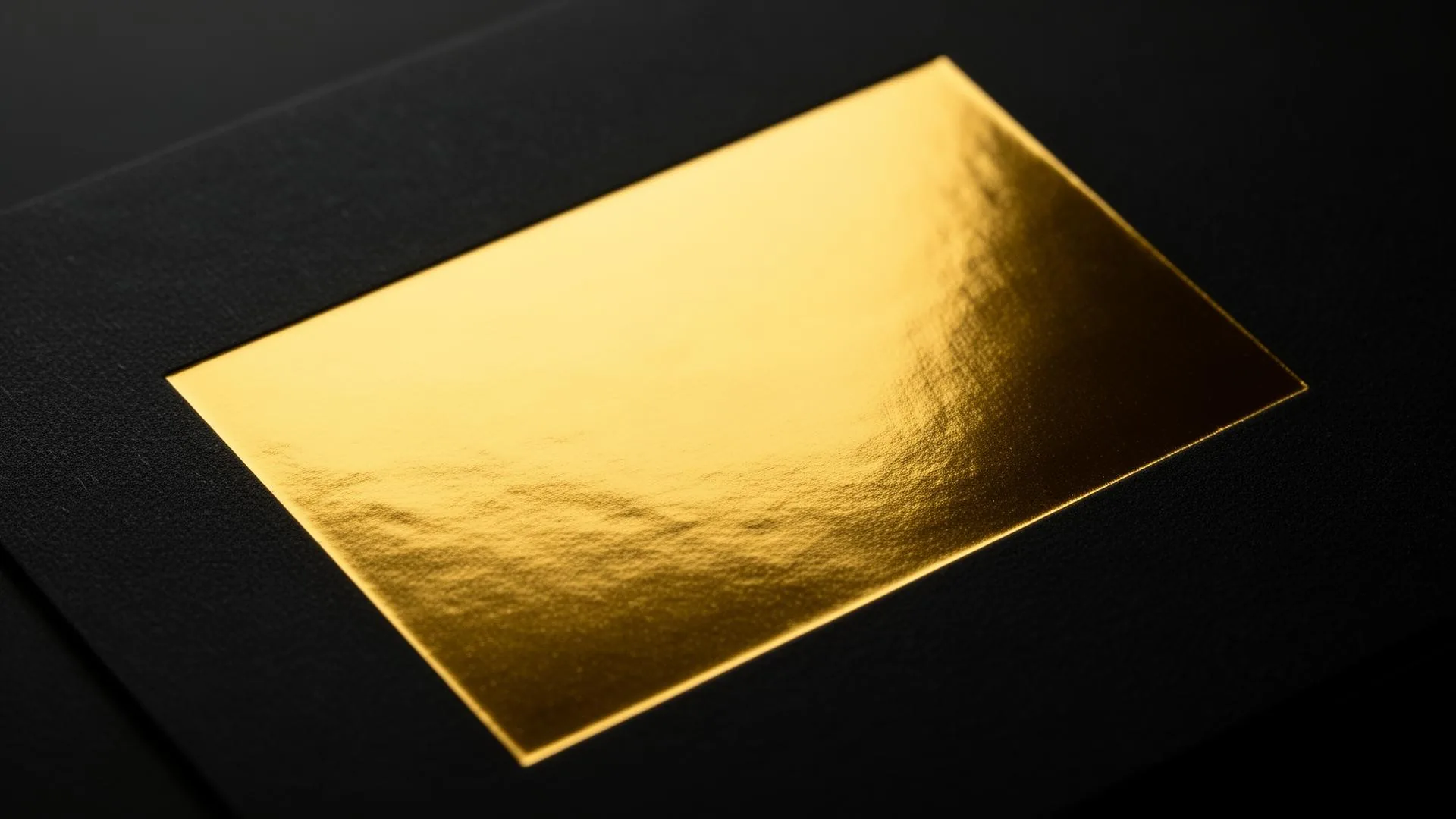
Mirror finish
Smooth, high-specular metallic surface. Use over coated black, navy or deep brand-color substrates for maximum optical impact.
Effects · Metallic
Bright gold, pale gold, champagne, rose gold, copper and silver cold transfer foils for cartons, labels and folding boxes. Up to 92% specular reflectance — indistinguishable from hot-stamped foil, at a fraction of the lead time.
The technology
Metallic cold foil is built around a vapor-deposited aluminium reflector (typically 30–50 nm) laminated to a 12 µm PET carrier. A pigmented lacquer above the aluminium defines the tone — yellow gold, pale gold, champagne, rose gold, copper. Transfer happens through a UV-cured adhesive printed inline on a flexo or offset plate.
Because no die and no heat are required, run-rates match the press — 450 m/min on a modern UV-flexo line, with no second pass and no tooling lead time. The same job that takes a hot-stamping line three shifts can run in a single offset pass.
Compared to metallic inks, cold foil delivers a true continuous metal reflection (~80–92% specular vs ~30–40% for the best metallic ink). Compared to transfer metallizing, it's selective — only printed where the design needs metal, so paperboard stays mono-material and recyclable.
The palette
High-chroma yellow gold (~24K visual). Goldmark for premium confectionery, wine and spirits, cosmetics top cartons.
Soft cooler gold for clean editorial brands — skincare, perfume, modern stationery. Reads as 'restrained luxury'.
Warm beige-gold tone that flatters cream, kraft and uncoated stocks. Popular for niche fragrance and natural beauty.
Pink-copper gold. Strongest performer in K-beauty, Valentine's gifting and limited-edition fashion drops.
Deep warm copper with red undertones. Excellent for whisky, craft spirits and heritage brand storytelling.
Neutral high-reflectance silver — the base for over-printed metallic CMYK builds. Tech, automotive, electronics.
Need to choose between bright, pale and champagne? Read the gold-tone comparison guide.
Finish variants
Smooth, high-specular metallic surface. Use over coated black, navy or deep brand-color substrates for maximum optical impact.
Add a 10–20% screened halftone under the foil to break the mirror into a brushed-metal reading. No second pass required.
Over-print 30–60% CMYK on a silver cold-foil base to build any brand-colored metallic — teal, magenta, deep forest.
Pair with an inline matte OPV to dial back specular reflection. Reads as 'soft luxury' instead of 'shouting metallic'.
Decoration comparison
| Parameter | Cold foil | Hot stamping | Metallic ink |
|---|---|---|---|
| Specular reflectance | 80–92% | 85–95% | 30–40% |
| Press speed | Up to 450 m/min | 30–80 m/min | Press-equivalent |
| Tooling lead time | None | 5–10 days (die) | None |
| CMYK over-print inline | Yes | No (second pass) | Yes |
| Large-area coverage cost | Low | Very high | Low |
| Mono-material recyclable | Yes (<5 g/m²) | Yes | Yes |
Full breakdown: hot vs cold foil stamping and cost difference guide.
Where it ships
Gold or rose-gold lockups, brand marks and borders on top-tier skincare and perfume cartons.
Bright gold and copper metallic for capsule labels, hangers and back-label medallions.
High-speed inline metallic on chocolate boxes, snack cartons, premium private label.
Edge-to-edge metallic flood, embossed-look brand marks, seasonal SKUs and gift sets.
Press setup
Anilox 8–11 cm³/m².
Slightly higher coat-weight than rainbow or holographic. Continuous metallic areas need a uniform adhesive flood to avoid mottling.
Substrate matters more than the foil.
Coated black, navy and deep brand-colored stocks give the most dramatic mirror reading. Uncoated and recycled stocks soften the metal — often desirable for craft and natural brands.
UV cure ≥ 200 mJ/cm².
Under-cured adhesive is the #1 cause of metallic dulling 24–72 hours after the print run. Verify with a tape-pull test before sign-off.
Nip pressure: light and even.
Too much nip flattens the metallic grain and can show paperboard texture through the foil. Calibrate against a 100% coverage swatch.
Plan for over-print last.
If you intend to over-print CMYK on the metallic, build the foil as a single base color (silver for tinted metallics, gold for shadow accents). See our CMYK-over-cold-foil guide.
Other effects
FAQ
Metallic cold foil is a cold transfer foil with a thin (<5 g/m²) aluminium reflector — optionally pigmented with gold, rose-gold, copper or other tones — applied inline on a UV-flexo or offset press using a UV-curable adhesive instead of heat and a die. The result is a true metallic finish at full press speed (up to 450 m/min) with no second pass.
Metallic ink uses ground metallic pigment suspended in a vehicle; reflectance is limited (~30–40%) and the surface is grainy. Cold foil deposits a continuous aluminium layer, giving 80–92% specular reflectance — visually identical to hot-stamped foil — at a fraction of the lead time and tooling cost.
Yes. CMYK printed inline on top of a silver cold-foil base is how 'metallic teal', 'metallic magenta' and similar brand-colored metallics are built. Typical screen values are 30–60%. See our anilox-selection and CMYK-over-cold-foil guides for press setup.
With aluminium deposit kept under 5 g/m², cold-foil-decorated mono-material paperboard remains within EU PPWR 2027 recyclability thresholds. We supply technical compliance letters per shipment.
For long runs, large coverage areas, fine detail and recyclable mono-material designs, cold foil wins on cost, speed and sustainability. Hot foil still has an edge for very small artwork on thick board where embossed register is required. Our hot vs cold foil guide breaks down the decision.
Metallic cold foil rolls ship from one master roll (~3,000 linear m). For qualification we send free sample rolls cut to your press width — no minimum on samples.
We ship free metallic cold foil sample kits — gold, rose gold, copper and silver — cut to your press width for qualification.
Request a free metallic sampleRecyclable mono-material designs supported.