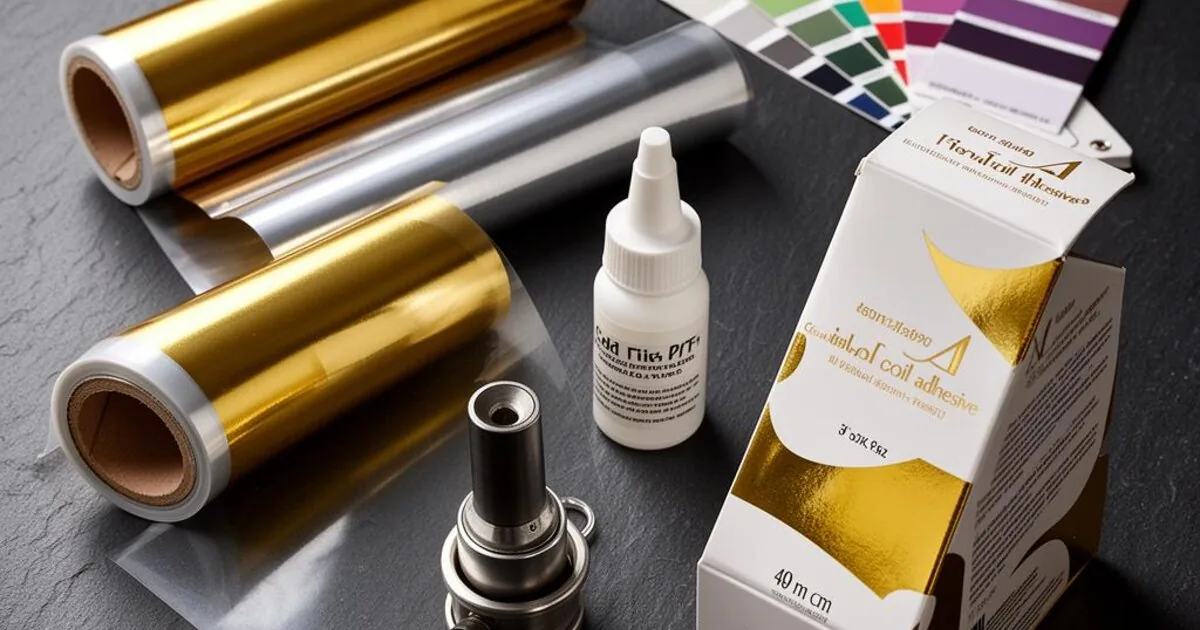
“TL;DR: "Cold foil stamping supplies" is not one SKU — it is a kit. You need the right metallic foil roll, a matched UV cold-foil adhesive, an anilox roller in the correct line-count, a clean UV lamp, and a few wear parts most buyers forget on the first PO. Get the kit wrong and the press will run; the foil just won't transfer. This guide is a working shopping list from the manufacturer side, written for printers and packaging buyers who are setting up — or restocking — a cold foil line.
People searching for cold foil stamping supplies usually fall into two camps. The first group has just bought a cold foil module and is trying to figure out what to keep on the shelf. The second group has been running cold foil for a while and is tired of the press stopping for a part that costs less than a coffee. Either way, the question is the same: what do I actually need to order, and in what quantity?
Below is the list we hand out at trade shows, cleaned up and turned into something you can paste into a purchase order. Nothing in it is theoretical — every item is something we have shipped, replaced, or argued about with a customer in the last twelve months.
The five things "cold foil supplies" really means
Strip away the marketing names and a cold foil line consumes five families of supplies on a regular basis:
- 1Metallic cold foil rolls — the decorative film itself.
- 2UV cold-foil adhesive — the printable glue that decides where foil sticks.
- 3Anilox and adhesive-delivery parts — anilox rollers, doctor blades, chambers.
- 4UV curing consumables — lamps, reflectors, filters, sometimes quartz tubes.
- 5Press wear parts and cleaning chemistry — sleeves, tapes, solvents, wipes.
Miss any one of those and the line stops. According to a recent industry summary, the global cold stamping foil market reached USD 432 million in 2024 and is forecast to grow at a 5.2% CAGR through 2032 — but that growth depends entirely on converters keeping these five buckets stocked correctly. The mechanics of the process itself are described well in Wikipedia's overview of cold foil printing; this article is about what to put on the shelf so that process actually runs on Monday morning.
1. Metallic cold foil rolls
The foil roll is what most buyers think of first, and it is also where most of the money goes. A cold foil roll is a multi-layer film: a PET carrier, a release layer, a tinted lacquer, a vacuum-metallized aluminum layer, and a tie coat. The vacuum-metallizing step is shared with food packaging and other decorative films — Wikipedia: Vacuum metallizing has a clean technical summary if you want the background.
For day-to-day stocking, three decisions matter:
- Shade — bright silver, bright gold, pale gold, champagne, rose gold, copper, holographic. Order by internal code or L\a\b\* target, not by adjective.
- Slit width — should match your foiled image area plus 5–10 mm safety per side. Buying wider than you need is the single most common hidden cost in cold foil.
- Roll length and core ID — long rolls reduce splice frequency on big runs; the core ID (usually 3" or 6") has to match your unwind shaft.
If you are setting up procurement for the first time, our companion guide to wholesale metallic cold stamping foil rolls walks through MOQs, lot consistency and the spec sheet to send suppliers.
2. UV cold-foil adhesive
The adhesive is the part new buyers under-spec. Cold foil only goes where adhesive is printed, so the adhesive is the image. Two things matter when you order it:
- Lamp compatibility — mercury-arc UV and UV-LED are not interchangeable. An LED-tuned adhesive run under a mercury lamp will over-cure and lose tack; the reverse will not cure at all. The basic chemistry is summarized in Wikipedia: UV curing.
- Substrate compatibility — coated SBS, uncoated stock, BOPP film and PE label film all want slightly different adhesive viscosities and tack profiles.
Keep at least two grades on the shelf if you run mixed jobs: one general-purpose offset cold-foil adhesive for coated cartons, and one tuned for the substrate you struggle with most. For uncoated work specifically, the trade-offs are covered in cold foil vs hot foil for uncoated paper.
A practical stocking rule: two weeks of adhesive at peak consumption, stored below 25 °C, away from direct light. Adhesive that has been hot or sun-exposed will gel in the can and waste an entire shift.
3. Anilox rollers, doctor blades and chambers
The anilox is the part most operators have strong opinions about. It meters how much adhesive lands on the plate, and it controls both transfer quality and foil consumption. Get it wrong by 20% in either direction and you will either pinhole or flood.
| Supply item | Typical spec range | Replacement cadence |
|---|---|---|
| Anilox roller (offset cold foil) | 200–400 LPI, 4–8 BCM | Re-engrave / replace every 18–36 months |
| Doctor blades (steel) | 0.15–0.20 mm, beveled | Every 1–3 shifts |
| Doctor blades (composite) | 0.30–0.50 mm | Every 1–2 weeks |
| End seals | Foam or rubber, press-specific | Each blade change |
| Chamber gaskets | Press-specific | Every 4–8 weeks |
For the detail on choosing line counts and cell volumes for different foil shades and substrates, see our deeper article on anilox roller selection for cold foil. The short version: do not let the press OEM pick this for you on autopilot — the right anilox depends on your adhesive and substrate, not just the press model.
“"Buyers who treat anilox rollers as a consumable instead of a capital part end up with the cleanest cold foil work — they rotate them, log volumes and retire them on a schedule." — internal applications note, CFS technical team
4. UV lamps, reflectors and curing consumables
The UV lamp is the most boring item on the list and the one that takes down the most jobs. Mercury lamps lose output gradually; LED arrays lose output suddenly. Either way, an under-cured adhesive will look fine on the press and fail at the foiling nip three meters downstream.
Stock to keep:
- Spare UV lamp or LED array for every active cold foil unit. One spare per press is the minimum; two is the realistic minimum if you run double shifts.
- Reflectors and quartz filters — clean every shift, replace when pitted or hazed.
- UV radiometer strips or a handheld meter — measure weekly, log the reading. A 30% drop from baseline is your replacement trigger.
If you are also evaluating press hardware (modules, foiling units, web-tension upgrades), the cold foil stamping machine guide covers what to look for and how the modules integrate with the rest of the line.
5. Press wear parts, tapes and cleaning chemistry
This is the category that quietly eats labor hours. None of these items are expensive individually; running out of any one of them stops the press.
- Plate-mounting tape — usually 0.38 mm or 0.50 mm cushion-back, in the width your press uses. Buy by the case, not the roll.
- Foil splice tape — high-tack, low-residue. Cheap tape causes splice breaks at speed.
- Roller wash and blanket wash — solvent type must match the press OEM's chemical-compatibility list. The wrong solvent can swell rubber rollers and ruin them.
- Lint-free wipes — 4-ply minimum. Paper towels shed fiber that ends up under the foil and shows as pinholes.
- Nitrile gloves and UV-safety glasses — boring, mandatory, almost always missing from the first PO.
A realistic starter kit is roughly one month of consumables at expected line speed, plus one spare of every wear part with a lead time longer than two weeks.
A starter shopping list for a new cold foil line
For a converter standing up a cold foil unit for the first time, this is the minimum order that gets you to a working first job:
- 2 × press-ready slit rolls of bright silver foil (most common base shade)
- 2 × press-ready slit rolls of your dominant gold shade
- 20–40 kg of UV cold-foil adhesive matched to your lamp and substrate
- 1 × anilox roller in the line count recommended for your substrate, plus 1 spare
- 1 case of doctor blades, 1 case of end seals, 2 chamber gaskets
- 1 spare UV lamp or LED array, plus reflectors
- 1 case of plate-mounting tape and 1 case of foil splice tape
- 1 drum of approved roller wash, 2 cases of lint-free wipes
- A UV radiometer and a logbook
After the first 30 days of production, look at what you actually consumed and adjust. The biggest mistake we see is buying too much exotic foil and not enough boring consumables.
Where designers and prepress fit into the supply list
Supplies do not run themselves. Two of the most common reasons a cold foil job fails on press are an artwork file built without a proper foil layer, and a prepress team that has not been briefed on minimum line widths or trap settings. If that is your situation, the cold foil prepress designer guide is the right next read — it pairs with the supplies list above and saves the press operator from having to fix things that should have been fixed in the file.
For the bigger picture on the process — where these supplies fit, how transfer actually works, and where cold foil sits relative to other decoration methods — the cold foil pillar guide is the umbrella page.
FAQ: cold foil stamping supplies
What are the basic cold foil stamping supplies I need? Metallic cold foil rolls, UV cold-foil adhesive matched to your lamp type, an anilox roller in the right line count, doctor blades and end seals, a UV lamp and reflectors, plate-mounting and splice tape, approved roller wash, and lint-free wipes. Everything else is optional.
Can I use hot stamping foil in a cold foil press? No. Hot stamping foil uses a heat-activated release and adhesive layer designed for a heated die. Cold foil rolls use a release tuned for transfer onto a printed UV adhesive at room temperature. Substituting one for the other will either fail to release or transfer everywhere.
How long do cold foil rolls stay good in storage? Most manufacturers quote 12 months in original packaging, stored at 15–25 °C and 40–60% RH, away from direct sunlight. Heat and humidity are the killers — a roll left near a south-facing window for a summer can lose release behavior even if it looks fine.
What is the shelf life of UV cold-foil adhesive? Typically 6–12 months unopened, much less once opened. Always check the certificate of analysis on each lot, store below 25 °C, and rotate stock FIFO. Adhesive that has thickened in the can should not be thinned with solvent — replace it.
How do I decide between mercury UV and UV-LED for a cold foil line? LED runs cooler, uses less power and has a longer lamp life, but the adhesive must be LED-formulated and the upfront cost is higher. Mercury is cheaper to install, has a wider adhesive selection, and is still the default on most older offset presses. New installations in 2026 trend toward LED; retrofits often keep mercury until the next major rebuild.
Where can I get sample rolls before committing to a large order? Most reputable manufacturers — including us — ship small evaluation rolls for press trials. If you want to run a trial on your own substrate before placing a wholesale order, request a sample and include your press model and substrate spec.
Before you order, check the cold foil stamping definition for the process basics.