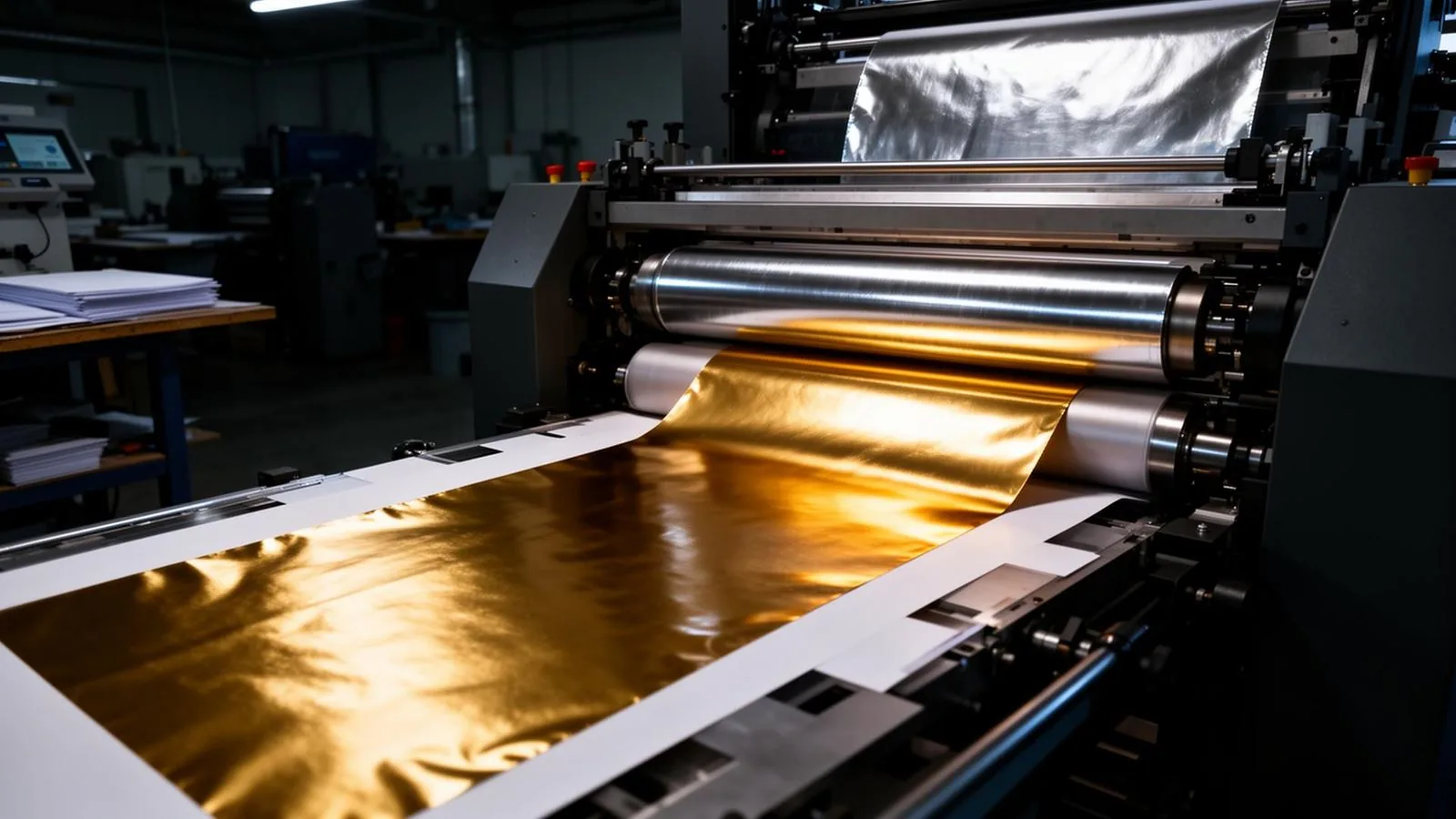
Cold foil stamping sits at the intersection of packaging design, press engineering, and supply-chain economics. Over the last decade we've spoken with brand owners in Shanghai, prepress teams in Mumbai, and press operators in Düsseldorf. The questions repeat — but the answers keep evolving as substrates, adhesives, and press controls improve.
This article collects the most common questions we hear, sorted by who is asking them. If you are evaluating cold foil for a new project, use this as a checklist. If you are troubleshooting an existing line, jump to the converter section.
TL;DR
- Mirror finish: Yes on coated stocks; satin-metallic on uncoated. Test your substrate before committing.
- Food safety: Aluminum is inert, but the adhesive must be FDA 21 CFR 175.105 compliant.
- Cost: Cold foil is typically 15–30 % cheaper than hot foil for medium-to-long runs because there is no die cost.
- Partial coverage + overprint: This is cold foil's strongest advantage — apply only where needed, then print CMYK on top.
- Anilox: 200–400 LPI, 3.0–8.0 BCM. Too high a line count starves the adhesive.
- Recyclability: Standard cold foil is generally not recyclable in standard paper streams; mono-material solutions are emerging.
What Brand Owners & Packaging Buyers Ask First
—Can cold foil match hot foil's mirror finish?
On coated paper and board, yes — the difference is invisible to most consumers. The aluminum layer in a cold foil laminate is roughly 25–35 nm thick, similar to hot foil. The perceived difference comes from surface smoothness: a gloss-coated SBS board gives a mirror-like reflection, while uncoated stock produces a softer, satin-metallic effect.
“A 2024 study by the Foil & Specialty Effects Association found that 89 % of consumers could not distinguish cold-foiled from hot-foiled cartons when both were applied to coated stock.
If your design demands a true mirror finish on uncoated paper, hot foil is still the safer choice. For everything else — coated folding cartons, labels, and flexible films — cold foil delivers comparable brilliance at a lower tooling cost.
Related: Hot vs Cold Foil Stamping: 2026 Buyer's Guide
—Is cold foil food-safe?
The aluminum layer itself is chemically inert and safe for food contact. The variable is the UV-curable adhesive. For direct food contact or primary food packaging, specify an adhesive that meets FDA 21 CFR 175.105 (indirect contact) or EU 10/2011 compliance. Most reputable cold foil suppliers can provide migration test reports.
For secondary packaging — luxury chocolate boxes, premium spirits cartons, gift sets — standard cold foil adhesives are widely accepted because there is no direct food contact.
—What substrates work with cold foil?
| Substrate | Compatibility | Notes |
|---|---|---|
| Coated paper / art paper | Excellent | Smooth surface maximizes metallic reflectance |
| SBS / folding carton | Excellent | Industry standard for cosmetics and pharma |
| Uncoated paper | Good | Satin finish; test adhesion on low-surface-energy grades |
| BOPP film | Good | Corona treatment required; flexible packaging |
| PET film | Good | High clarity; excellent for label applications |
| PE film | Moderate | Low surface energy; primer often needed |
| Metallized board | N/A | Use foil for accents, not full coverage |
Cold foil relies on a UV-curable adhesive that bonds to the substrate surface. Surface energy matters: coated papers (38–48 dyn/cm) accept adhesive readily; untreated PE films (<32 dyn/cm) need a primer or corona treatment.
Related: Cold Foil Stamping for Labels: Materials, Adhesives & Printing
—How does the cost compare to hot foil or metallic board?
| Cost factor | Cold foil | Hot foil | Metallic board |
|---|---|---|---|
| Tooling | None | Die required (USD 200–2,000) | None |
| Foil / material | Per m² usage | Per m² usage | Full sheet cost |
| Setup waste | 5–10 m | 20–50 m + die alignment | None |
| Speed | 100–250 m/min | 50–150 m/min | Normal print speed |
| Design flexibility | Any pattern | Die-limited | Full sheet only |
For short runs (<5,000 units), hot foil can be cheaper because the foil itself is less expensive per m². For medium runs (5,000–100,000 units), cold foil wins because there is no die cost and less setup waste. For very long runs, metallic board becomes competitive — but you lose the ability to apply metallic accents selectively.
“Industry data: Smithers Pira's 2025 report estimates cold foil adoption in folding cartons grew 12.3 % year-over-year, driven by SKU proliferation and shorter run lengths.
Related: Cost Difference Between Cold Foil and Hot Foil Stamping
—Can you foil only part of a design and then overprint?
Yes — and this is arguably cold foil's biggest strategic advantage. The process works like this:
- 1Print the UV adhesive only where foil is desired (using a standard flexo or offset plate).
- 2Laminate the cold foil web across the entire sheet.
- 3UV cure to bond the foil to the adhesive.
- 4Strip away the carrier film, leaving foil only on the adhesive areas.
- 5Overprint CMYK, Pantone, or varnish on top of the foil in subsequent stations.
This means a single carton can have metallic logos, matte backgrounds, and full-color photography — all inline, all in one pass. No registering a separate hot-foil die to a pre-printed sheet.
Related: CMYK Over Cold Foil: Building the Rainbow Metallic Effect
What Converters & Press Operators Ask on the Shop Floor
—What anilox line count and BCM should I use?
For cold foil adhesive, the anilox specification depends on the adhesive viscosity and the desired coat weight:
| Application | Line count (LPI) | BCM range | Typical coat weight |
|---|---|---|---|
| Fine detail / labels | 360–400 | 2.5–3.5 | 1.0–1.4 gsm |
| General packaging | 250–300 | 4.0–5.5 | 1.5–2.0 gsm |
| Rough / porous stock | 200–250 | 6.0–8.0 | 2.2–3.0 gsm |
| Holographic foil | 280–320 | 3.5–5.0 | 1.4–1.8 gsm |
Common mistake: Using too high a line count. A 550 LPI anilox with 1.8 BCM may look precise, but it cannot deliver enough adhesive volume for reliable foil transfer. If you see pinholing or poor edge definition, drop 50–80 LPI before adjusting viscosity.
Related: Anilox Roller Selection for Cold Foil
—Why is the foil flaking or showing poor adhesion?
The four usual suspects, in order of likelihood:
- 1Insufficient UV adhesive volume. Check anilox line count and BCM. Measure actual coat weight with a differential scale.
- 2Low UV lamp intensity. Mercury lamps degrade over time. A handheld radiometer should read >300 W/cm² at the substrate surface. LED-UV units need 395–405 nm peak output.
- 3High ambient humidity. Above 65 % RH, adhesive can absorb moisture before cure, weakening the polymerization. Dehumidify the press area or increase lamp power.
- 4Low substrate surface energy. Uncoated recycled board or aged film stock may fall below 36 dyn/cm. Corona treat or switch substrate.
Related: Cold Foil Pinholing & Ghosting: Diagnosis Flowchart
—Can cold foil run inline with other processes?
Yes. A typical inline sequence on a sheetfed offset press looks like this:
Clean → Corona/primer station → Cold foil adhesive print → Cold foil lamination → UV cure → CMYK overprint → UV varnish → Delivery
On a web press, the same stations appear in continuous configuration. The key constraint is web tension: cold foil carrier film is usually 12 µm PET, which can stretch or wrinkle if tension exceeds 15–20 N. Most modern presses handle this with closed-loop dancer arms.
Related: Cold Foil Stamping Machine: How It Works, Cost, Speed and Buyer Spec Guide
—What production speeds are realistic?
- Sheetfed offset: 10,000–15,000 sheets/hour (B1 format), limited by sheet transfer and UV cure dwell time.
- Web flexo/offset: 100–250 m/min, limited by UV lamp power and web tension stability.
- Narrow-web labels: 80–150 m/min; holographic foil often requires the lower end to preserve pattern registration.
Speed is rarely limited by the foil itself — it is limited by how fast you can cure the adhesive without creating heat-distortion or incomplete polymerization.
—Does cold foil need a special blanket or heated die?
No heated die. Cold foil uses pressure — not heat — to transfer. A standard offset blanket or flexo plate works for the adhesive print station. The foil application unit needs:
- An impression cylinder (usually rubber-covered, 70–80 Shore A)
- A foil unwind and rewind system with edge guidance
- A nip pressure adjustment (typically 50–120 N/cm)
If you are retrofitting an existing press, the main additions are the foil path (unwind → dancer → nip → rewind) and a UV curing module. No temperature controls needed.
Related: Retrofit Cold Foil Module Installation: Press Audit, Setup and Buyer Checklist
What Designers & Prepress Teams Need to Know
—What is the minimum line weight for cold foil?
0.25 mm (0.01 in) is the safe rule for positive lines and text. For knock-out lines (foil surrounded by print), increase to 0.35 mm to account for press gain and adhesive spread.
Halftone screens for vignette foil effects should stay above 100 lpi at 150 lpi print resolution. Finer halftones can moiré with the foil micro-structure.
Related: Cold Foil Prepress: A Designer's Guide
—Can foil be applied under ink (between substrate and print layer)?
No — not in standard cold foil. The sequence is always:
Substrate → UV adhesive → Foil → Overprint
The foil must bond to the adhesive, and the overprint must bond to the foil's topcoat. If you attempt to print wet ink and then foil on top, the adhesive cannot polymerize through the ink film, and the foil will not adhere.
If your design concept requires "foil under ink," you are thinking of transfer metallizing or direct metallized board, not cold foil stamping.
Related: Cold Foil vs Transfer Metallizing: Same Thing?
—How do I set up files for foil-only areas?
Create a dedicated spot color in your design file — name it "ColdFoil" or "CF". Export it as a separate plate (or vector layer) alongside your CMYK separations. The prepress workflow then:
- 1Outputs the ColdFoil plate to a flexo or offset plate.
- 2Keeps the ColdFoil art in register with CMYK using standard trapping rules.
- 3Specifies adhesive type (standard, high-tack, or low-BCM) in the job ticket.
Avoid rasterized foil masks at low resolution — vector paths give the cleanest edges.
Durability, End-Use & Sustainability
—Is cold foil rub-resistant enough for shipping cartons?
With the right combination, yes. A standard cold foil with UV overprint varnish survives 4 lb/cm² pressure, 50 cycles on a Sutherland rub tester — adequate for most retail and e-commerce transit.
For heavy-duty shipping (corrugated export cartons, pallet display boxes), specify:
- A cross-linking UV adhesive (higher molecular weight after cure)
- A full UV OPV or lamination over the foil
- Foil with a protective topcoat rated for abrasion (ask your supplier for ASTM D5264 data)
—Does cold foil survive freezer or high-humidity environments?
Yes, with grade selection. Standard cold foil is rated for 0–40 °C and <75 % RH. For freezer applications (ice cream cartons, frozen food), specify:
- Cold-grade foil with a modified release layer that remains stable at −20 °C
- Cross-linking UV adhesive to prevent embrittlement
- Sufficient coat weight (≥2.0 gsm) to compensate for condensation cycles
For tropical climates or condensation-prone supply chains, add a moisture-barrier varnish.
—Is cold foil recyclable?
This is the most nuanced question on the list.
Short answer: Standard cold foil is generally not recyclable in standard paper streams because the PET carrier film is stripped at the converter, but the aluminum and adhesive remain on the board. These fragments complicate repulping.
Emerging solutions:
- Mono-material foil uses a water-dispersible or fiber-compatible release layer. Trials at major mills in Europe show 85 % fiber recovery when cold foil cartons are pulped with mono-material foil.
- Wash-off adhesives separate from fiber during standard repulping, leaving aluminum flakes that are filtered out.
- Keep it on the substrate: For fiber-based packaging, the aluminum layer is <0.5 % of board weight. Some recyclers accept it as a minor contaminant.
“According to Two Sides North America, aluminum in paper packaging is not considered a critical contaminant if it remains below 1 % of total package weight.
Related: Is Cold Foil Recyclable? Related: Cold Foil for Mono-Material Recyclable Packaging
Frequently asked questions
Can cold foil match hot foil's mirror finish? +
On coated stocks, cold foil achieves a mirror finish virtually indistinguishable from hot foil. On uncoated stocks, the result is a softer satin-metallic effect. A 2024 FSEA study found 89 % of consumers could not tell the difference on coated cartons.
Is cold foil stamping food-safe? +
The aluminum layer is inert, but the UV adhesive must be FDA 21 CFR 175.105 or EU 10/2011 compliant for food-contact applications. Secondary packaging applications rarely require special adhesive grades.
What substrates can cold foil be applied to? +
Cold foil works on coated paper, SBS board, uncoated paper, BOPP, PET, and PE films. Surface energy must be ≥36 dyn/cm; low-energy films need corona treatment or primer.
How does cold foil cost compare to hot foil? +
Cold foil is typically 15–30 % cheaper for medium-to-long runs because there is no die cost and less setup waste. Hot foil wins on very short runs; metallic board wins on very long runs with full coverage.
Can cold foil be applied only to specific areas and then overprinted? +
Yes. This is one of cold foil's key advantages. The adhesive is printed only where foil is needed, the foil is laminated and stripped, and subsequent stations overprint CMYK or varnish directly on the foil.
What anilox line count and BCM should I use for cold foil adhesive? +
For general packaging, use 250–300 LPI with 4.0–5.5 BCM. For fine detail, use 360–400 LPI with 2.5–3.5 BCM. For rough stock, use 200–250 LPI with 6.0–8.0 BCM.
Why is my cold foil flaking or showing poor adhesion? +
The most common causes are insufficient adhesive volume (check anilox spec), low UV lamp intensity (replace degraded lamps), high humidity (>65 % RH), or low substrate surface energy (<36 dyn/cm).
Can cold foil run inline with CMYK printing? +
Yes. Typical inline sequence: clean → primer → cold foil adhesive → lamination → UV cure → CMYK → varnish. Modern sheetfed and web presses support this in a single pass.
What production speeds are realistic for cold foil stamping? +
Sheetfed offset runs at 10,000–15,000 sheets/hour; web flexo at 100–250 m/min; narrow-web labels at 80–150 m/min. Speed is limited by UV cure capacity, not the foil itself.
Does cold foil require a heated die? +
No. Cold foil uses pressure and UV adhesive, not heat. A standard offset blanket or flexo plate is sufficient. The foil unit needs an impression cylinder, unwind/rewind, and nip pressure control.
What is the minimum line weight for cold foil designs? +
0.25 mm for positive lines; 0.35 mm for knock-out lines. Halftone vignettes should stay above 100 lpi to avoid moiré with the foil micro-structure.
Can foil be applied underneath wet ink? +
No. The correct sequence is always substrate → adhesive → foil → overprint. Foil cannot adhere to wet ink because UV adhesive cannot cure through an ink film.
How should files be prepared for cold foil areas? +
Create a dedicated spot color (e.g., "ColdFoil") in the design file. Export it as a separate plate in register with CMYK. Use vector paths rather than low-resolution raster masks for cleanest edges.
Is cold foil rub-resistant enough for shipping? +
With UV overprint varnish, standard cold foil survives 4 lb/cm² at 50 Sutherland cycles. For heavy-duty shipping, specify cross-linking adhesive and a full UV OPV or lamination.
Can cold foil survive freezer environments? +
Yes with cold-grade foil and cross-linking UV adhesive rated for −20 °C. Standard foil is rated for 0–40 °C. Specify ≥2.0 gsm coat weight for freezer applications.
Is cold foil recyclable? +
Standard cold foil is generally not recyclable in standard paper streams. Mono-material foil solutions and wash-off adhesives are emerging. Aluminum content below 1 % of package weight is often accepted as a minor contaminant.
Next Steps
If you are evaluating cold foil for a specific project, the most valuable next step is a substrate-specific trial. Send your exact board or film to your foil supplier and request a lab transfer test. The results — measured in gloss units, adhesion tape tests, and rub counts — will tell you more than any specification sheet.
For press operators, download our Tech Notes for adhesive viscosity curves and UV lamp maintenance schedules. For designers, refer to the Cold Foil Prepress Guide for file-setup templates.
Last updated: June 2026
If you need the fundamentals first, read our cold foil process overview.